
Malta is one of those destinations that rewards travellers who get off the main roads. The island may be small enough to cross in under an hour, but it packs an impressive range of scenery into a compact space: fortified cities, cliff‑top viewpoints, traditional fishing villages and quiet rural roads.
Exploring by car makes it possible to experience these contrasts properly. Public transport connects the main towns, but many of the island’s most scenic locations are far easier to reach with your own vehicle.
Below are five of the best scenic drives in Malta, each manageable within half a day and each offering a different perspective on the island.
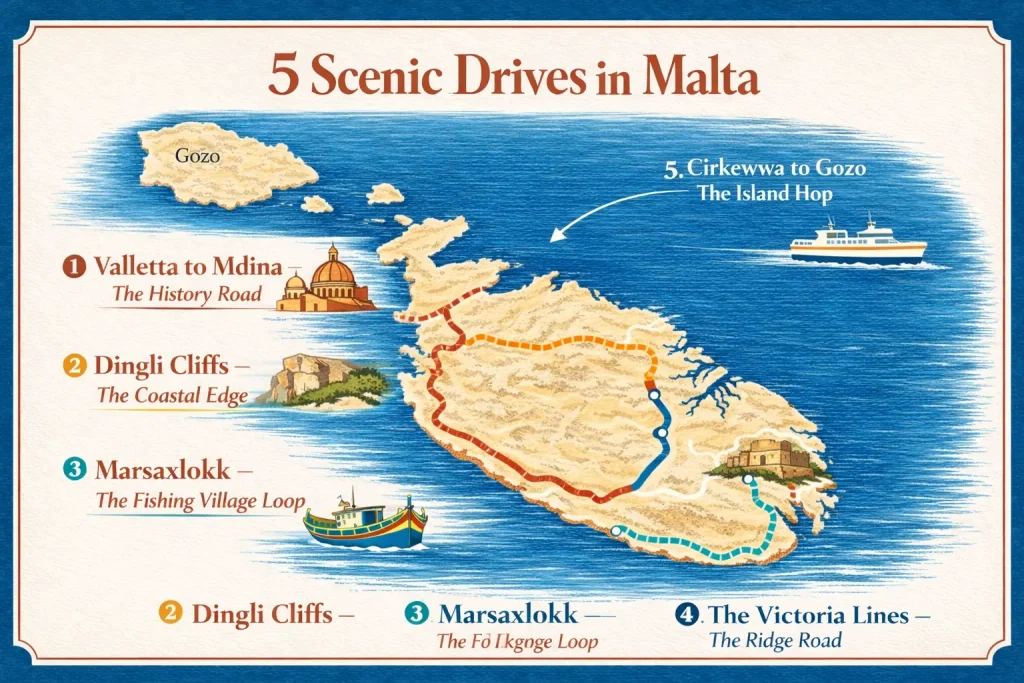
Scenic Driving Map of Malta
1. The Classic: Valletta to Mdina
Duration: Approximately 30 minutes each way
Highlights: UNESCO World Heritage Sites, panoramic countryside views
This is the route that puts Malta’s history in sharpest relief. You start in Valletta, the world’s smallest capital city and a UNESCO World Heritage Site in its own right, and head inland through a series of quiet villages to Mdina, the former capital that locals have called the Silent City for centuries.
The drive itself is straightforward but the contrasts are striking. Valletta’s grand baroque fortifications give way to rolling countryside within minutes, with views stretching toward the coast on clear days. Mdina sits on a hilltop and the approach from the south gives you the best view of the old city walls before you arrive.
Once inside Mdina, the narrow streets were designed for horses, not cars, so leave the vehicle outside the walls and explore on foot. The cathedral, the Palazzo Falson and the views from the bastion across to Valletta are all worth the short walk.
Pro Tip: Plan your arrival in Mdina for late afternoon. The light on the old stone walls is something else, and the day-trip crowds have largely cleared by then.
2. The Coastal Marvel: Zurrieq to Mellieha
Duration: About 1 hour each way
Highlights: Blue Grotto, Dingli Cliffs, Golden Bay
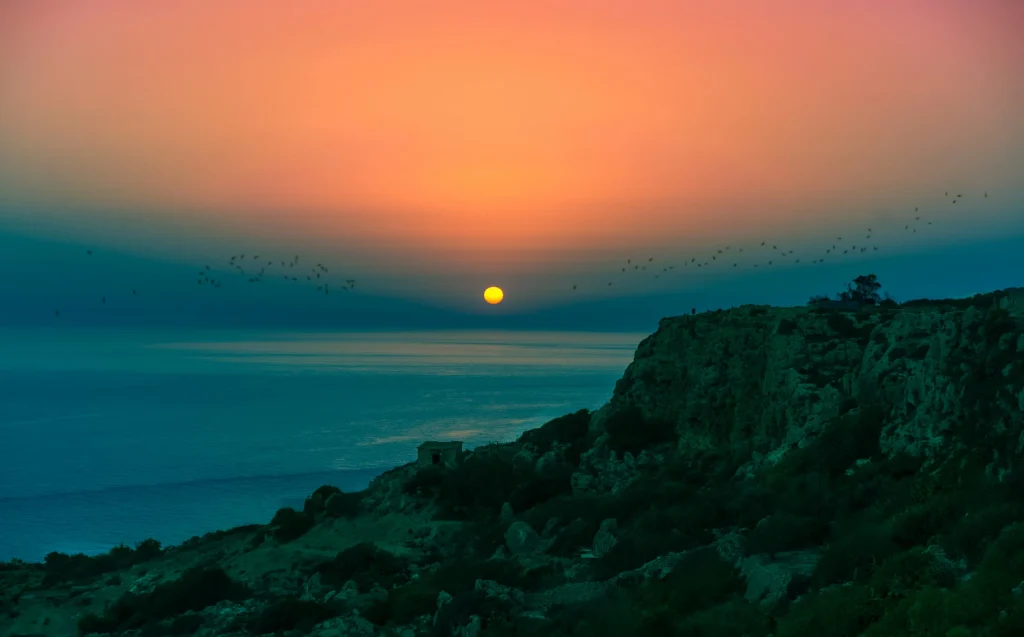
This coastal drive links several of Malta’s most dramatic landscapes. Beginning near the Blue Grotto, the road runs north past Dingli Cliffs before continuing inland towards Mellieha.
On clear days the views from the cliffs stretch far across the Mediterranean. If you only do one drive in Malta, make it this one. The southwest coastal route takes you along some of the most dramatic scenery on the island, from the sea caves at Zurrieq to the long sandy beach at Mellieha Bay in the north.
Start at Zurrieq and pick up a boat trip to the Blue Grotto if the sea conditions allow; the cave system and the colour of the water underneath are genuinely worth it. From there, head north along the cliff road to Dingli, where the cliffs reach around 250 metres above sea level and the views on a clear day extend as far as the island of Filfla offshore.
The road continues through Rabat and past the Hagar Qim temples, which date to around 3600 BC and rank among the oldest freestanding structures in the world. They deserve more than a passing glance; set aside at least 45 minutes here if you have any interest in history.
Finish at Mellieha Bay, Malta’s longest sandy beach, which is considerably quieter at either end of the tourist season.
Pro Tip: Do this route on a Tuesday or Friday morning and stop at the Marsaxlokk fish market on the way back. Fresh seafood, local atmosphere, and a sharp reminder that not everything in Malta is aimed at tourists.
3. Cirkewwa to Gozo: The Island Crossing
Duration: Approximately 2 hours each way, including ferry
Highlights: Ferry crossing, Victoria Citadel, Azure Window site, coastal scenery
From the northern tip of Malta, ferries run regularly to Gozo. The 25‑minute crossing leads to quieter countryside, traditional villages and excellent coastal viewpoints.
A drive around Gozo easily fills a full day. Technically this route crosses to a different island, but Gozo is easily done as a day trip from Malta and the contrast between the two is striking. Where Malta can feel busy and built-up in places, Gozo is quieter, greener and noticeably more relaxed.
Drive to the Cirkewwa ferry terminal at the northern tip of Malta and take the 25-minute crossing to Mgarr Harbour in Gozo. The ferry runs frequently and takes cars without advance booking, though in peak summer you may wait for the next sailing.
From Mgarr, head up to Victoria, known locally as Rabat, and walk up to the citadel for views across the whole island. From there, drive out to the west coast to see the site of the Azure Window, the famous limestone arch that collapsed into the sea in 2017. The rock formations around it are still impressive and the area is less visited now than it was when the arch was standing.
Gozo also has some of the best diving in the Mediterranean and several excellent restaurants if you want to make a full day of it.
Pro Tip: If your schedule allows, spend a night in Gozo. One day gives you a flavour of it. Two days gives you time to properly slow down and explore the inland villages, which is where the real character of the island lives.
4. Marsaxlokk to Wied iz-Zurrieq: Southern Seascapes
Duration: Approximately 45 minutes each way
Highlights: Traditional fishing village, colourful luzzu boats, Blue Grotto boat tours
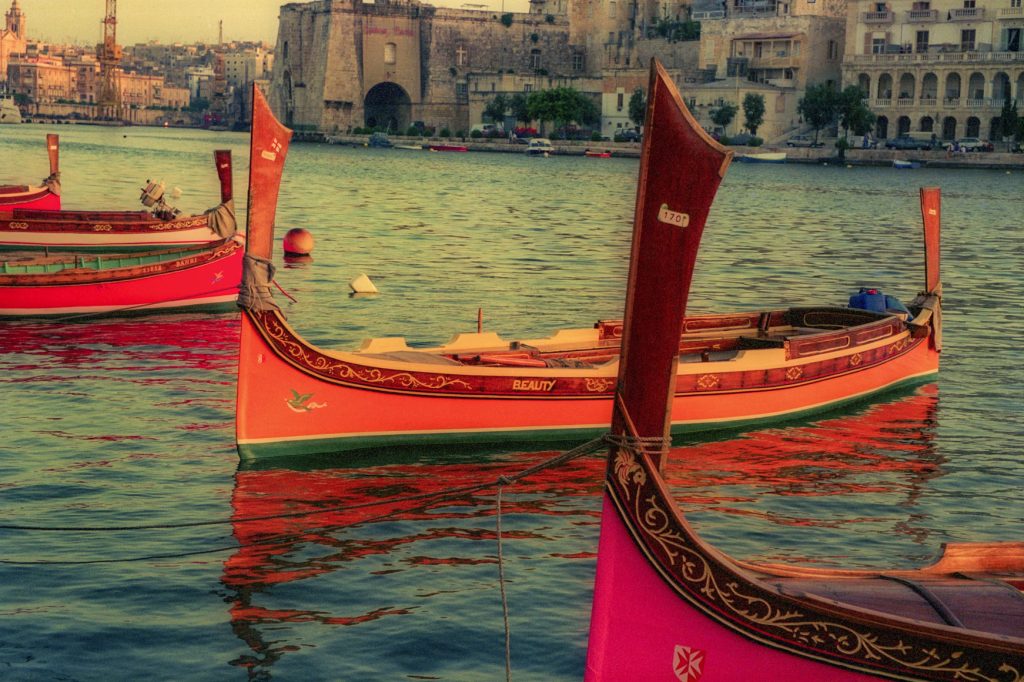
Marsaxlokk’s harbour filled with colourful luzzu fishing boats is one of Malta’s most recognisable scenes. The surrounding roads offer relaxed coastal driving and access to the Blue Grotto caves.
This southern route centres on Marsaxlokk, one of the most photogenic fishing villages in the Mediterranean. The harbour is lined with luzzu, the traditional painted wooden fishing boats that have been working these waters for centuries, and on Sunday mornings there is a fish market along the waterfront that draws locals from across the island.
From Marsaxlokk, head west through Zejtun and past the prehistoric Ghar Dalam Cave, where animal bones and early human remains dating back 7,400 years were discovered. It is not the most dramatic site on the island but it puts Malta’s history in proper perspective.
The route ends at Wied iz-Zurrieq, a small inlet on the south coast and the launch point for boat tours into the Blue Grotto cave system. The colour of the water here on a calm morning is extraordinary.
Pro Tip: Arrive in Marsaxlokk early on a Sunday if you possibly can. The market is at its best before 10am and the waterfront restaurants serve fresh fish at prices that bear no resemblance to what you’d pay in Valletta.
5. St Paul’s Bay to Cirkewwa: The Northern Run
Duration: Approximately 40 minutes each way
Highlights: Red Tower, Popeye Village, views toward Comino and Gozo
This route follows Malta’s northern coastline, passing Mellieha before climbing toward the Red Tower where panoramic views stretch towards Gozo and Comino.
Malta’s north is quieter and less developed than the centre of the island, and this route gives you the best of it. Start at St Paul’s Bay, named after the apostle who was shipwrecked here in 60 AD according to Acts of the Apostles, and head northwest along the coast toward the tip of the island.
The road passes through Bugibba and on to Mellieha before climbing toward the Red Tower, a 17th-century watchtower that offers 360-degree views of the northern coastline, Comino and Gozo on a clear day. It is one of the best viewpoints on the island and rarely crowded.
From there, drop down to Anchor Bay and the Popeye Village film set, which was built for the 1980 Robin Williams film and has been a visitor attraction ever since. It is unashamedly touristy but the bay itself is genuinely pretty and worth a short stop.
The route ends at Cirkewwa, which also happens to be where you pick up the Gozo ferry if you want to combine routes three and five into a longer day out.
Pro Tip: The Red Tower is managed by Heritage Malta and has limited opening hours, so check before you go rather than finding it locked when you arrive.
Malta Road Trip Planner
Malta Road Trip Planner
Build a Malta road trip itinerary based on the time you have available and the types of places you would most like to explore. Select your trip length, starting point and travel interests to generate a simple scenic driving route.
Planning a driving route around Malta can be tricky if you want to combine historic towns, coastal viewpoints and traditional villages in a logical order. Our Malta Trip Planner helps you build a practical driving itinerary based on your trip length, starting point and travel interests, generating a personalised route that highlights scenic drives, cultural stops and some of the island’s best viewpoints.
Practical Information
When to Go
Spring (April to June) and autumn (September to November) are the best months for driving in Malta. The weather is warm but not oppressive, the roads are quieter and accommodation costs considerably less. July and August are hot, busy and best avoided if you have any flexibility.
Driving in Malta
Driving in Malta is relatively straightforward, particularly for visitors from the UK since traffic keeps to the left. Roads connecting the main towns are generally in good condition although village streets can be narrow.
Speed limits are usually 50 km/h in towns and 80 km/h on open roads and are set by Transport Malta, and visitors can review the latest guidance on the official Transport Malta website before travelling.
Roundabouts are common and vehicles already on the roundabout normally have priority.
Parking is usually marked clearly:
White lines – public parking
Blue lines – resident zones
Yellow lines – no parking
When driving through villages, patience is essential as streets can be tight and passing places limited.
Hiring a Car
Most of these routes are straightforward enough in any hire car, though the country roads around Gozo and the cliff roads of the southwest are more enjoyable in something compact and easy to manoeuvre.
Compare rates and availability for car hire in Malta and booking in advance, particularly in the summer months, will save you both money and disappointment on arrival.
FAQs
Do I need a special licence to drive in Malta?
A valid driving licence from your home country is sufficient provided it is in English or uses the Roman alphabet. Otherwise, an International Driving Permit is required alongside your national licence.
Are the roads safe for driving?
Generally yes, though Maltese driving habits can take some getting used to. Rural roads in particular can be narrow. Take your time, especially on the coastal cliff roads where passing places are limited.
Can I take a hire car on the Gozo ferry?
Yes. Most hire car companies permit their vehicles on the Gozo ferry but check the terms of your hire agreement before boarding. Some companies have specific requirements or restrictions.
What side of the road do they drive on?
The left, the same as the UK.
What is the best time of year to visit Malta?
April to June and September to November offer the best combination of good weather, manageable crowds and reasonable prices. The summer peak is busy and very hot.
Ready to Explore?
Malta may be compact, but the island offers a surprising variety of driving routes. From historic hilltop cities to coastal cliffs and traditional fishing villages, exploring by road reveals a side of Malta that many visitors never see.
A hire car is the only realistic way to do justice to these routes, and to Malta generally. Public transport covers the main towns but leaves the best parts of the island out of reach.
Compare car hire rates in Malta and book early if you are travelling between June and September. The island is small but the roads fill up quickly in peak season.