
The Pink Granite Coast scenic drive is one of the strangest and most beautiful stretches of road in Brittany, and quite possibly in France. For about 16 miles along the North coast of the Côtes d’Armor, the granite turns a warm rose pink, weathered by 300 million years of wind and sea into boulders the size of houses, balanced in poses that look impossible. The colour is genuinely rare, found in only a handful of places on Earth, and against the turquoise sea it is unforgettable.
Most guides send you walking the coastal path, and the walk is wonderful, but a car is what lets you take in the whole coast in a day, from the Western beaches of Trébeurden to the wild Côte des Ajoncs in the East. That is the case this Pink Granite Coast scenic drive makes: see the highlights on foot, but link them by car.
This Pink Granite Coast scenic drive follows the Corniche Bretonne, the coastal road that links the highlights, with real drive times, parking notes, the best walk on the coast and where to eat. Car hire in the region starts from around £20 a day, and Brittany’s roads are toll-free, so this is an easy and rewarding coast to explore under your own steam.
The Pink Granite Coast Scenic Drive at a Glance
Route: Trébeurden, Trégastel, Ploumanac’h, Perros-Guirec, Plougrescant
Distance: About 25 miles (40 km) end to end along the coast
Driving time: Around 1 hour of pure driving, but allow a full day with stops and the coastal walk
Nearest airport: Rennes (RNS), about 2 hours away, or Brest (BES), about 1 hour 30
Best time: May to September for the light, though the pink is at its richest at sunrise and sunset year-round
Roads: Toll-free throughout, the coastal Corniche Bretonne links the main stops
Table of Contents
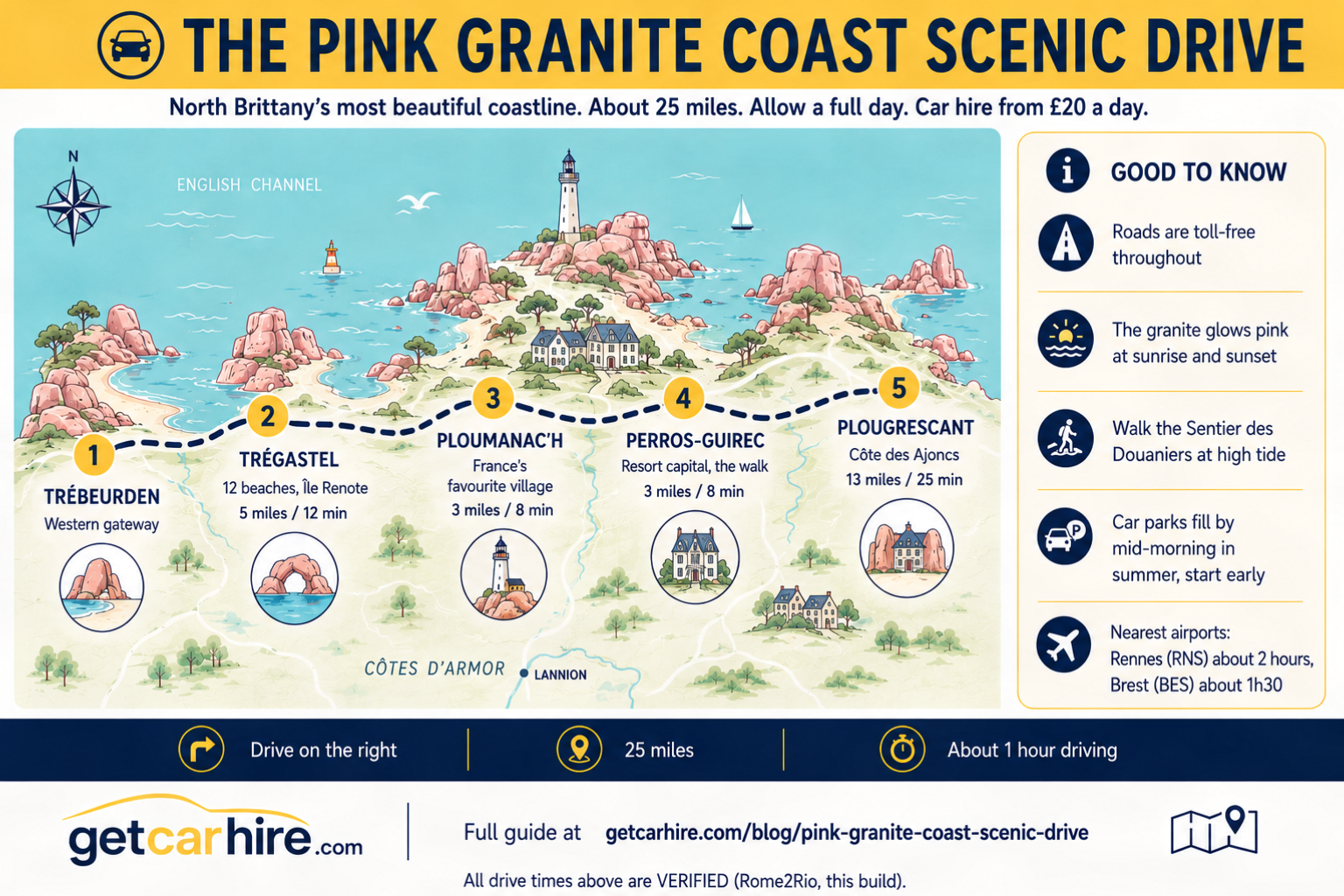
The Pink Granite Coast Scenic Drive, Stop by Stop
1. Trébeurden: The Western Gateway
Begin in the West at Trébeurden, a former sardine port that makes a relaxed, unshowy start to the coast. The first pink granite appears here in the shape of Le Castel, a chaos of rose-coloured boulders on a headland facing the little island of Île Milliau, which you can walk out to across the sand at low tide. It is the opening stop on the Pink Granite Coast scenic drive and a gentle introduction to what is coming, and the wide beaches either side of the headland are lovely for a first stretch of the legs.
It is worth knowing what you are looking at. The pink comes from a rare mix of quartz, feldspar and mica shot through with iron oxide, which oxidised at around 800 degrees when the granite formed deep underground some 300 million years ago. It is a colour found in only three places on Earth, here, Corsica and parts of China, which is part of what makes the Pink Granite Coast scenic drive so special. Once you know it is rare, you look at it differently.
Climb the Pointe de Bihit just South of the town for a sweeping view over the Bay of Lannion, and you will already understand why this coast has drawn artists and holidaymakers for over a century. Park at the main beach and walk out to Le Castel. The pink granite is only going to get more spectacular from here.
2. Trégastel: Twelve Beaches and Quiet Chaos
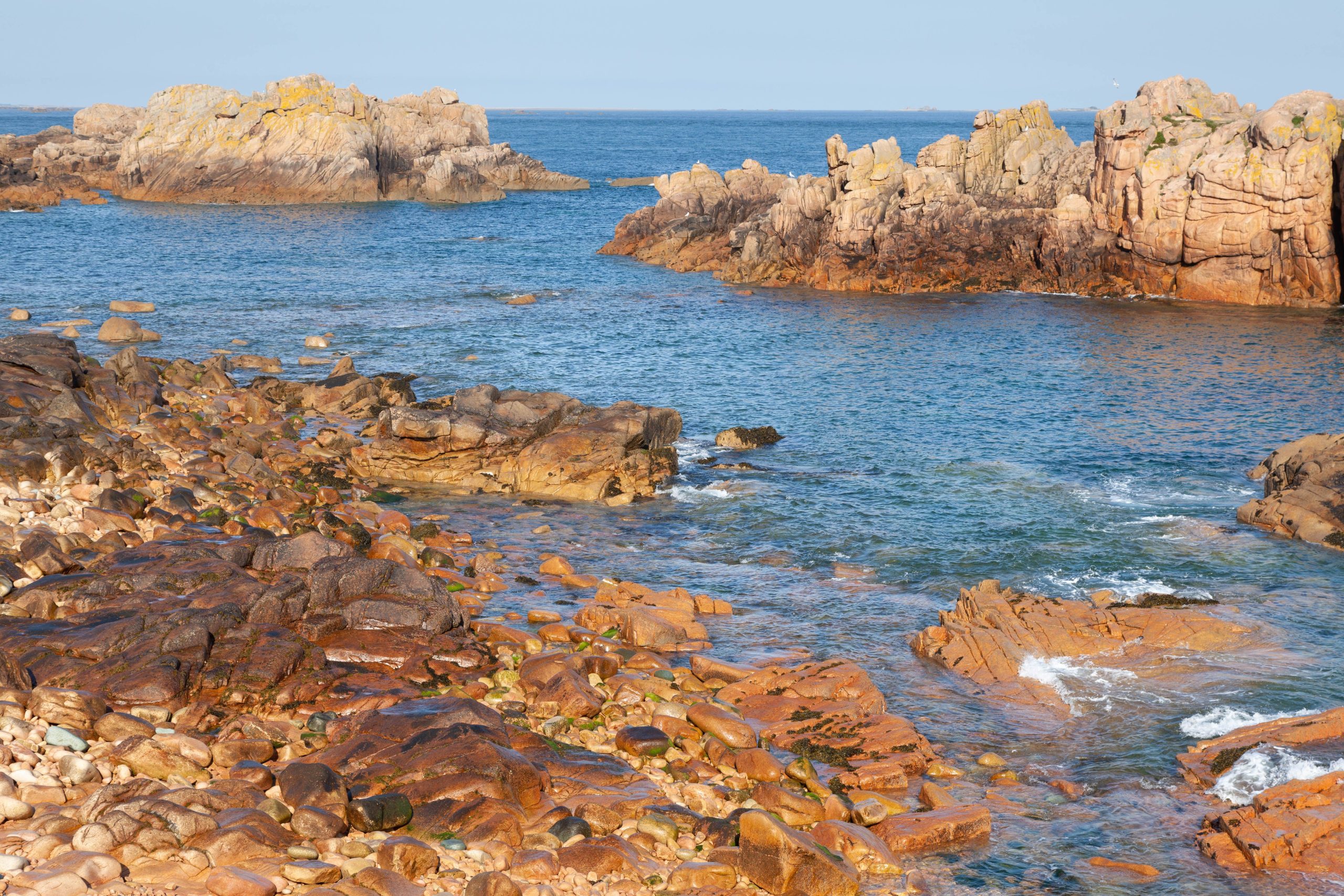
A short hop East along the Pink Granite Coast scenic drive, Trégastel is the calmer twin of the more famous Ploumanac’h, and many visitors prefer it for exactly that reason. It has twelve beaches, a scatter of Neolithic dolmens and menhirs, and the beautiful Île Renote peninsula, a granite-strewn headland you can drive close to and then explore on foot, ringed by pink boulders and rock pools with the Sept-Îles archipelago on the horizon.
The rocks here have earned nicknames over the years, the Tortoise, the Death’s Head, the pile of giant pebbles on the Île aux Lapins. There is a marine aquarium built right into the granite for anyone travelling with children, and the beaches are calmer and less crowded than those around the corner. Park near the Plage du Coz-Pors and walk out onto Île Renote.
3. Ploumanac’h: The Jewel of the Coast
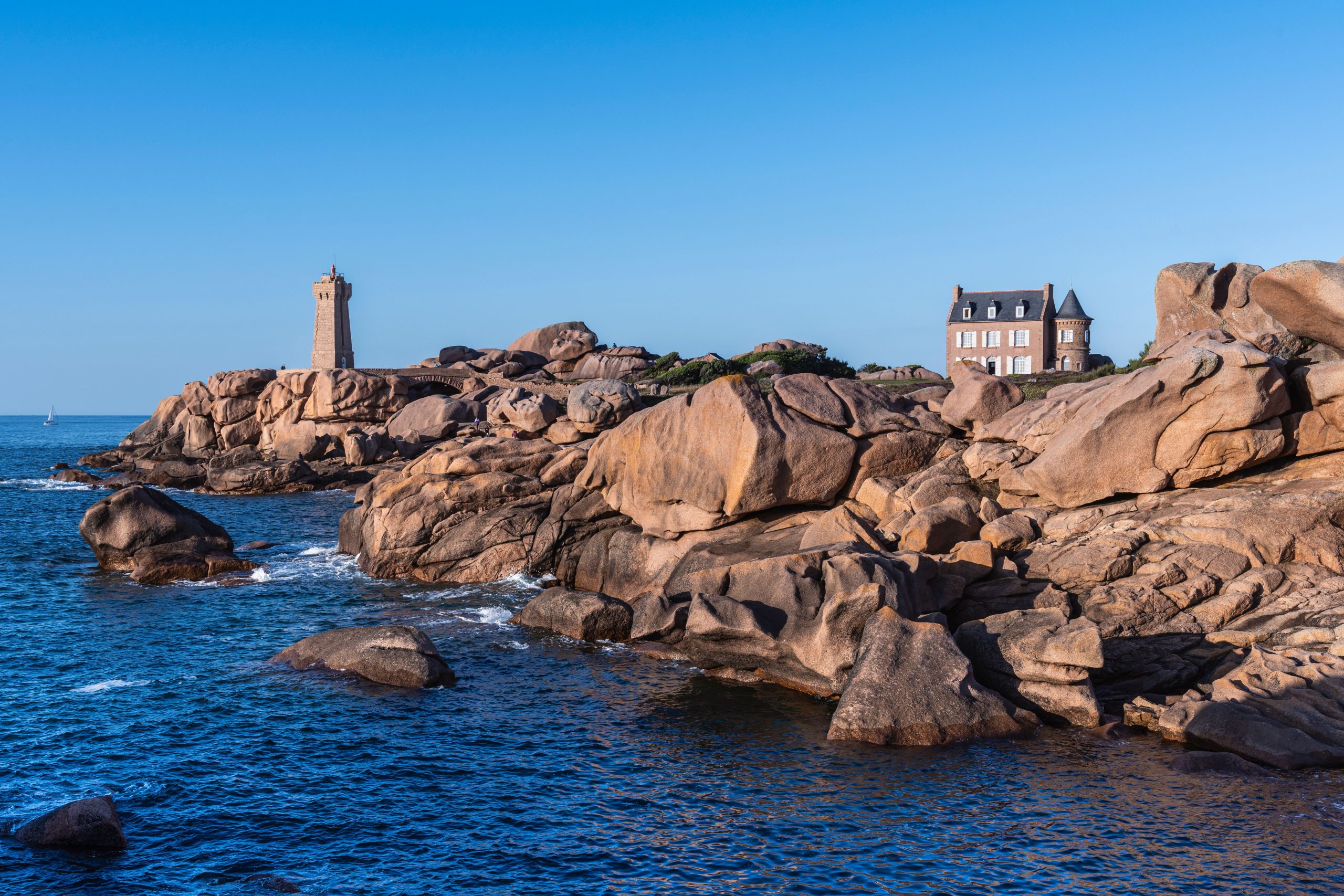
If the Pink Granite Coast scenic drive has a single must-see, it is Ploumanac’h. This former fishing village was voted France’s favourite village, and the moment you see the granite chaos around its little harbour you understand why. Enormous rose-pink boulders, some more than 20 metres high and 300 million years old, are piled along the shore in shapes so strange they have all been named, Napoleon’s Hat, the Rabbit, the Mushroom.
The village itself is built almost entirely of the pink stone, right down to the harbour walls and the houses, so the whole place seems to glow at either end of the day. There is a granite sculpture trail, a tidal mill dating from the 14th century, and the sheltered Saint-Guirec beach where an oratory sits out on the sand, reachable at low tide. Of all the stops on the Pink Granite Coast scenic drive, this is the one people remember.
The crowning sight is the Mean Ruz lighthouse, built of the same pink granite in 1860, destroyed in 1944 and faithfully rebuilt in 1947. It is the only straight-edged, man-made thing in a landscape of curves, and it is one of the most photographed spots in Brittany. Park at the port of Ploumanac’h and take the short walk out to the lighthouse and the postcard beach of Saint-Guirec, with its little oratory and offshore castle at Costaérès. Arrive early: this is a popular place and the car park fills fast.
4. Perros-Guirec: The Resort Capital and the Best Walk
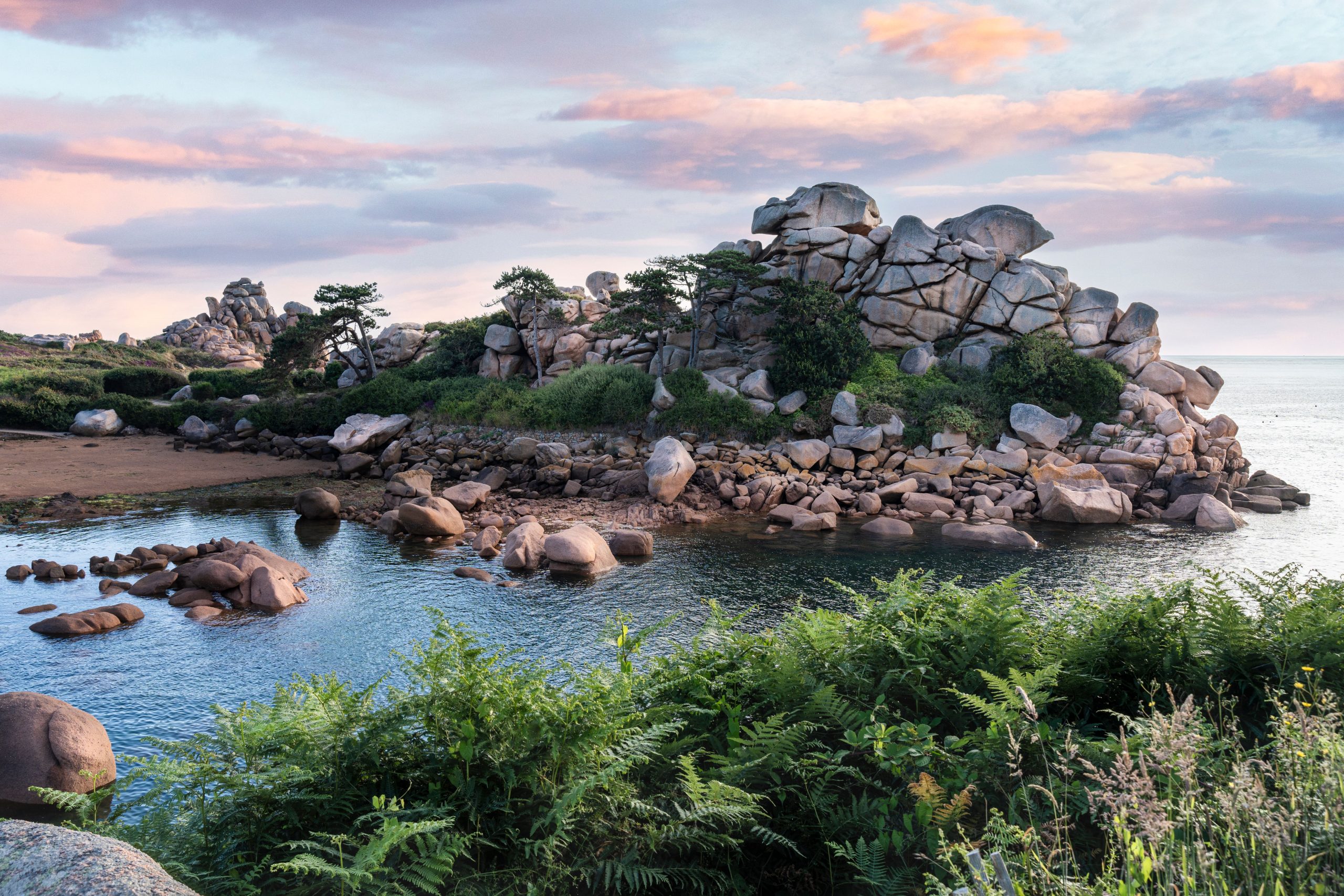
The fourth stop on the Pink Granite Coast scenic drive, Perros-Guirec is the lively heart of the coast, an elegant seaside resort of pink granite villas, a granite sculpture park and three fine sandy beaches. It is the natural base for exploring, with the widest choice of restaurants and hotels, and it is where the coast’s most famous experience begins.
The Sentier des Douaniers, the old Customs Officers’ Path, runs from Perros-Guirec’s Plage de Trestraou around to Ploumanac’h, and it is the best walk on the entire Pink Granite Coast. It is about 8 km round trip and takes roughly two and a half hours, threading between the giant boulders with the sea on one side the whole way. Walk it in the morning at high tide for the best of the colour and the light. From Perros-Guirec you can also take a boat out to the Sept-Îles, a protected bird sanctuary alive with puffins and gannets.
5. Plougrescant and the Côte des Ajoncs
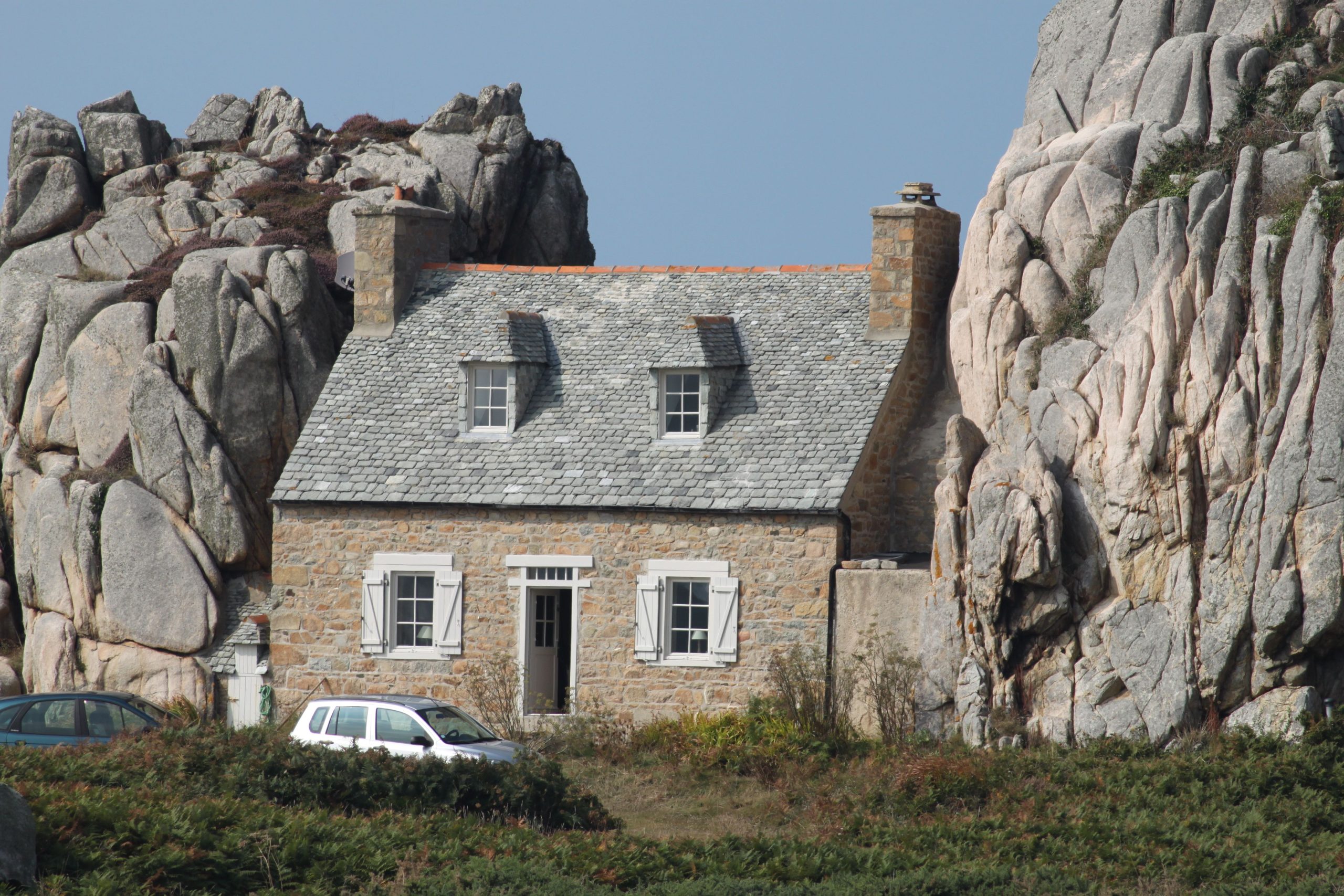
For a wilder finale, drive East to Plougrescant and the Côte des Ajoncs, a rugged continuation of the coast that far fewer visitors reach. This is where you find the Maison entre les deux roches, the famous little house with white shutters wedged tightly between two huge granite boulders, one of the most photographed houses in France and an unmissable stop on this Pink Granite Coast scenic drive.
Nearby, the Gouffre de Plougrescant is a spectacular cleft where the sea surges into a narrow chasm in the rock, and the Pointe du Château gives long views along a coast of coves, islets and wind-bent gorse. It is quieter, rawer and more elemental than the resorts to the West, and it makes a fitting end to the drive before you turn back inland.
Where to Eat on the Pink Granite Coast Scenic Drive
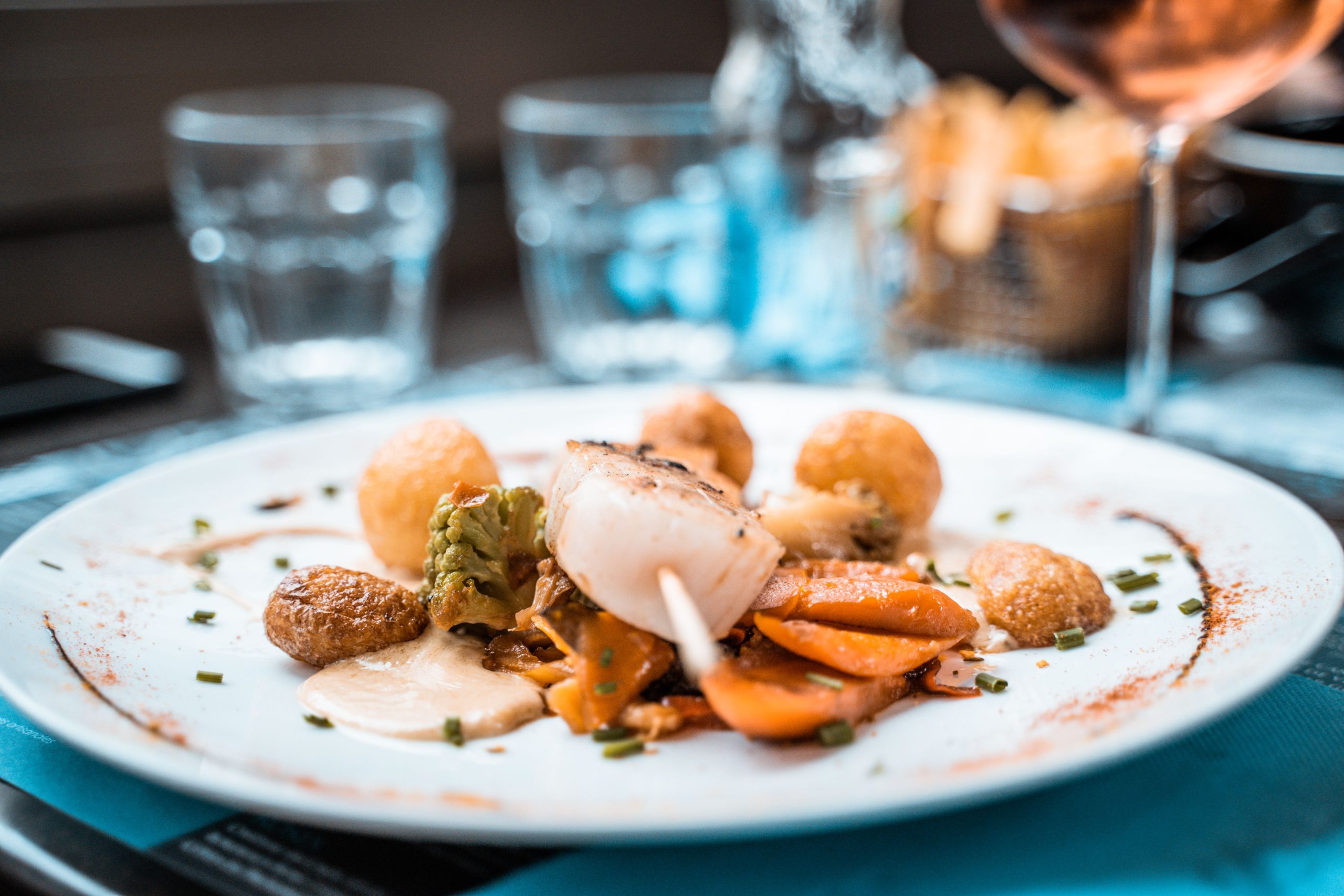
The Pink Granite Coast scenic drive is a coast of seafood, and it is superb. Oysters and mussels are local specialities, and you will find them fresh everywhere from harbour shacks to smart terraces. In Ploumanac’h, the Restaurant des Rochers overlooks the pretty port and is worth booking, while the beachside spots around Saint-Guirec do everything from full seafood platters to takeaway galettes. Ossa Bar à Galettes near the beach is a local favourite for the traditional Breton buckwheat pancake.
In Perros-Guirec, the waterfront at Trestraou beach has a run of bistros and brasseries, Le Sextant among them, where a late lunch of fresh fish with a view over the bay is one of the quiet pleasures of this coast. Wash it down with a bowl of Breton cider, and finish with a slice of far breton or a buttery kouign-amann. As elsewhere in Brittany, many kitchens close in the mid-afternoon, so time your lunch rather than leaving it to chance.
When to Go and How Long to Allow
Allow a full day for the Pink Granite Coast scenic drive. The driving itself is barely an hour end to end, but the whole point of this coast is to stop, walk and look, and the Sentier des Douaniers alone deserves half a day.
The pink along the Pink Granite Coast scenic drive is at its most intense in low, warm light, so sunrise and sunset are magical here in any season. May to September gives the best weather and the warmest sea, though July and August bring the crowds and the fullest car parks, so an early start pays off.
Spring and autumn are quieter and the light is often even better. Even in winter, on a bright day with the sea up, this coast is spectacular and almost empty. However you time it, the Pink Granite Coast scenic drive is one of those rare places that lives up to its photographs, and then some.
Making a Weekend of the Pink Granite Coast Scenic Drive
The Pink Granite Coast scenic drive fills a day beautifully, but the wider region rewards a second. The most natural extension is by boat: from Perros-Guirec, a 90-minute cruise runs out to the Sept-Îles, one of the most important seabird reserves in France, where puffins, gannets and grey seals gather on a scatter of uninhabited islands. In spring and early summer the birdlife is extraordinary.
A little further East lies the car-free island of Bréhat, a ten-minute ferry from the mainland near Paimpol, its sheltered climate famous for flowers and its Northern tip a chaos of pink rock known locally as the Grand Canyon. Inland, the medieval cathedral town of Tréguier is well worth an afternoon, and to the West the beaches around Trébeurden and the Île Grande give quieter walking away from the crowds.
For a base, Perros-Guirec has the widest choice of hotels and restaurants and puts you minutes from the coastal path. Ploumanac’h is more romantic but smaller and busier, while Trégastel is the calmer, more family-minded option. Wherever you stay, the car means you can be at the best viewpoints for sunrise before the day-trippers arrive.
Getting to the Pink Granite Coast: Your Gateway
The Pink Granite Coast sits on the North coast of Brittany, and the most flexible way to reach it is to fly in and hire a car. Rennes Airport (RNS) is about two hours away by the N12 and then the D786, and it has the strongest rental supply and flight connections in the region. Compare deals and pick up your car on our cheap car hire Rennes Airport page, where prices start from around £20 a day in the quiet season.
Brest Airport (BES) is a little closer, around an hour and a half to the West, and is worth checking if the flight times suit. Either way a car is essential here: public transport along the coast is limited and slow, and the freedom to chase the light between Trégastel and Plougrescant is exactly what makes this drive special. For more on your options across the region, our guide to car hire in Brittany compares all four gateways side by side. For the complete picture, our easy touring Brittany guide brings together all six of the region’s finest scenic drives and the three airport gateways that unlock them.
Driving Tips for the Pink Granite Coast
France drives on the right, and the roads along this route are toll-free, well surfaced and easy going, following the coastal Corniche Bretonne between the main stops. The lanes get narrow around the headlands and the village centres of Ploumanac’h and Trégastel, so a small car makes parking far easier.
Speed limits are 50 km/h in towns, 80 km/h on two-way rural roads and 110 km/h on dual carriageways, lower in the wet. Watch for priorité à droite at smaller junctions. Parking at Ploumanac’h and Perros-Guirec is paid and fills early on summer days, so arrive before mid-morning to get a space near the coastal path. For the official rules of the road, the UK Foreign, Commonwealth and Development Office keeps an up to date summary on its France travel advice pages.
One tip worth knowing: the coastal path and the rock formations look their absolute best at high tide, when the sea comes right up among the boulders. Check the tide times and aim to walk the Sentier des Douaniers as the water rises, and you will see this coast exactly as the postcards promise.
What Most Guides Do Not Tell You
Three things will improve your Pink Granite Coast scenic drive more than any list of sights. The first is timing your visit around the light. Unlike most coasts, the colour here genuinely changes with the sun, and the same boulders that look grey-brown at noon glow deep rose at sunset. Plan to be at Ploumanac’h or on the coastal path in the golden hour and the difference is extraordinary.
The second is going East. Almost everyone stops at Ploumanac’h and Perros-Guirec and turns back, which means the Côte des Ajoncs around Plougrescant, with its famous house between the rocks, is far quieter even in peak season. The extra 25 minutes of driving buys you the wildest scenery on the coast with a fraction of the crowds.
The third is to combine the drive with the walk rather than choosing between them. The Sentier des Douaniers can only be done on foot, and it reaches boulder formations no road goes near, but the car is what gets you between Trébeurden, Trégastel and Plougrescant in a single day. Do both, and you see the whole coast properly.
Frequently Asked Questions
How long is the Pink Granite Coast scenic drive?
The Pink Granite Coast scenic drive from Trébeurden through Trégastel, Ploumanac’h and Perros-Guirec to Plougrescant is about 25 miles, with only around an hour of driving. Allow a full day to enjoy the stops and walk the coastal path.
Do I need a car for the Pink Granite Coast?
A car is by far the best way to do the Pink Granite Coast scenic drive. Local buses connect some towns but are slow and infrequent, and the wilder spots like Plougrescant are hard to reach without one. Driving lets you follow the light and see the whole coast in a day.
Which airport is best for the Pink Granite Coast?
Rennes (RNS) has the best flight and rental choice and is about two hours away. Brest (BES) is a little closer at around 90 minutes. Both work well as a starting point for the drive.
What is the best walk on the Pink Granite Coast?
The Sentier des Douaniers between Perros-Guirec and Ploumanac’h is the classic, about 8 km round trip and roughly two and a half hours, winding right through the giant pink boulders. Walk it in the morning at high tide for the best light.
When is the best time to see the pink granite?
The granite glows most intensely in low, warm light, so sunrise and sunset are best in any season. May to September has the best weather, while spring and autumn are quieter with often beautiful light.
Download the Pink Granite Coast Scenic Drive Guide
Take the route with you. Our free downloadable guide has everything you need for the day, and the GPX file loads straight into your sat nav or phone.
Download includes:
- The full stop-by-stop route with verified drive times
- Parking notes for every stop
- The best walk on the coast, timed to the tide
- Where to eat, from harbour galettes to seafood terraces
- A printable route map
Drive the Pink Granite Coast for Yourself
There is nowhere else in France quite like the Pink Granite Coast scenic drive. Rose-pink boulders the size of houses, a lighthouse the colour of the rock it stands on, France’s favourite village and a little house wedged between two stones, all strung along a few toll-free miles of coast road. Pick up your car, follow the Corniche Bretonne, and let the Pink Granite Coast scenic drive show you one of Brittany’s true wonders. Compare deals on our cheap car hire Rennes Airport page and start planning.
About the Author
Written by the Digitalhound.co.uk editorial team. Every guide is thoroughly researched with genuine local knowledge, road numbers, food stops and practical driving tips gathered from on-the-ground experience.