
Malta may be one of Europe’s smallest countries, but it is one of the most satisfying places in the Mediterranean to explore by car. The island is compact enough to cover without long slogs behind the wheel yet varied enough to make each day feel distinct.
One morning you can be wandering through a walled medieval city, that afternoon standing above limestone cliffs, and by evening eating beside a harbour lined with fishing boats. That change of pace is exactly what makes a Malta road trip so appealing.
Driving gives you a kind of freedom that is difficult to recreate through buses, day tours or taxis. You can leave a place early if it feels crowded, linger when the light turns good, and take a detour because a side road looks promising.
Malta rewards that sort of curiosity. Some of the island’s best moments are not always the headline attractions, but the drive between them, the village you stop in for coffee, or the quiet viewpoint that would be easy to miss if you were rushing from stop to stop.
This route builds on several of the ideas in our guide to the 5 best scenic drives in Malta, but instead of treating those drives separately, it brings them together into a single, practical itinerary.
The aim here is not to cram in every sight on the island. It is to create a route that feels realistic, enjoyable and flexible. If you only have three days, you can still cover the main highlights without feeling as though you are simply ticking boxes.
If you have five days, the itinerary opens up nicely and gives you time to include Gozo and the northern coast.
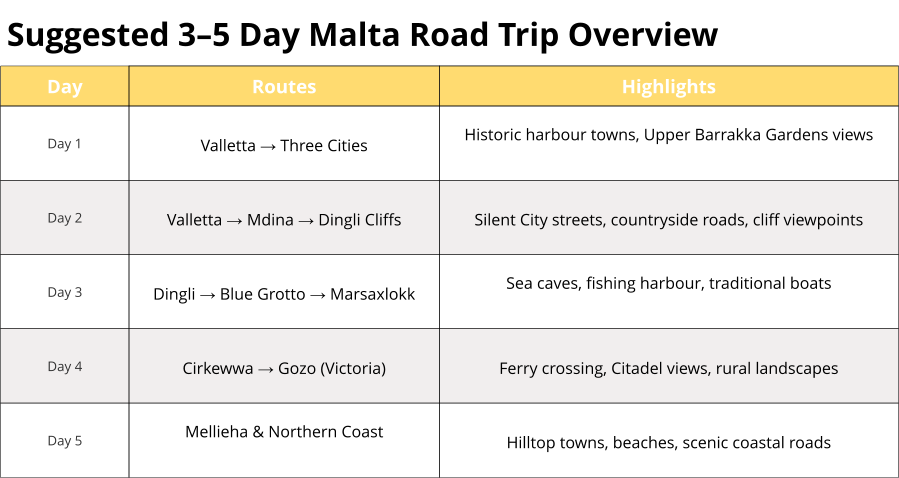
A visual overview of the journey is shown on the map below, followed by a table that summarises each day at a glance.
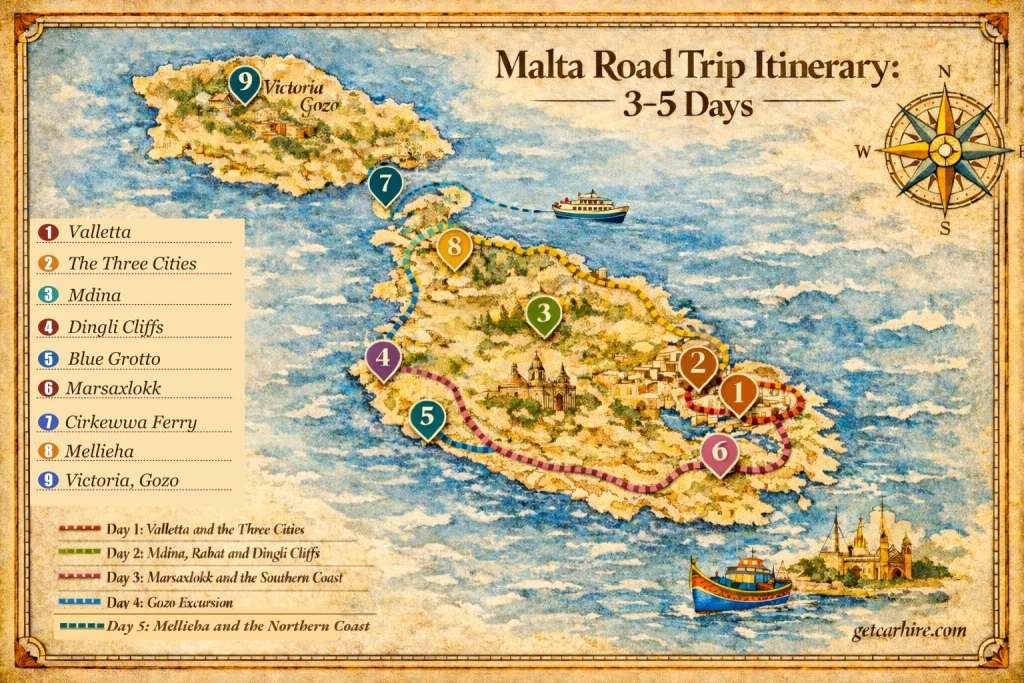
If you are short on time, the table gives you the short version. If you are planning carefully, the sections below explain why each day works, what to prioritise and where it makes sense to slow down.
Day 1: Valletta and the Three Cities
Valletta is the right place to begin because it gives immediate context to the island. Malta’s history can feel dense when you first arrive, but Valletta makes it visual.
The city’s street plan, stone buildings and harbour views tell you straight away that this is a place shaped by defence, trade and empire. It is also small enough to be manageable.
That matters on the first day of a road trip, when you are still settling in and probably do not want to launch straight into a full-island drive.
The best approach is to park just outside the city walls and explore Valletta on foot. Central parking can be awkward, and the city is far more enjoyable without worrying about moving the car every few minutes.
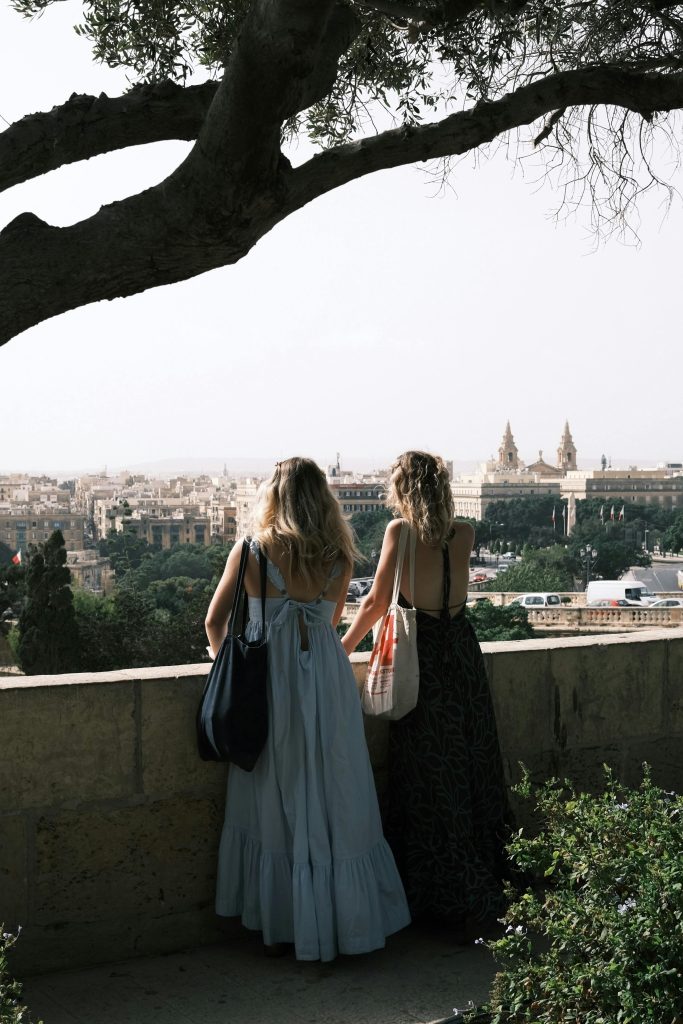
Walk through the main gate, take your time along Republic Street, and make a point of visiting the Upper Barrakka Gardens. The harbour view from here is one of the best on the island and gives you a clear sense of what comes next.
St John’s Co-Cathedral is the obvious big stop if you want interiors and history. If not, simply walking the streets is rewarding enough.
From Valletta, the natural second half of the day is the Three Cities: Vittoriosa, Senglea and Cospicua. Although they sit just across the Grand Harbour, the atmosphere changes noticeably. Valletta can feel polished and theatrical.
The Three Cities feel more lived in. Vittoriosa in particular is worth unhurried time. The marina, narrow lanes and fortified edges give it depth that many visitors overlook because they only glance across at it from Valletta.
Driving between the capital and the Three Cities is short, but this is not a day defined by mileage. It is about beginning with places that explain Malta’s character.
You can move gently, get used to the roads and still finish the day feeling as if you have covered somewhere significant. If you arrive in the morning and start early, there is also room to slow down over lunch without losing momentum.
Day 2: Mdina, Rabat and Dingli Cliffs
The second day shifts the mood inland. Where Valletta and the Three Cities are all about harbours, fortifications and maritime history, Mdina feels withdrawn and self-contained.
The drive out from the eastern side of the island is straightforward, and because Malta is so compact you are into a different landscape surprisingly quickly. Roads begin to open, the density eases and the island starts to feel more rural.
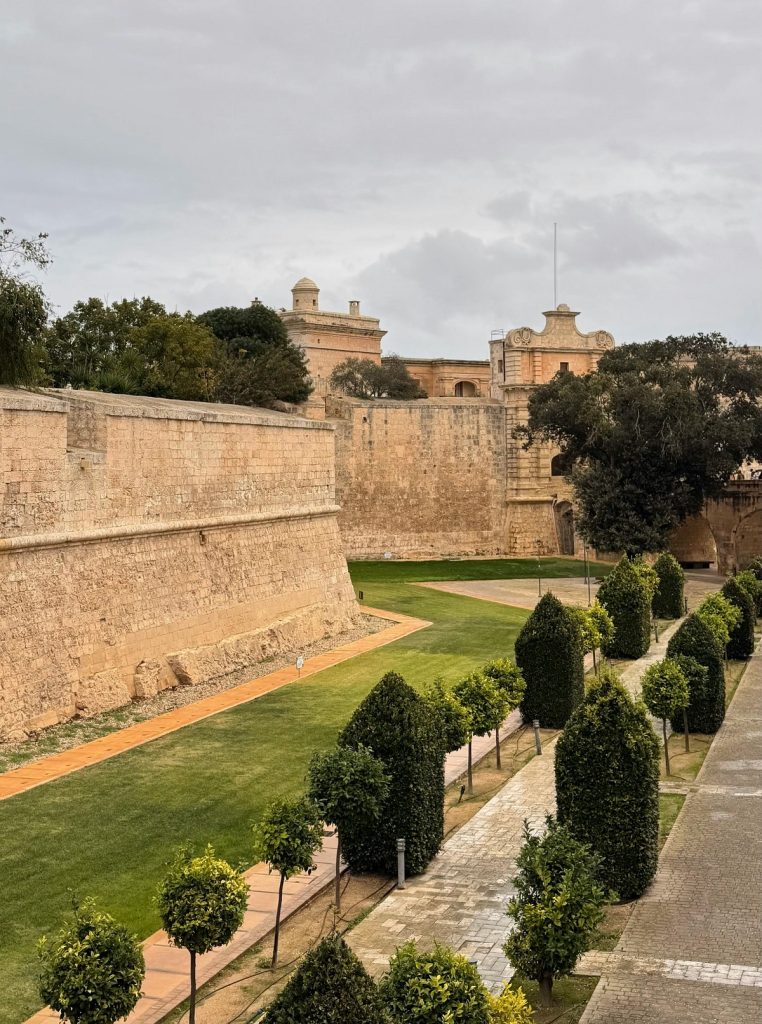
Mdina has a reputation for being atmospheric, and in this case the reputation is deserved. The city’s narrow streets, heavy stone facades and quiet corners create a sense of enclosure that is very different from Valletta.
Arriving in the morning is often the best way to experience it. It feels calmer, and if you are here before the busiest part of the day you can walk the streets without too much background noise. You do not need a long checklist in Mdina. The point is to move slowly and let the place work on you.
Rabat sits immediately beside Mdina and provides a useful contrast. It is less stage-like, more practical and more obviously part of everyday Malta. Depending on how much time you want to give this stop, you can keep Rabat short or turn it into a substantial part of the day.
Either way, it is worth including because it prevents the itinerary from feeling as though it is only chasing postcard moments.
From Rabat, continue west towards Dingli Cliffs. This is one of the stretches that makes a Malta road trip feel worthwhile.
The roads are not dramatic in a hairpin-mountain-pass sense, but they are open enough to feel scenic and quiet enough to invite stopping. The closer you get to the cliffs, the more the landscape simplifies. Stone walls, low vegetation and open sea views take over.
Dingli Cliffs are best treated as a late afternoon or early evening stop. The west-facing position matters. Earlier in the day they can feel exposed and stark. Later on, the light softens and the whole coastline gains more depth.
That change is exactly the sort of thing a car gives you freedom to chase. If you were moving through Malta by fixed schedule, this is the sort of timing advantage you would lose.
If you want individual scenic route ideas beyond this itinerary, our guide to the 5 best scenic drives in Malta covers Day 2’s territory in more detail, particularly the drive from Rabat towards the western coast.
Day 3: Marsaxlokk, Blue Grotto and the Southern Coast
The third day heads south and changes the pace again. Marsaxlokk is one of those places that people often recognise from photographs before they ever visit.
The harbour is lined with traditional luzzu boats, and when the weather is clear the water and paintwork do exactly what you expect them to do.
It is photogenic, yes, but it also works as a road trip stop because it feels rooted in daily life rather than built purely around tourism.
If you arrive early, Marsaxlokk is calmer and easier to enjoy. Sundays are livelier because of the market, which some people like and others find slightly too busy.
Neither is wrong, but it is worth deciding beforehand what sort of atmosphere you want. The point of a self-drive itinerary is that you can make those calls yourself.
From Marsaxlokk, the route naturally threads into the southern coast. This is where the day starts to feel broader than a simple village visit. You move from harbour scenery into rougher coastal views, low cliffs and wider sea horizons.
St Peter’s Pool is one of the more obvious diversions if you want a swimming stop or simply a dramatic natural viewpoint. The road network in the south is not complicated, but it pays to keep the pace loose and accept that this is not a day for racing between stops.
The Blue Grotto is the day’s headline stop. Timing matters here more than almost anywhere else on the route. Earlier in the day tends to work best for sea conditions, and if you are interested in taking a boat trip it is sensible to check the latest details through official or locally recognised sources rather than assuming they will run.
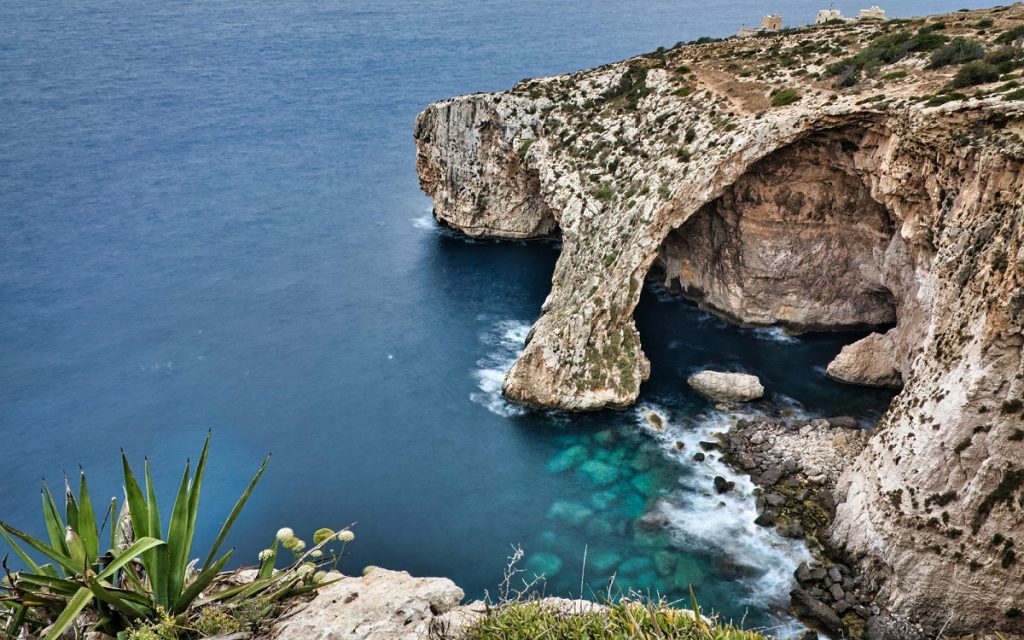
Even without going on the water, the viewpoint from above is enough to justify the stop. The coastline here has a dramatic, sculpted feel that is very different from the open edge of Dingli Cliffs.
This day combines three different aspects of Malta in one manageable arc: traditional coastal life in Marsaxlokk, raw coastal scenery in the south, and one of the island’s best-known natural sights at the Blue Grotto.
Day 4: Gozo Excursion
If you have the time, a day on Gozo is worth building into the trip. It stops the itinerary from becoming just a loop around Malta and adds a second island with a different mood. The crossing from Cirkewwa is short enough to be practical and distinctive enough to feel like part of the trip rather than a logistical inconvenience.
Gozo works best when it is treated as a day of contrast. The roads feel quieter, the scale feels more open and the pace is noticeably slower. Even if you cover only a few key stops, the tone of the trip changes. That matters on a five-day itinerary because it keeps the route from feeling repetitive.
Start in Victoria and head up to the Citadel. It is the logical anchor stop because it gives you views across the island and an immediate sense of Gozo’s layout. From there you can decide how structured or loose to be.
Ramla Bay is an easy inclusion if you want a beach and broader landscape, while smaller coastal viewpoints make sense if you prefer driving and stopping.
You can check the latest crossing times and fares on the official Gozo Channel Ferries. Ferries run frequently throughout the day, and the crossing itself is short, but it is worth checking timetables in advance during busier periods.
Gozo is also where the road trip starts to feel more complete. Without it, the itinerary still works. With it, the route becomes more varied and more memorable.
Day 5: Mellieha and the Northern Coast
The final day should feel lighter. By this stage, most of the itinerary has covered history, harbours, villages, cliffs and a separate island. The north of Malta is the right place to finish because it offers openness, coastline and flexibility.
Mellieha makes a good starting point. The town sits on a hillside and gives broad views across the surrounding coast. It also works well as a pivot because from here you can shape the day depending on energy levels and time.
If you want beaches, they are close. If you want a relaxed coastal loop with occasional stops, that works just as well.
This is not the day to over-plan. One of the pleasures of ending in the north is that it gives the road trip room to breathe.
You can revisit somewhere you rushed earlier, detour towards a bay, or simply enjoy a final stretch of driving without needing to be anywhere in a hurry. If the rest of the itinerary is about structure, Day 5 is about release.
Practical Tips for Driving in Malta
Malta is easy to underestimate because the island is small. Distances look short on a map, which can make people assume planning hardly matters. In practice, planning still helps. Roads may be compact, but traffic, village streets and parking can all slow things down at the wrong moment.
For UK visitors, driving on the left removes one major hurdle. That alone makes Malta more approachable than many Mediterranean road trip destinations. The more noticeable challenge is not the side of the road but the width of certain streets in older towns and the limited parking around historic centres.
Valletta is the obvious example, which is why it makes sense to park outside and walk in. The same basic logic applies elsewhere: do not fight the most congested areas if you do not need to.
It is also worth keeping the daily shape of the island in mind. Moving around early in the day is usually easier. By afternoon, some areas become busier, especially in peak travel months.
Fuel stations are easy enough to find, and the island is not large enough for range anxiety to be a serious issue, but short distances should not trick you into squeezing in too much.
The point of this route is not to prove how much you can cover. It is to enjoy the fact that Malta allows you to do a lot without feeling constantly on the move.
If you are organising your trip, it is worth comparing your options for cheap Malta car hire before you arrive. Having your own vehicle makes it far easier to explore beyond the main tourist areas and gives you the flexibility this itinerary is built around.
If you want to tailor the route around your own priorities, you can also try our Malta Trip Planner to build a route that matches your interests and trip length.
3-Day vs 5-Day Malta Itinerary
A short version of this road trip is still worthwhile. If you only have three days, the strongest route is Day 1 through Day 3: Valletta and the Three Cities, then Mdina and Dingli Cliffs, then Marsaxlokk and the southern coast.
That combination gives a balanced introduction to Malta without making the trip feel rushed.
The five-day version works better if you want variation and breathing room. Gozo changes the tone of the itinerary, and the northern coast gives the final day a more relaxed finish.
If you are deciding between the two, the real question is not what you can technically fit in, but how much pace you want. Malta is best enjoyed when the route still leaves room for curiosity.
Frequently Asked Questions
Is Malta good for a road trip?
Yes. Malta is one of the easiest Mediterranean destinations to explore by car because it combines short driving distances with a surprising variety of scenery, history and coastal viewpoints.
How long does it take to drive around Malta?
You can cross the island in well under an hour, but that is not really the point. A proper road trip is about stopping and exploring, which is why three to five days works far better than trying to rush it in one.
Do you need a car in Malta?
Not for every kind of trip, but if your aim is to combine villages, scenic routes, cliff viewpoints and flexible timing, having a car makes the island much easier to enjoy.
Is driving in Malta difficult?
It can feel busy in certain areas, especially around older towns and main routes, but overall it is manageable. UK visitors usually adjust quickly because the traffic drives on the left.
Closing Thoughts
What makes Malta work as a road trip destination is not sheer scale. It is contrast. The island can move from urban to rural, from fortified to open, from fishing harbour to cliff edge within a very short distance.
That means a road trip here never depends on epic distances or big dramatic highway moments. It depends on rhythm. The right stops, the right timing and enough flexibility to let the island reveal itself properly.
That is why this itinerary is worth doing by car. It gives you enough structure to make sense of the route, but enough freedom to keep it personal.
Pack light, leave early each morning, and let the roads take you somewhere unexpected.
That is when Malta does its best work.