
Menorca may be the smallest of the three main Balearic Islands, but its roads reward the driver more than either of its neighbours.
The island crosses in under an hour, yet the five best scenic drives in Menorca take you through landscapes as varied as the reddish moonscape of the north coast, the pine-backed turquoise coves of the south, the prehistoric interior and the open ME-1 with its succession of detours worth every minute.
Each drive in this guide includes the best places to stop, eat and what to order when you get there.
Table of Contents
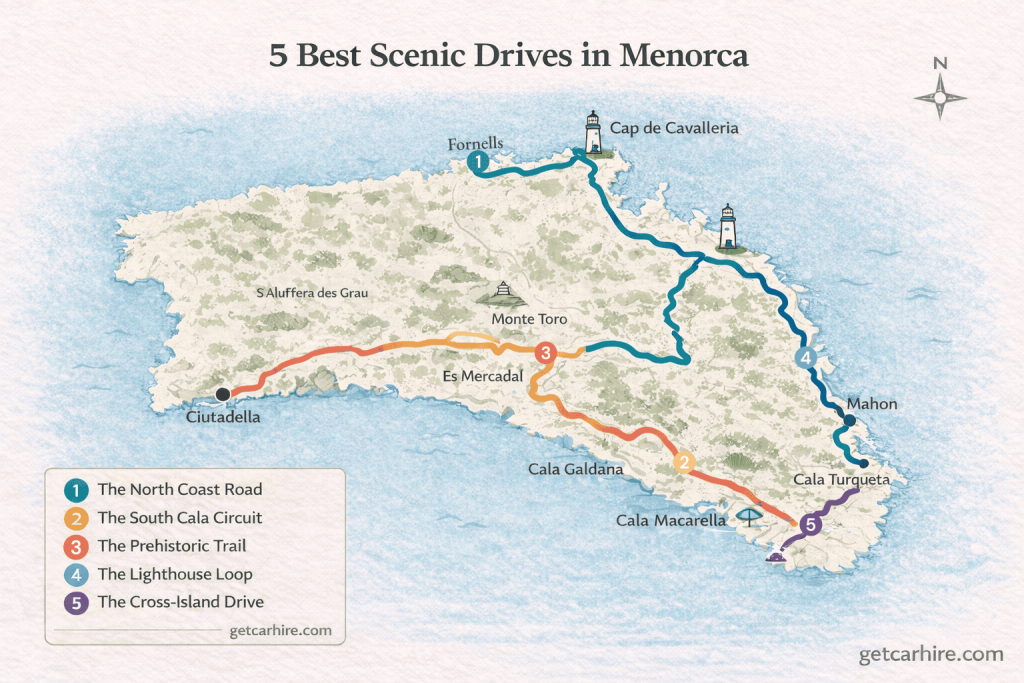
The 5 Best Scenic Drives in Menorca at a Glance
Drive 1: The North Coast Road. Mahon to Cap de Cavalleria via Fornells. Approximately 55 kilometres. Full day. Lunch stop at Fornells harbour for caldereta de llagosta at Es Cranc or Sa Llagosta.
Drive 2: The South Cala Circuit. Ciutadella to Cala Macarella and Cala Turqueta. Approximately 40 kilometres. Half day. Start with breakfast at Cafe Balear on Ciutadella harbour before heading south.
Drive 3: The Prehistoric Trail. Mahon to Naveta des Tudons via Monte Toro. Approximately 50 kilometres. Half day. Lunch at Moli d’Es Raco in Es Mercadal, a family farmhouse restaurant serving traditional Menorcan food since 1982.
Drive 4: The Lighthouse Loop. Favaritx to Cap de Cavalleria across the north. Approximately 70 kilometres. Full day. Fill up at Mahon before departing. Lunch at Fornells on the return leg.
Drive 5: The Cross-Island Drive. Mahon to Ciutadella on the ME-1 with the best detours. Approximately 45 kilometres each way. Full day. Stop in Es Mercadal for pastries at Forn Sant Francesc bakery, dinner at Cafe Balear or S’Amarador on Ciutadella harbour.
What You Need to Know Before Driving in Menorca
Spain drives on the right. Road signs appear in both Spanish and Catalan throughout the island. The ME-1 is Menorca’s spine road, running from Mahon in the east to Ciutadella in the west, and all five drives branch from or connect back to it.
Speed limits follow the standard framework set by the Direccion General de Trafico (pronounced dee-RECK-syon heh-neh-RAL deh TRAH-fee-ko), Spain’s national road traffic authority, known as the DGT: 50 km/h in towns and villages, 90 km/h on open rural roads. There are no motorways and no toll roads on Menorca.
Petrol stations are concentrated in Mahon, Ciutadella and the larger resort towns. The north coast in particular has very few between the ME-1 junction and the coastal endpoints. Fill the tank before setting off on Drives 1 and 4 in particular.
When another driver flashes headlights at you in Menorca, it signals that they are coming through and that you should yield, the opposite of UK convention. This is worth remembering on the single-track lanes to the south coast calas on Drive 2.
Insider Tip: A small SUV or crossover is worth the modest extra cost for Menorca. Several of the access roads to the north coast coves and south cala car parks are unpaved for the final stretch. A standard compact car manages them in dry conditions but a slightly higher clearance makes the Cala Pregonda track on Drive 1 and the Favaritx approach on Drive 4 considerably more comfortable. Book the upgrade before you travel rather than at the desk, where choice is limited in peak season.
Drive 1: The North Coast Road
Mahon to Cap de Cavalleria via Fornells
Start in Mahon (pronounced ma-ON), the island’s capital, and head north on the Me-7 road towards Es Grau (pronounced ess GRAW).
The S’Albufera des Grau (pronounced sal-boo-FAIR-a des GRAW) natural park begins here, one of the most important wetland reserves in the Balearic Islands, with more than 90 recorded species of migratory birds using the lagoon in spring and autumn.
Leave the car at the village and walk the coastal path for an hour before continuing north.
Continue west along the coast road to Fornells (pronounced for-NELS), a small fishing harbour on a wide sheltered bay. Fornells is famous throughout Menorca for caldereta de llagosta (pronounced kal-deh-REH-ta deh lya-GOST-a, meaning lobster stew), and the waterfront restaurants here are the best argument for timing your arrival at lunchtime.
The two most celebrated are Es Cranc (pronounced ess KRANK, meaning the crab), a Michelin-listed institution with lobster tanks visible from the dining room, and Sa Llagosta (pronounced sa lya-GOST-a, meaning the lobster), slightly more refined and run by chef David Coca. Both serve the caldereta with toasted bread for dipping into the rich shellfish broth.
For those watching the budget, the arroz caldoso de langosta (pronounced a-ROSS kal-DOH-so, meaning soupy lobster rice) is widely considered even better than the stew itself and is served as a sharing dish. Book ahead in July and August; both restaurants fill early.
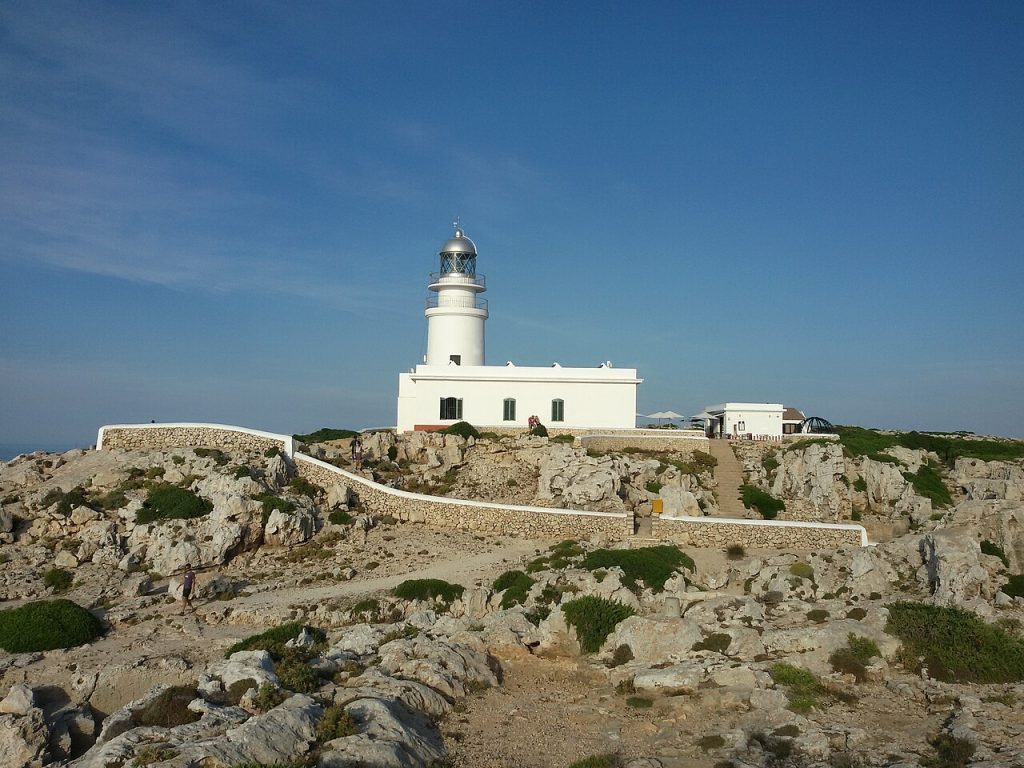
From Fornells, take the Me-15 north towards Cap de Cavalleria (pronounced kap deh ka-va-LLEH-rya, meaning the Cape of the Cavalry). The road crosses open scrubland of reddish rock unlike anywhere else on the island. The lighthouse at the cape sits above dramatic cliffs with views north to the French coast on very clear days.
Insider Tip: The small cove of Cala Pregonda (pronounced KAH-la preh-GON-da), reached by a rough track off the Cap de Cavalleria road, has reddish sand, turquoise water and very few visitors even in high summer. The track requires a high-clearance vehicle. Worth the detour if you have the right car and arrive before midday. There are no facilities here, so bring water and food from Fornells.
Total distance: approximately 55 kilometres from Mahon to Cap de Cavalleria and back to the ME-1. Allow a full day with the S’Albufera walk and a proper lunch in Fornells.
Drive 2: The South Cala Circuit
Ciutadella to Cala Macarella and Cala Turqueta
This circuit begins in Ciutadella (pronounced syoo-ta-DEL-la), the island’s former capital and most architecturally distinguished city. The Placa des Born (pronounced PLAH-sa des BORN) at the city’s heart and the Gothic cathedral are the highlights on foot.
Before leaving the city, breakfast at Cafe Balear (pronounced ka-FEH ba-lee-AHR) on the harbour is worth an early start: it has been open since the 1970s, runs on fresh catches sourced by its own boat, and serves the caldereta alongside simpler dishes at a table overlooking the water.
For a quicker, cheaper option before heading south, stop at any of the bakeries along Carrer des Seminari in the old town for an ensaimada (pronounced en-sai-MAH-da), the traditional spiral pastry made with pork fat that is the standard Balearic breakfast. Expect to pay well under two euros.
Head south-east from Ciutadella briefly on the ME-1, then south towards Cala Galdana (pronounced KAH-la gal-DAH-na), the most developed of the south coast beaches and the broadest. Continue east along the access road to the car park above Cala Macarella (pronounced KAH-la ma-ka-REL-ya).
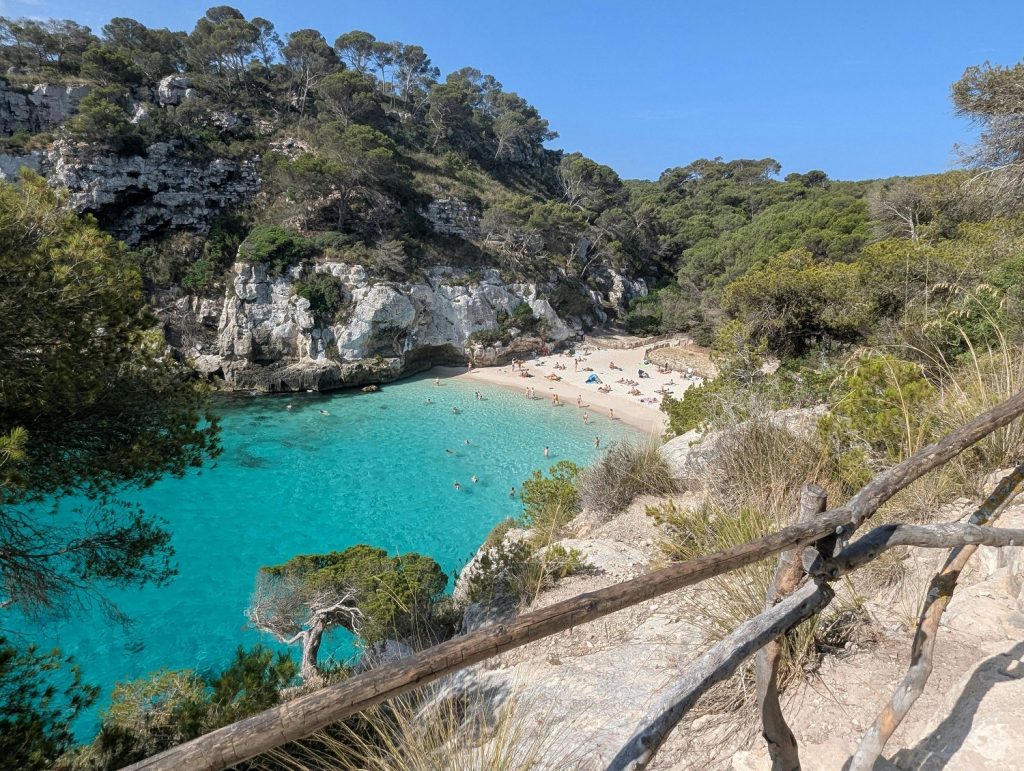
The cove below is one of the finest in the Mediterranean: ivory-white sand, pine-backed cliffs and water that runs from pale turquoise at the shore to deep blue in the centre. A beach bar operates throughout the summer season and serves cold drinks, basic food and, in high season, fresh seafood brought in by local boats.
A ten-minute walk around the headland brings you to Cala Macarelleta (pronounced KAH-la ma-ka-rel-YEH-ta), completely without facilities and correspondingly quieter.
Continue east by car to Cala Turqueta (pronounced KAH-la tur-KET-a), equally spectacular with its own clifftop car park. Return to Ciutadella for dinner: S’Amarador (pronounced sa-ma-ra-DOR) on the harbour is in the Michelin Guide and specialises in lobster and black rice with cuttlefish.
Total distance: approximately 40 kilometres from Ciutadella and back. Allow half a day, more if you stay for the beach bar at Macarella and dinner back in Ciutadella. Arrive at both cala car parks before 9am in July and August.
Drive 3: The Prehistoric Trail
Mahon to Naveta des Tudons via Monte Toro and Es Mercadal
Menorca is a UNESCO Biosphere Reserve with more than 1,500 recorded prehistoric sites. This route threads through the most significant and accessible of them, crossing the agricultural interior from east to west.
Leave Mahon heading west on the ME-1 and turn north at Es Mercadal (pronounced ess mer-ka-DAL) for Monte Toro (pronounced MON-teh TOR-o, meaning the bull mountain), the highest point on the island at 358 metres.
A 13th-century sanctuary and a statue of Cristo Rey crown the summit. On a clear day both coastlines are visible simultaneously.
There is a restaurant at the summit of Monte Toro with views across the central plain and serving traditional Menorcan food at reasonable prices.
For a more characterful stop, return to Es Mercadal and seek out Moli d’Es Raco (pronounced MO-lee dess RA-ko, meaning the mill of the corner), a family farmhouse restaurant that has been serving traditional Menorcan cuisine since 1982 using produce from its own garden and livestock.
The sobrasada (pronounced so-bra-SAH-da), the traditional Menorcan cured pork sausage seasoned with paprika and spices, is excellent here, served on toast with local honey as a starter. The tumbet (pronounced toom-BET), a baked layered vegetable dish, is the island’s answer to ratatouille.
For pastries before or after, the Forn Sant Francesc bakery in Es Mercadal is considered among the best on the island.
Continue west on the ME-1, diverting south near Alaior (pronounced a-la-YOR) for the Talatí de Dalt (pronounced ta-la-TEE deh DALT) prehistoric settlement: an extensive site of talaiots (pronounced ta-lay-YOTS, meaning watchtower structures) and a central taula (pronounced TAU-la), the T-shaped megalithic monument unique to Menorca.
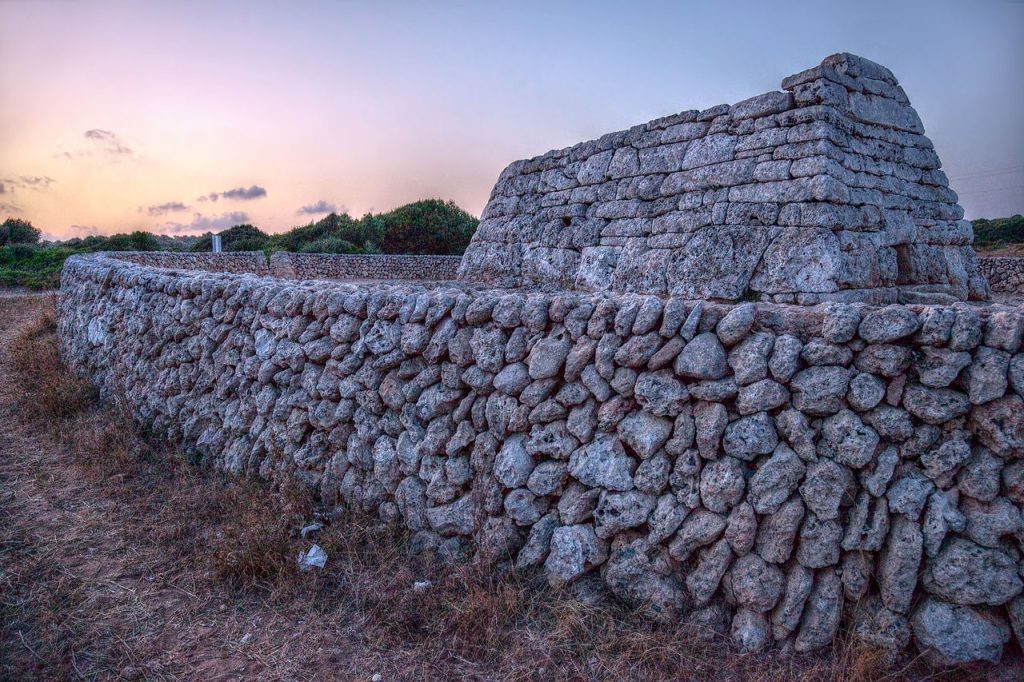
Continue to the Naveta des Tudons (pronounced na-VEH-ta des too-DONS), sitting alongside the ME-1 five kilometres east of Ciutadella, one of the oldest roofed buildings in Europe. The site is managed by Heritage Menorca with a small car park opposite.
Insider Tip: The Naveta des Tudons is best visited before 10am, when the low eastern light picks out the texture of the limestone blocks most dramatically and coach tours from Ciutadella have not yet arrived. The Mahon cheese produced on the island, Queso Mahones (pronounced KEH-so ma-yo-NESS), is the perfect food souvenir to buy before leaving: look for the artisan version labelled DO Menorca at any of the interior town markets or roadside farm shops between Es Mercadal and Ferreries.
Total distance: approximately 50 kilometres from Mahon to the Naveta and back. Allow half a day with Monte Toro, lunch in Es Mercadal, Talatí de Dalt and the Naveta des Tudons.
Drive 4: The Lighthouse Loop
Favaritx to Cap de Cavalleria Across the North
This is the most dramatic drive on the island and the one least known to visitors staying in the south coast resorts. It links two of Menorca’s most atmospheric coastal endpoints: the lighthouse at Favaritx (pronounced fa-va-REETS) in the north-east and the lighthouse at Cap de Cavalleria in the north-west.
Fill the tank in Mahon before departing. Head north-east from Mahon on the Me-7, turning east before Es Grau towards the Favaritx peninsula. The approach road crosses a landscape of dark slate rock unlike anything else on the island: no vegetation, no buildings, just the road and the sea appearing suddenly ahead.
There is a small beach below the lighthouse, Cala Presili (pronounced KAH-la preh-SEE-lee), reachable on foot from the car park with a twenty-minute walk over the rock. Bring all food and water from Mahon as there are no facilities anywhere on this peninsula. Return to the ME-1 and head west to the Fornells junction, then north as per Drive 1 to Cap de Cavalleria.
Build in a lunch stop at Fornells: Can Tanu (pronounced kan TA-noo) is a family-run restaurant with a more relaxed atmosphere than Es Cranc and Sa Llagosta, and serves the caldereta alongside Menorcan prawns and queen scallops at slightly lower prices.
The contrast between the two lighthouses, Favaritx dark and angular, Cap de Cavalleria reddish and windswept, is one of the most compelling reasons to combine them in a single day.
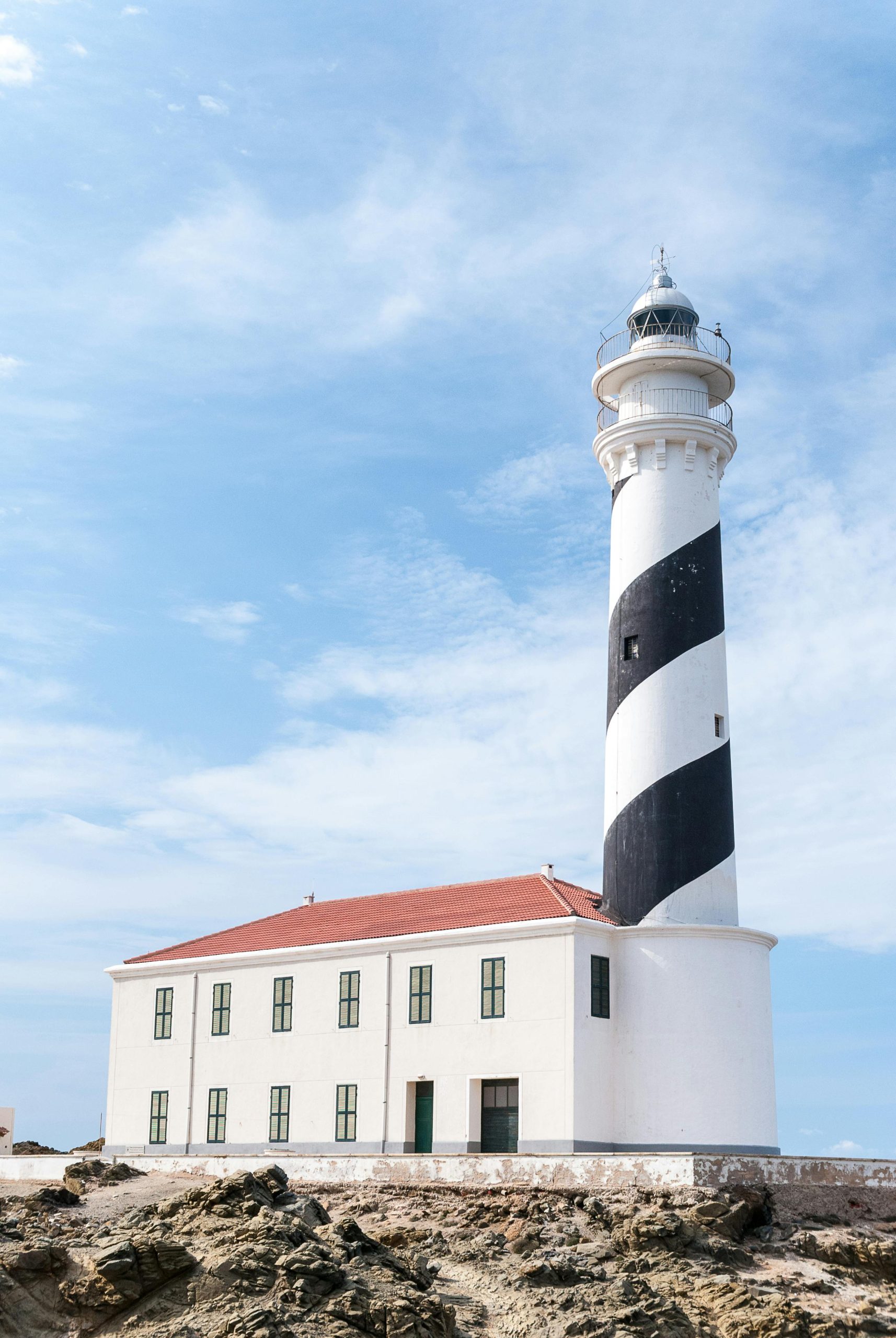
Total distance: approximately 70 kilometres for the full loop. Fill the tank in Mahon before departing and again in Fornells if needed. Allow a full day.
Drive 5: The Cross-Island Drive
Mahon to Ciutadella on the ME-1 With the Best Detours
The ME-1 runs 44 kilometres from Mahon to Ciutadella through the agricultural centre of the island. Driven straight through, it takes under 45 minutes. Driven properly, with the right detours and food stops, it takes a full day.
Before leaving Mahon, the port is worth a slow circuit by car: one of the largest natural harbours in the Mediterranean at over five kilometres in length, it is best appreciated from the road running along the northern bank.
The Xoriguer gin distillery (pronounced sho-ri-GAIR) is on the harbour quayside and open for tastings throughout the day. Menorca gin has been produced here since the 18th century, when the British garrison introduced the taste for it during their occupation of the island. The gin is distinctively flavoured and produced in copper pot stills visible through the distillery windows.
Continue west on the ME-1, diverting north for Monte Toro from Es Mercadal and stopping in the town itself at the Forn Sant Francesc bakery for pastries. The town’s main square has several good cafes and a morning market in summer. Continue west through Ferreries (pronounced feh-REH-rees) and divert south briefly to Cala Galdana, the most accessible of the south coast beaches and a good swimming stop. Return to the ME-1 for the final stretch into Ciutadella.
Ciutadella deserves a full afternoon and evening. After exploring the historic quarter on foot, dinner on the harbour is the natural end to the day. Cafe Balear is the most established option, serving fresh daily fish and seafood sourced by its own boat.
For something more refined, S’Amarador in the Michelin Guide serves lobster and black rice at tables overlooking the water. For those preferring a modern take on Menorcan ingredients, Es Tast de na Silvia (pronounced ess TAST deh na SEEL-vya) in the old town is run by local chef Silvia Anglada and focuses on seasonal, market-fresh small plates built around island produce.
Insider Tip: The drive back from Ciutadella to Mahon along the ME-1 at dusk, with the sun dropping behind you and the eastern sky turning amber over the port, is one of the finest ends to a day on the island. Time your departure from Ciutadella about an hour before sunset. The light on the limestone walls of the interior villages at that hour makes the slower pace more than worthwhile.
Total distance: approximately 90 kilometres for the full return. Allow a full day with stops at Mahon port, Monte Toro, Es Mercadal, Cala Galdana and Ciutadella.
Practical Notes for All Five Drives
The south coast cala car parks fill completely by mid-morning in July and August. For Drives 2 and 5, arriving before 9am is the only reliable means of guaranteeing a space at Cala Macarella, Cala Turqueta or Cala Galdana. After 10am, queues back along the access roads are common.
The ME-1 and all secondary roads are toll-free. Fuel is the only ongoing driving cost. The main petrol stations are in Mahon, Ciutadella, Alaior, Es Mercadal and Ferreries. There are none on any of the five coastal endpoints described above.
Hire car bookings for July and August should be made three to four months in advance. Availability tightens significantly as the season approaches and prices rise sharply for late bookings. Compare deals across all Menorca pickup locations alongside the rest of Spain’s islands on our Spain car hire page.
Frequently Asked Questions
How long does it take to drive around Menorca?
The island is approximately 47 kilometres from east to west along the ME-1. The full cross-island drive from Mahon to Ciutadella without stops takes under 45 minutes. A proper circuit of the island including the north and south coast roads takes two full days driven at a relaxed pace.
What is the best food to try in Menorca?
Caldereta de llagosta (lobster stew) is the island’s signature dish, best eaten in Fornells. Sobrasada, the paprika-cured pork sausage, is the essential food souvenir and available at farm shops and markets across the interior. Queso Mahones, the island’s DO-certified cow’s milk cheese, comes in fresh, semi-cured and aged versions and is best bought direct from producers in the rural centre.
Ensaimada, the spiral pastry, is the standard Balearic breakfast found at any bakery.
Are the roads in Menorca suitable for all hire cars?
The ME-1 and main secondary roads are in good condition and suitable for any vehicle. Access roads to several north coast coves and the south cala car parks are unpaved for the final stretch and more comfortable in a high-clearance vehicle. A small SUV is worth considering if you plan to reach the more remote coves on Drives 1 and 4.
Do you need a hire car to explore Menorca properly?
For the resorts and the two main cities, the bus network is adequate. For the south coast calas, the north coast lighthouses, the prehistoric sites and the interior villages, a hire car is the only practical means of getting there on your own schedule. The five drives described above give a clear picture of what the island offers with your own wheels.
When is the best time to hire a car in Menorca?
May, June and September offer the best combination of good weather, manageable traffic at the calas and competitive hire car pricing.
July and August are the busiest and most expensive months. Outside the summer season many beach facilities close, but the roads are quieter and the prehistoric sites and north coast drives are at their most peaceful.
Plan Your Menorca Road Trip
Each of the 5 best scenic drives in Menorca can be completed as a standalone day out from any resort on the island. Together they cover the island in full: both coastlines, the prehistoric interior, two cities and some of the finest food in the Balearics along the way.
The island rewards unhurried driving more than almost anywhere else in the Mediterranean, and all five routes are straightforward to navigate once you are on the ME-1.
Ready to explore Menorca on your own terms? Find the best deals on car hire in Menorca with transparent pricing and no hidden fees.
Looking for a bigger island to explore by car? See our scenic drives guide for Mallorca.
About the Author
Darryl Antonio is CEO of Digitalhound, a London-based digital marketing agency with over two decades of experience in SEO and content strategy. Darryl oversees digital strategy across all sectors the agency represents and manages content production and digital strategy for Getcarhire.com.
Pingback: Car Hire in Menorca – The Essential Insider Guide to Exploring the Island by Car