
Most people who visit Ibiza see perhaps a quarter of it. They stay close to the resort, take taxis to the beach clubs and leave having missed the island that lies just a few kilometres inland: the whitewashed villages, the dramatic rock coastlines, the UNESCO-listed hilltop city and the hidden coves that no bus route has ever reached. Car hire in Ibiza is not a luxury. It is the difference between visiting Ibiza and actually discovering it.
Table of Contents
Why Car Hire in Ibiza Changes Everything
Ibiza, known locally as Eivissa (pronounced ay-VEE-sa), is the third largest of the Balearic Islands and measures roughly 45 kilometres from north to south. That compact geography is deceptive. While the resorts, beach clubs and nightlife venues cluster around Ibiza Town and Sant Antoni de Portmany, the island’s most extraordinary places lie scattered across the rural interior and the quieter northern coastline, reachable only by road.
Public transport on the island is limited to a handful of bus routes connecting the main resorts during the summer season. Taxis are expensive and, in peak season, difficult to find at short notice.
With a hire car, you can cross from coast to coast in under an hour, stop wherever the view demands it and reach beaches that do not appear in any resort brochure. There are no toll roads on Ibiza, which makes exploring genuinely cost-effective once you have the car.
The contrast with Mallorca, where the motorway network makes getting around straightforward, is notable. Ibiza’s rural roads are generally well maintained in the south but become narrower and more winding as you head north. That is precisely where the best of the island is hiding.
If you are island-hopping across the Balearics, our complete guide to car hire in Mallorca covers everything you need to know about navigating Spain’s largest island by road.
Picking Up Your Hire Car in Ibiza
The Aeroport d’Eivissa (pronounced ay-VEE-sa airport), also known as Ibiza Airport and carrying the code IBZ, sits approximately seven kilometres south-west of Ibiza Town. All major hire car suppliers operate from desks within the terminal building, and the collection process is straightforward.
You will need a valid driving licence, a credit card in the main driver’s name and your booking confirmation. Check the rental conditions for your specific booking as most suppliers require a credit card rather than a debit card for the security deposit.
If you are travelling in July or August, book your hire car well in advance. Ibiza is one of Europe’s most popular summer destinations and demand for vehicles rises sharply, pushing prices considerably higher for late bookings and reducing the available choice.

Insider Tip: At the collection desk, before you accept the keys, walk the car with the agent and photograph every panel, including the roof, wheels and underside. Ibiza’s rural tracks and tight village lanes are unforgiving on paintwork, and even minor pre-existing marks can become a dispute at drop-off if they are not documented. A short video as you walk around the vehicle takes two minutes and protects you entirely.
The Ibiza That Only a Hire Car Unlocks
The version of Ibiza that most visitors experience, the clubs, beach bars and promenade at Sant Antoni, is real but it is a fraction of what the island offers. The interior and the north are a different world.
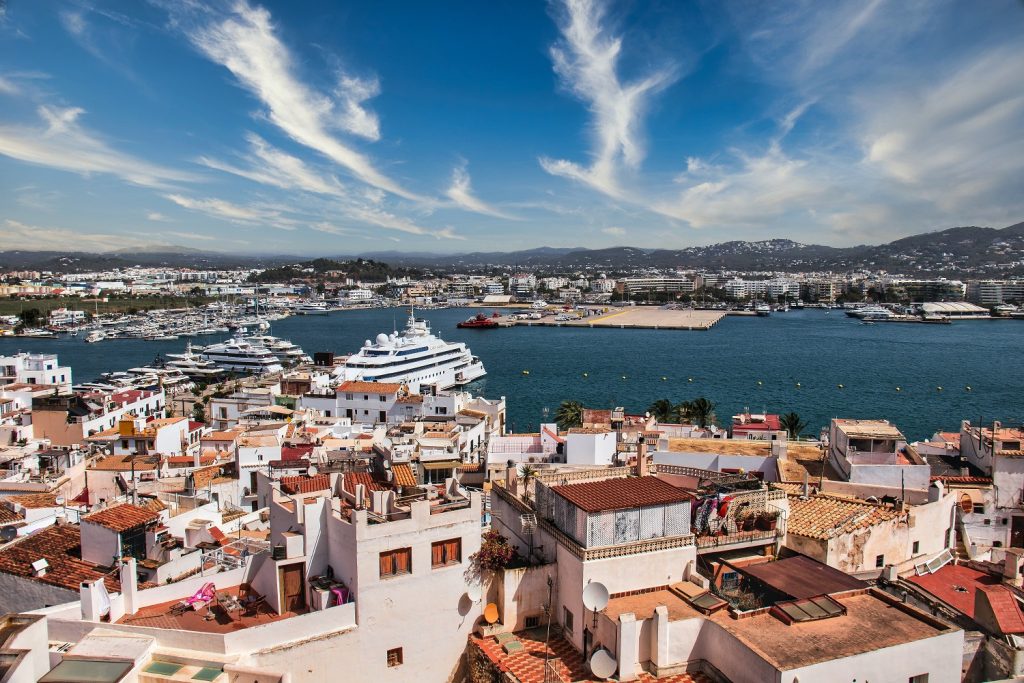
Dalt Vila (pronounced dalt VEE-la, meaning the high town or old walled city) is the ancient fortified settlement that crowns Ibiza Town. A UNESCO World Heritage Site since 1999, its ramparts, cathedral and labyrinthine streets date back through Moorish, Roman and Phoenician occupation.
The views from the walls across the harbour and out to the open sea are extraordinary, and the walk up from the port through the Porta de ses Taules (pronounced POR-ta deh sess TAU-less, meaning the gate of the tables) is one of the finest approaches to any historic city in the Mediterranean. With a hire car, you can time your visit to arrive at dawn before the crowds and have the streets almost entirely to yourself.
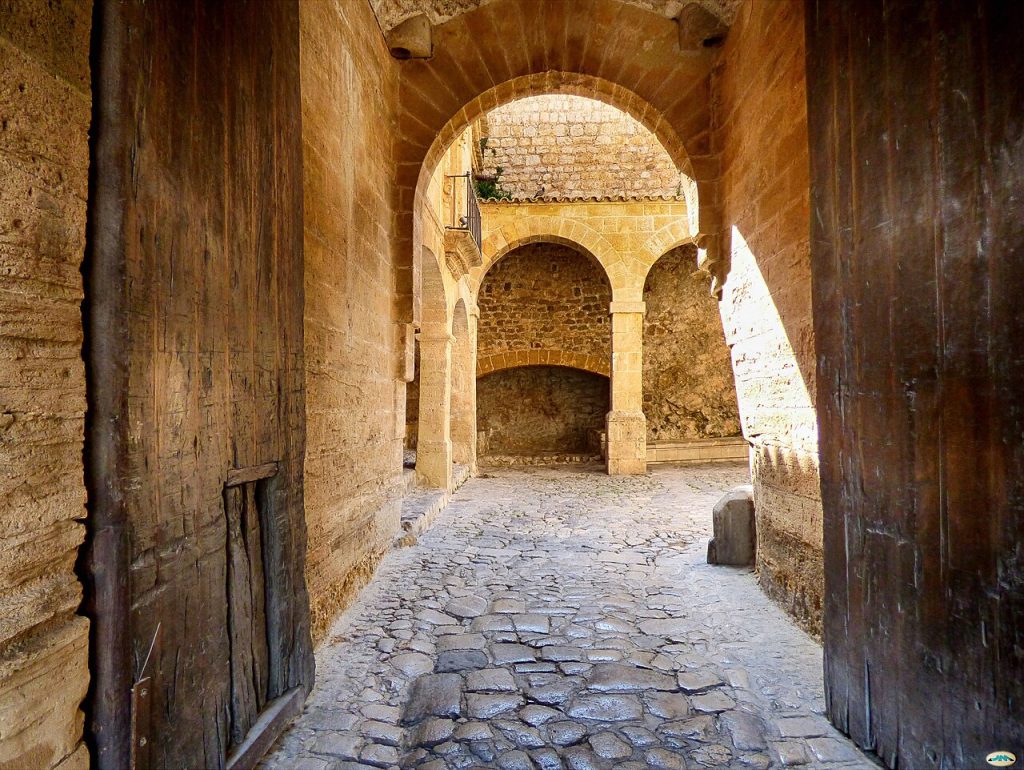
Heading north from Ibiza Town on the PM-810 road, the island changes character completely within twenty minutes. The flat, resort-dominated south gives way to rolling hills, pine forest and a scattered patchwork of fincas (pronounced FEEN-kas, meaning rural farmhouses).
Villages like Santa Gertrudis de Fruitera (pronounced SAN-ta Hehr-TROO-diss deh Froo-ee-TAIR-a) appear around corners with their whitewashed churches and shaded squares, entirely unchanged in appearance from a century ago.
Essential Routes to Drive in Ibiza by Hire Car
The Northern Loop
Start in Ibiza Town and take the PM-810 north towards Santa Gertrudis, continuing to Sant Joan de Labritja (pronounced sant zhwan deh la-BREET-ya), the most northerly village on the island.
From there, drop west towards Benirras (pronounced ben-ee-RASS), a sheltered, pine-backed cove famous for its Sunday drum sessions at sunset, when musicians gather on the rocks at the water’s edge.
Continue to Portinatx (pronounced por-tee-NATCH), the northernmost resort, before looping back south through Sant Miquel de Balansat (pronounced sant mee-KEL deh ba-lan-SAT). Allow a full day and keep the tank topped up as petrol stations are sparse in the north.
The Sunset Coast
Drive west from Ibiza Town to Sant Antoni de Portmany, then continue south along the coast road towards Cala Comte (pronounced KAH-la KOM-teh, meaning Count’s Cove), one of the most celebrated sunset spots on the island.
The views from the rocks above the water as the sun drops into the sea are exceptional. Book dinner at one of the beach restaurants here well in advance during summer as tables fill early.
The Southern Beaches and Es Vedra
Head south from Ibiza Town through the salt flats of Ses Salines (pronounced sess sah-LEE-ness), a protected natural park home to flamingos and other migratory birds during spring and autumn.
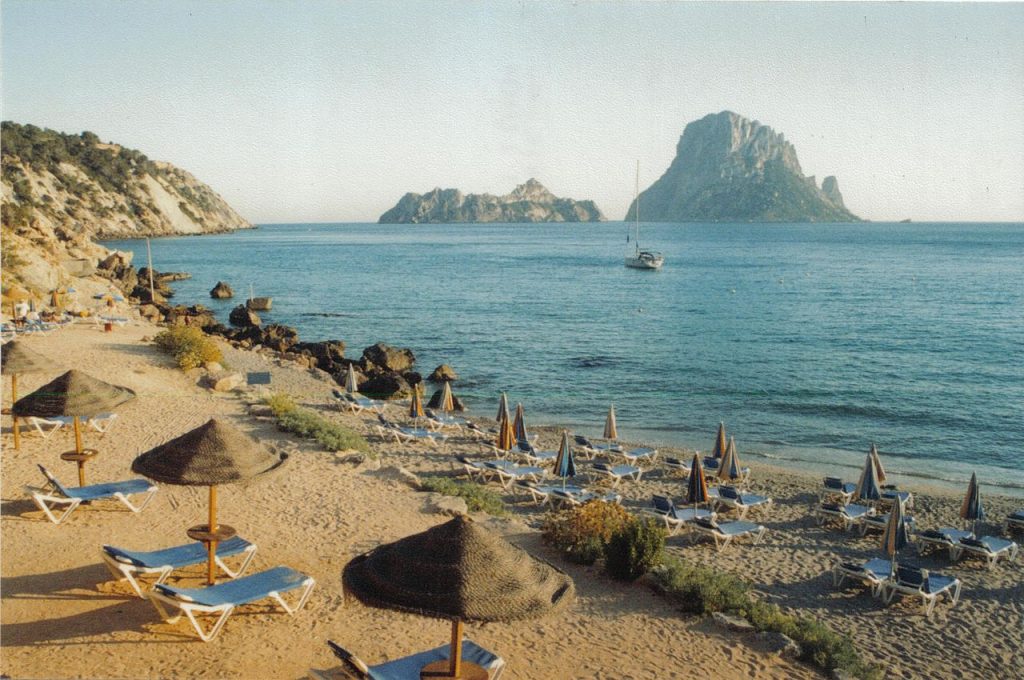
Continue to the car park above Cala d’Hort (pronounced KAH-la dort) for the most dramatic view in the Balearics: a direct sightline to Es Vedra (pronounced ess veh-DRAH), a towering, near-vertical rock island that rises 382 metres from the sea and has accumulated centuries of myth, including associations with Homer’s Odyssey.
It cannot be visited by the public, which makes the view from the cliff above Cala d’Hort all the more compelling.
Insider Tip: The car park above Cala d’Hort is small and fills completely by mid-morning throughout summer. Arrive before 9am to guarantee a space and to catch the early light on Es Vedra, which is at its most dramatic when lit from the east. An hour later, the coaches begin to arrive.
Driving in Ibiza: What You Need to Know
Spain drives on the right, and all road signs on Ibiza appear in both Spanish and Catalan. When you see the name Eivissa on a road sign, that is the Catalan name for Ibiza itself, not a different destination. Sant Antoni may appear in full as Sant Antoni de Portmany, and the old town may be signed as Dalt Vila. None of this is as confusing as it first appears once you are oriented.
Speed limits follow the standard framework set by the Direccion General de Trafico (pronounced dee-RECK-syon heh-neh-RAL deh TRAH-fee-ko), Spain’s national road traffic authority, known as the DGT: 50 km/h within towns and villages, 90 km/h on open rural roads and 120 km/h on motorways.
There are no motorways and no toll roads on Ibiza, so the open road limit of 90 km/h applies to most of your driving. In practice, the northern rural lanes require considerably more care than that, particularly on blind bends where agricultural vehicles and cyclists appear without warning.
Parking in Ibiza Town and Sant Antoni uses a colour-coded system: blue kerb markings indicate paid parking with a time limit, yellow markings indicate no parking at any time, and white markings are generally unrestricted.
Parking apps and pay-and-display machines are standard. During peak summer, parking in Ibiza Town can be genuinely difficult. The paid car parks near the port are reliable and worth the cost.
Some of the most beautiful beaches and viewpoints on the island are reached by narrow, unpaved tracks, particularly along the north and west coastlines.
Before turning onto a rough track, check that your hire car agreement covers off-road use, as some suppliers exclude damage to undercarriages and tyres on unpaved roads.
A standard compact car will handle most of Ibiza’s better-known routes, but if you plan to explore extensively off the main roads, consider booking a small SUV.
Insider Tip: Avoid driving into the centre of Ibiza Town on Friday and Saturday evenings in July and August. The streets around the port and Vara de Rey fill completely from around 9pm and the traffic barely moves for hours. Park outside the centre and walk in, or arrive in the late afternoon before the gridlock builds.
Beyond the routes already described, several destinations reward a specific detour. Las Dalias Market in the village of San Carlos de Peralta (pronounced san KAR-loss deh peh-RAL-ta) is one of the most celebrated markets in the Balearics, running every Saturday throughout the year.
The market is famous for its hippie heritage dating to the 1970s, its artisan craft stalls and live music.
It sits 15 kilometres north of Ibiza Town on the PM-810 and is beyond the reach of any reliable public transport. The official Ibiza tourism board publishes updated seasonal hours and additional market dates during summer.
Can Marca Caves (pronounced kan MAR-sa) near Port de Sant Miquel on the northern coast form an extensive cave system that includes a natural underground lake, stalactites and stalagmites shaped over thousands of years.
The guided tour takes approximately 45 minutes and the caves maintain a constant cool temperature, making them a welcome detour on hot summer days.
Ses Salines Natural Park deserves more than a passing drive-through. The salt flats have been harvested since Phoenician times and the landscape is entirely unlike anywhere else on the island: flat, wide, palest pink in the afternoon light, edged with low salt-tolerant vegetation and crossed by paths alongside the working salt harvest.
The park extends south to the beach of Ses Salines itself, one of the finest on the island, within easy reach of the car park near the salt flat entrance.
Frequently Asked Questions About Car Hire in Ibiza
Do I need a car in Ibiza?
It depends on what you want to see. If your plan is to stay in one resort and visit the beach clubs, you can manage without one. If you want to explore Dalt Vila, the northern villages, the quieter beaches and the rural interior, a hire car is essential. The bus network covers the main resort corridors but nothing beyond them.
Is it easy to drive in Ibiza?
Generally yes, with some caveats. The main roads are well maintained and clearly signed. The northern rural lanes are narrower and require more care. Summer traffic around Ibiza Town and Sant Antoni can be heavy from late morning onwards.
If you have driven on the right in any European country before, Ibiza presents no particular challenge beyond the seasonal congestion.
Are there toll roads in Ibiza?
No. There are no toll roads on Ibiza. You pay only for your fuel, which makes car hire in Ibiza particularly good value for exploring the island in full.
What age do I need to be to hire a car in Ibiza?
The minimum age is 21 with most suppliers, though some will hire to drivers aged 18 to 20 with a young driver surcharge applied.
Drivers over 70 may face additional conditions or surcharges depending on the supplier. Always check the rental conditions for your specific booking before you travel.
When is the best time to hire a car in Ibiza?
May, June and September offer the best combination of good weather, manageable traffic and more competitive pricing. July and August are the peak months: busiest, most expensive and hottest.
Outside the summer season, many beach facilities close, but the island is quieter, the roads are clearer and the driving is considerably more relaxed.
Explore Ibiza on Your Own Terms
Ibiza rewards the visitors who look beyond the resort. The hidden coves, the UNESCO hilltop city, the drum circles at sunset and the quiet northern villages are all within easy reach once you have a hire car and a rough idea of where you are headed.
The island is compact enough to explore properly in four or five days, and with no toll roads to navigate, the only ongoing cost is fuel. Start planning your Ibiza hire car alongside the rest of Spain’s islands on our Spain car hire page, where you can search and compare deals across the Spanish islands and mainland, with transparent pricing and no hidden fees.