
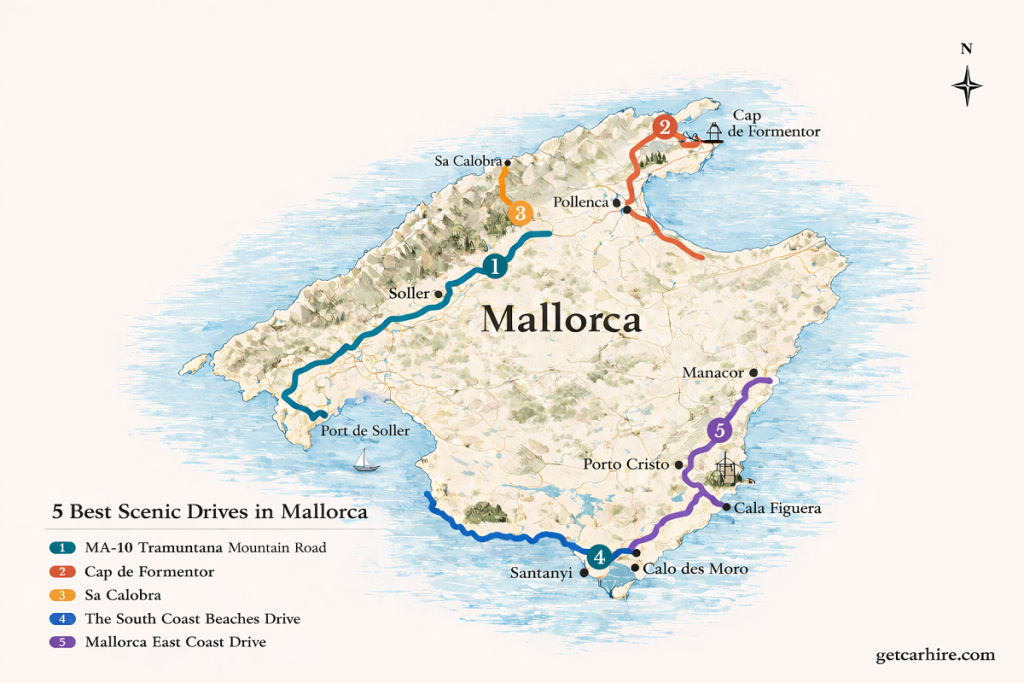
Mallorca is the largest of the Balearic Islands and one of the most rewarding in Europe to drive. Its roads range from the hairpin mountain passes of the UNESCO-listed Serra de Tramuntana to the straight coastal run of the south, and the 5 best scenic drives in Mallorca cover terrain as varied as any island on the Mediterranean.
Each drive in this guide includes the route in full, driving times, the best places to stop and eat, and the local knowledge that makes the difference between a good day out and an extraordinary one.
Table of Contents
The 5 Best Scenic Drives in Mallorca at a Glance
Drive 1: The Tramuntana Mountain Road. Palma to Port de Soller via Valldemossa and Deia on the MA-10. Approximately 55 kilometres. Full day.
The most celebrated drive on the island. Lunch at Ca’s Patro March at Cala Deia, the clifftop seafood restaurant made famous by the television series The Night Manager. Book well in advance.
Drive 2: Cap de Formentor. Pollenca to the lighthouse at the island’s northern tip. Approximately 30 kilometres each way. Half day. Note: private cars are restricted from the Formentor peninsula between 10am and 7pm from late May to October.
Take the shuttle bus from Port de Pollenca car park or arrive before 9am. Lunch at La Fonda de l’Aigua in Pollenca for traditional Mallorcan food before or after.
Drive 3: Sa Calobra. Port de Soller to the hidden beach at the end of the most dramatic road on the island. Approximately 30 kilometres each way. Half day.
No restaurant at Sa Calobra worth recommending specifically. Eat in Port de Soller before the drive and arrive at Sa Calobra early.
Drive 4: The South Coast Beaches Drive. Palma to Calo des Moro via Santanyi and Mondrago Natural Park. Approximately 70 kilometres. Full day. Lunch at Cafe Drac in Cala Santanyi, a relaxed spot overlooking the beach.
Drive 5: The East Coast Drive. Manacor to Capdepera via the Drach Caves, Cala Figuera fishing village and the castle at Capdepera. Approximately 60 kilometres. Full day. Lunch at Cala Figuera waterfront restaurants for fresh fish.
5 Best Scenic Drives in Mallorca: What to Know Before You Set Off
Spain drives on the right. Road signs in Mallorca appear in both Spanish and Catalan. Speed limits follow the standard framework set by the Direccion General de Trafico (pronounced dee-RECK-syon heh-neh-RAL deh TRAH-fee-ko), Spain’s national road traffic authority: 50 km/h in towns, 90 km/h on open rural roads, 120 km/h on motorways.
Mallorca has an extensive motorway network radiating from Palma that is toll-free. The mountain roads of the Serra de Tramuntana (pronounced seh-RA deh tra-moon-TAH-na, meaning the range of the northern wind) are in excellent condition but narrow, with tight hairpin bends and significant gradients on Drives 1, 2 and 3. A small or compact car is considerably easier to handle on these roads than a large SUV or people carrier.
Mallorca is a popular cycling destination and the mountain roads in particular carry large numbers of cyclists year-round. Patience on the hairpin bends of the Tramuntana is essential. Overtaking is rarely safe and never necessary. The cyclists are there for the same reason you are.
One restriction specific to Mallorca: the road to Cap de Formentor is closed to private vehicles between 10am and 7pm from late May through to October. A free shuttle bus runs from the car park at Port de Pollenca throughout this period. Outside these hours and outside the restricted season, the road is open. See Drive 2 for full details.
Insider Tip: The MA-10, the road that runs along the spine of the Tramuntana mountains, is considered one of the finest driving roads in Europe. Cyclists also know this and the road carries a very high volume of them, particularly on weekend mornings from March through to November. If you want the mountain road without the cyclists, drive it on a weekday afternoon in shoulder season. The light on the mountains in late afternoon is also significantly better for the views than the harsh midday sun.
Drive 1: The Tramuntana Mountain Road
Palma to Port de Soller via Valldemossa and Deia
The MA-10 road through the Serra de Tramuntana is the most celebrated drive on the island and one of the finest in the whole of Spain. The Serra de Tramuntana is a UNESCO World Heritage Site, a mountain range running the full length of Mallorca’s north-west coast with peaks reaching over 1,400 metres.
The MA-10 threads through it for approximately 90 kilometres from Andratx in the south to Pollenca in the north, passing through a succession of medieval villages, olive groves and coastal viewpoints that justify every superlative written about it.
Leave Palma heading north on the MA-11 towards Valldemossa (pronounced val-deh-MOH-sa), a hilltop village 20 kilometres from the city where the composer Frederic Chopin wintered in 1838 with the writer George Sand.
Their stay in the Carthusian monastery is the town’s defining story and the monastery is open to visitors. The old town itself is compact and walkable with cobbled lanes lined with flowering pots.
For breakfast before continuing, Barbaflorida Cafe in the town centre is consistently rated for quality coffee and pastries, and Aromas in Valldemossa is known specifically for the coca de patata (pronounced KO-ka deh pa-TAH-ta), a traditional Mallorcan potato bun served with ice cream that is unique to the village.
Continue north on the MA-10 to Deia (pronounced DAY-ya), the most celebrated village on the island and home to the Belmond La Residencia hotel, which has drawn artists, writers and musicians since the 1970s. The poet Robert Graves lived here for much of his adult life.
The village sits on a steep hillside above a small rocky cove, Cala Deia, at the end of a narrow road that descends sharply from the MA-10. At the cove, Ca’s Patro March (pronounced ka’ss PA-tro MARSH) is the most sought-after lunch table on the island: a seafood restaurant built into the rocky shoreline, used as a filming location for the BBC series The Night Manager, serving fresh fish and shellfish caught daily.
Book well in advance throughout the season or arrive before it opens and wait.
Continue north to Soller (pronounced SOL-yer), a handsome market town in a wide valley surrounded by orange and lemon groves. From Soller a vintage wooden tram runs down to Port de Soller on the coast, a 15-minute ride through the citrus groves that is worth taking even if you plan to drive down afterwards.
Port de Soller is a sheltered horseshoe bay with a long promenade of restaurants and bars and makes an excellent base for Drive 3 the following day.
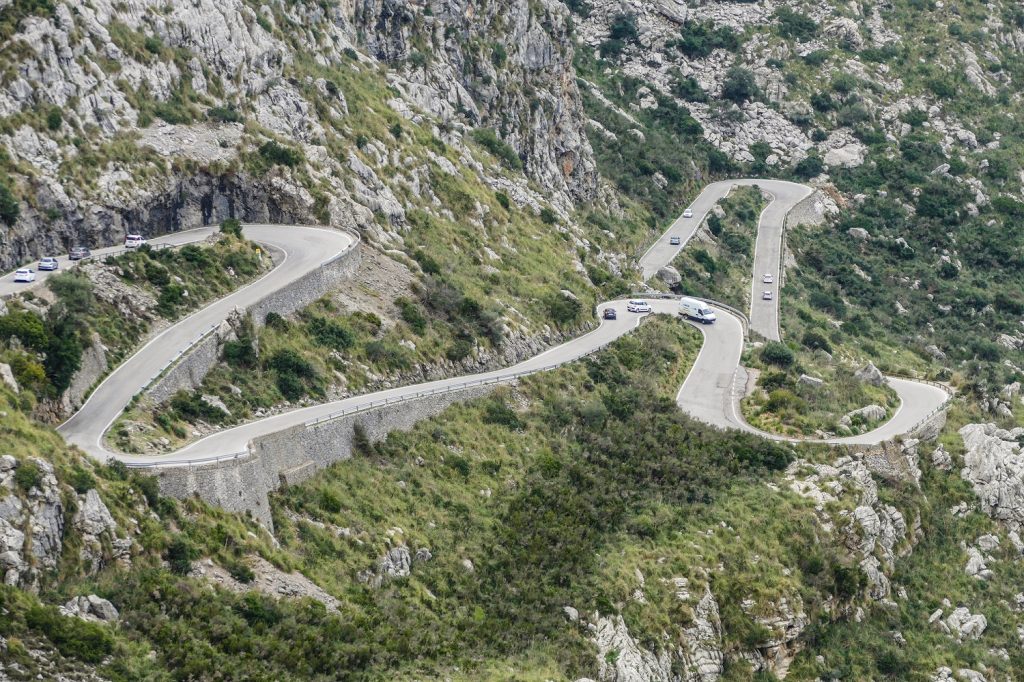
Total distance: approximately 55 kilometres from Palma to Port de Soller. Allow a full day with stops in Valldemossa, a cove walk at Deia and lunch at Ca’s Patro March.
The MA-10 in its entirety from Andratx to Pollenca is a further 90 kilometres and deserves two full days driven at a proper pace.
Drive 2: Cap de Formentor
Pollenca to the Lighthouse at the Island’s Northern Tip
Cap de Formentor (pronounced kap deh for-men-TOR, meaning the Cape of Formentor) is the northernmost point of Mallorca and the end of a 20-kilometre peninsula that juts into the Mediterranean with sheer cliffs on both sides.
The road to the lighthouse is consistently described as one of the most scenic stretches of tarmac in Spain and routinely appears on European greatest drives lists. The views from the lighthouse at the tip extend to Menorca on very clear days.
The access restriction is important to understand before planning this drive. From late May through to October, private vehicles are prohibited from driving beyond the Formentor beach area between 10am and 7pm.
A free shuttle bus operates from the car park at Port de Pollenca (pronounced port deh po-LEN-sa) throughout the restricted period, running approximately every 20 minutes to the lighthouse and back.
Outside these hours and outside the restricted season entirely, the road is open to hire cars with no restriction. The practical options are to arrive before 9am and drive it in the morning quiet, or to take the shuttle during the day.
Before or after the drive, Pollenca itself is worth a proper stop. The town sits at the foot of a hill crowned by a Calvary chapel reached by a famous 365-step staircase lined with cypress trees. The Sunday morning market in the main square is one of the best on the island.
For lunch in Pollenca, La Fonda de l’Aigua (pronounced la FON-da deh la EYE-gwa) on a side street off the main square serves traditional Mallorcan food from locally sourced ingredients, with lamb shoulder and seafood paella among the consistently praised dishes.
Frito Mallorquin (pronounced FREE-to ma-yor-KEEN, meaning Mallorcan fry), a traditional dish of offal and potatoes cooked together in a pan, is the authentic local order for anyone wanting to eat what the Mallorcans actually eat rather than the tourist menu.
Insider Tip: The Mirador Es Colomer (pronounced mee-ra-DOR ess ko-LO-mer), a viewpoint approximately halfway along the Formentor road, offers the most dramatic aerial view of the peninsula’s cliff faces and the bay below. It is accessible even during the vehicle restriction period as it sits before the restricted zone. Park at the layby directly below the viewpoint and walk up the steps. The view south across the bay to Alcudia is one of the finest on the island and the stop takes no more than 20 minutes.
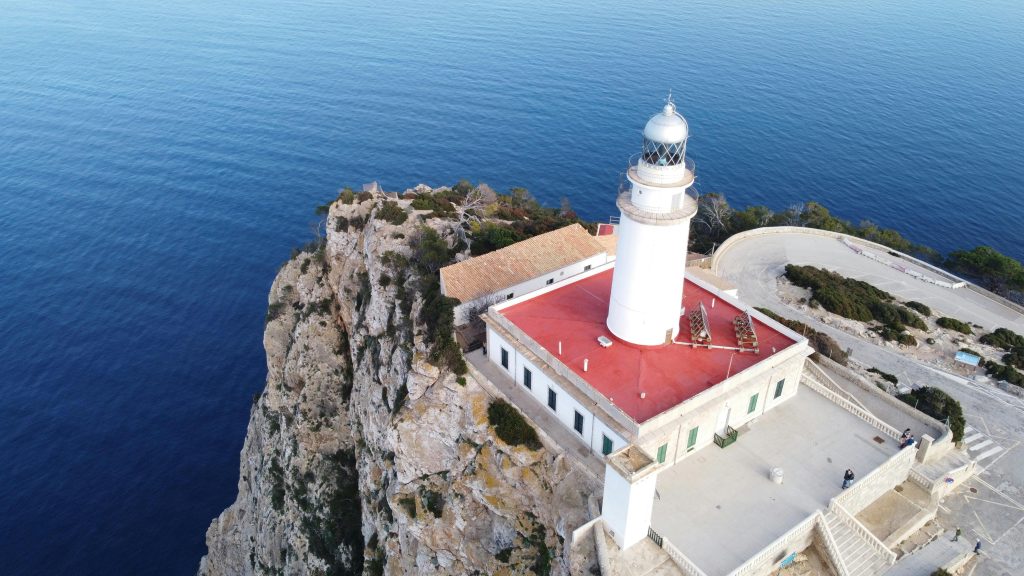
Total distance: approximately 30 kilometres from Pollenca to the lighthouse. Allow a half day for the drive and viewpoints, more if you include the Sunday market and lunch in Pollenca.
Drive 3: Sa Calobra
Port de Soller to the Hidden Beach on the Island’s Most Dramatic Road
The road to Sa Calobra (pronounced sa ka-LO-bra, meaning the she-viper, a reference to the road’s serpentine bends) is the most technically spectacular piece of driving on the island and one of the most famous roads in the Mediterranean.
The MA-2141 descends approximately 800 metres from the MA-10 junction to sea level in a series of tight hairpin bends with sheer drops to the sea below, culminating in a complete 270-degree loop that passes under itself. The road was built in the early 20th century and has been a pilgrimage for drivers and cyclists ever since.
Leave from Port de Soller, a 30-minute drive east along the MA-10 to the Sa Calobra junction. Eat breakfast or a full lunch in Port de Soller before departing as there are no restaurants at Sa Calobra worth recommending specifically – the few there are serve basic tourist food at elevated prices given the captive audience.
The drive itself is the destination. At the bottom, Sa Calobra has a small shingle beach and, more impressively, the Torrent de Pareis (pronounced to-RENT deh pa-RAYS, meaning the torrent of the twins), a dramatic limestone gorge that empties into the sea through a narrow crack in the cliff face.
A short walk through the Pareis tunnel brings you to the canyon proper, one of the most extraordinary natural features on the island.
A practical note: the road is narrow and popular with cyclists. Going down is straightforward. Coming back up is the same road in reverse, which requires care on the hairpin bends when meeting vehicles coming the other way.
Large motorhomes and campervans are prohibited and the restriction is enforced. A compact car makes the drive considerably less stressful than a large SUV.
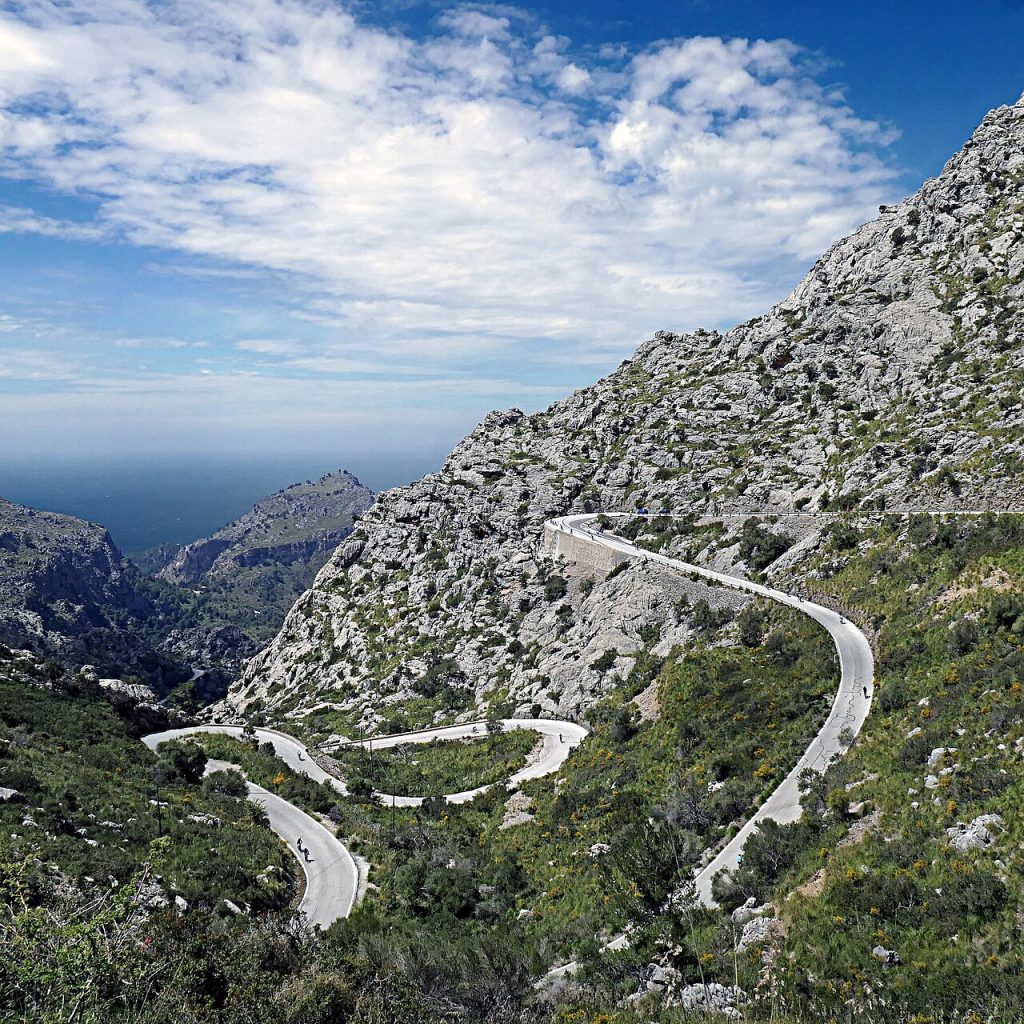
Insider Tip: Sa Calobra is best visited on a weekday morning outside of July and August when the car park at the bottom holds a manageable number of vehicles. At peak summer weekends, queues to enter the car park stretch back several kilometres along the descent road, trapping vehicles on the hairpins for extended periods. If you are visiting in July or August, aim to be at the car park by 8am. The Torrent de Pareis is also significantly more dramatic after rainfall when the stream runs through the canyon.
Total distance: approximately 30 kilometres from Port de Soller to Sa Calobra. Allow a half day including the Torrent de Pareis walk. Combine with Drive 1 for a full two-day Tramuntana itinerary based from Port de Soller or Soller.
Drive 4: The South Coast Beaches Drive
Palma to Calo des Moro via Santanyi and Mondrago Natural Park
Mallorca’s south and south-east coast is a different island from the mountainous north-west: flatter, warmer and home to some of the finest beaches in the Mediterranean.
The MA-19 motorway runs south from Palma along the east coast before the road narrows into a network of rural lanes connecting the coves, fishing villages and natural parks of the south. This drive covers the best of it.
Leave Palma south on the MA-19 to the junction for Santanyi (pronounced san-ta-NYEE), a handsome stone town with a weekly market on Saturdays and Wednesdays.
The Cafe Drac (pronounced ka-FEH DRAK, meaning the dragon cafe) in Cala Santanyi, a small cove a few kilometres south of the town, is a consistently rated spot for brunch and lunch with tables overlooking the beach.
From Santanyi head south through the rural lanes to the Mondrago Natural Park (pronounced mon-DRA-go), a protected coastal area of pine forest, wetlands and twin golden sand beaches that is one of the least developed stretches of the entire south coast. The car parks here fill quickly in summer but the park is large enough that the beaches themselves are never as crowded as the resort areas to the north.
Continue west along the coastal lanes to Calo des Moro (pronounced KA-lo des MO-ro, meaning the cove of the Moor), a tiny perfectly turquoise cove ranked consistently among the most beautiful beaches in Spain. Access is by a narrow track descending to a small car park and the beach is reached on foot from there.
The cove holds a very limited number of visitors comfortably. Arriving before 9am is the only reliable way to have it to yourself. Return to Palma via the MA-19 motorway for an efficient finish to the day.
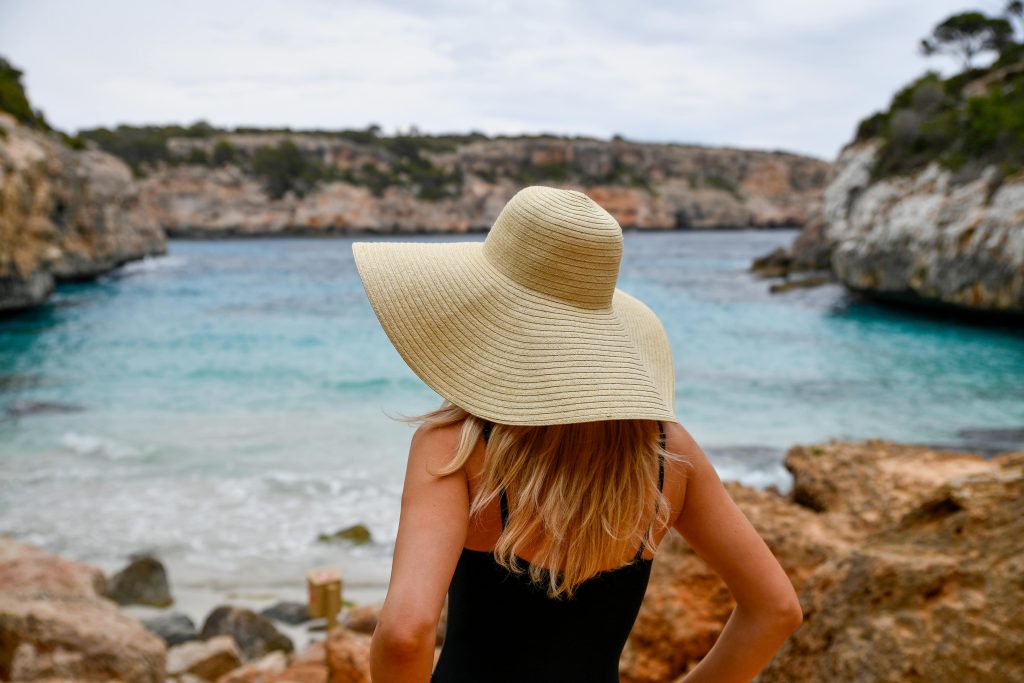
Total distance: approximately 70 kilometres from Palma to Calo des Moro and back. Allow a full day with the Santanyi market if timing allows, lunch at Cafe Drac, and time at Mondrago and Calo des Moro.
Drive 5: The East Coast Drive
Manacor to Capdepera via the Drach Caves and Cala Figuera
The east coast of Mallorca is the least visited by drivers staying in the western resorts, which makes it the most rewarding for those who seek it out. The coastline here is more ragged and less manicured than the south, with small fishing villages, medieval hill towns and the most impressive cave system in the Balearic Islands.
Begin in Manacor (pronounced ma-na-KOR), the island’s second city and the home of both the Mallorcan pearl industry and the tennis academy of Rafael Nadal.
The MA-15 east from Manacor leads to Porto Cristo (pronounced POR-to KREES-to), a small resort town on the east coast and the entrance to the Coves del Drach (pronounced KO-vehs del DRAK, meaning the Caves of the Dragon).
The Drach Caves are four interconnected underground chambers extending four kilometres, containing one of the largest underground lakes in the world, Lake Martel, where a classical music concert is performed on a boat during every guided tour.
Guided tours run throughout the day and last approximately 60 minutes. Book tickets online to avoid long queues in summer.
Continue north along the coast on the MA-4014 to Cala Figuera (pronounced KAH-la fee-GEH-ra, meaning the cove of the fig tree), a fishing village whose harbour is one of the most photogenic on the island: a narrow inlet lined with whitewashed boathouses and small fishing craft.
The waterfront restaurants here serve the catch of the day at tables overlooking the boats. Grilled fish, seafood rice and fresh prawns are the standard order.
Continue north through the walled medieval town of Capdepera (pronounced kap-deh-PEH-ra), whose castle crowns a hill above the town with views to Menorca on clear days, before returning south to Manacor and the motorway back to Palma.
Insider Tip: The Coves del Drach concert is performed at every tour but the timing of each performance varies slightly. The tour guide announces at the start of the tour that the concert will begin at a specific point in the cave. At that point the lights in the cave go out entirely and you hear the music before the boat appears on the lake carrying the musicians. The darkness is complete and the effect, however many times you have read about it in advance, is genuinely extraordinary. If you are visiting with children, the darkness and sudden music can be startling. Worth mentioning beforehand.
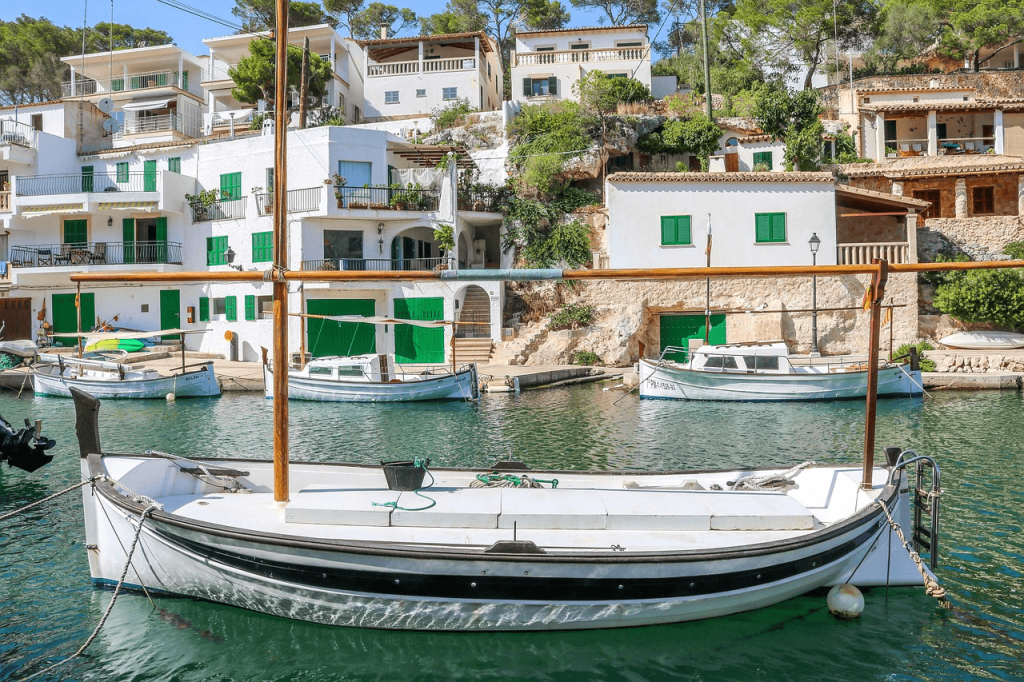
Total distance: approximately 60 kilometres from Manacor to Capdepera. Allow a full day with the Drach Caves tour, lunch at Cala Figuera and the castle at Capdepera.
Practical Notes for All Five Drives
Mallorca Airport (IATA code: PMI) is the busiest airport in Spain by passenger numbers in summer and the largest hire car operation in the country. Book three to four months in advance for July and August travel. Later bookings in peak season mean significantly higher prices and limited choice.
The Tramuntana mountain roads have specific requirements: a small or compact car handles the hairpin bends considerably more comfortably than a large vehicle, and the Sa Calobra road prohibits large motorhomes and campervans entirely. When booking, consider specifying a compact or small car rather than automatically upgrading.
Petrol stations are plentiful throughout the island and along all five routes. Palma city parking can be challenging and expensive. For Drives 1, 2 and 3 in the north-west, basing yourself in Soller or Port de Soller eliminates the daily drive from Palma and puts you in the ideal starting position for all three mountain routes.
For a full comparison of pickup locations and deals across the island, visit our car hire in Mallorca page.
Frequently Asked Questions
What is the best food to try in Mallorca?
The ensaimada (pronounced en-sai-MAH-da), a spiral pastry made with pork fat and dusted with icing sugar, is the essential Mallorcan breakfast available at any bakery on the island. Sobrasada (pronounced so-bra-SAH-da), the soft paprika-cured pork sausage spread, is the signature charcuterie.
Soller prawns (gambas de Soller, pronounced GAM-bas deh SO-ller) are a local speciality considered the finest prawns in the Balearics. Hierbas Mallorquinas (pronounced ee-EHR-bas ma-yor-KEE-nas), the local anise and herb liqueur, is the traditional after-dinner digestif brought complimentary with the bill at most traditional restaurants.
Is the MA-10 road difficult to drive?
The MA-10 through the Tramuntana mountains is narrow and winding with tight hairpin bends and significant drops on the coastal side. It is not technically difficult but it demands full attention and a comfortable pace. A small or compact car is considerably easier to manage than a large vehicle.
The road is in excellent condition throughout. First-time drivers on mountain roads should allow more time than they think necessary and resist any pressure to keep up with local drivers who know the bends.
When is the best time to hire a car in Mallorca?
May, June and September offer the best combination of good weather, manageable road traffic and competitive hire car pricing. July and August are the most expensive months with the heaviest traffic on the mountain roads and the most pressure on cala car parks.
April and October are excellent for drivers willing to accept slightly cooler weather in exchange for roads that are essentially to themselves.
Can you drive to Cap de Formentor with a hire car?
Yes, outside the restricted period. From late May to October, private vehicles including hire cars are prohibited from the Formentor road beyond the beach area between 10am and 7pm. Outside these hours the road is fully open.
A free shuttle bus runs during the restricted period from the Port de Pollenca car park. Arriving before 9am and driving the road in the morning quiet is strongly recommended.
Do you need a hire car in Mallorca?
For Palma city and the immediate resort areas, the bus network is adequate.
For the Tramuntana mountain villages, the Drach Caves, the south coast coves, Cap de Formentor, Sa Calobra, Cala Figuera and all five drives described above, a hire car is the only practical means of getting there on your own schedule and at your own pace.
The island is large enough that the bus network cannot substitute for it.
Plan Your Mallorca Road Trip
The five drives above cover Mallorca in full: the UNESCO mountain spine, the northern lighthouse peninsula, the most dramatic descent road in the Mediterranean, the finest beaches on the south coast and the historic east coast villages. None of them overlap.
Each rewards a full day driven at a pace that allows for stops, detours and the kind of meals that justify the whole trip.
Each rewards a full day driven at a pace that allows for stops, detours and the kind of meals that justify the whole trip.
Ready to book? Compare deals and find the best car hire in Mallorca with transparent pricing and no hidden fees.
For dramatic volcanic landscapes and mountain roads, our Tenerife scenic drives guide is essential reading.
About the Author
Darryl Antonio is CEO of Digitalhound, a London-based digital marketing agency with over two decades of experience in SEO and content strategy. Darryl oversees digital strategy across all sectors the agency represents and manages content production and digital strategy for Getcarhire.com.