
Few places in England feel as instantly, almost impossibly, picturesque as the Cotswolds, and the Cotswolds scenic drives that thread between its honey-stone villages are among the most rewarding in the country. Honey-gold stone cottages with steep gabled roofs, market towns that have barely changed in three centuries, and lanes that wind between dry-stone walls into a landscape of rolling green hills the locals call wolds. Stretching across nearly 800 square miles of Gloucestershire, Oxfordshire, Worcestershire and Warwickshire, this is England at its most quietly beautiful, and a hire car is the key to unlocking the finest Cotswolds scenic drives.
Public transport here is sparse and slow, and the real magic lies down the side roads, in villages too small for a railway station and viewpoints reached only on a quiet B road. This guide to the best Cotswolds scenic drives maps out a classic touring loop through the most beautiful villages of the northern Cotswolds, with the best places to stop, eat and explore along the way, plus everything you need to know about driving the region with a hire car. Whether you have a single day or a long weekend, this is how to enjoy the Cotswolds scenic drives at their finest.
Cotswolds Scenic Drives at a Glance
| Route | Classic northern Cotswolds villages loop |
| Distance | About 60 miles round trip |
| Driving time | Around 2.5 to 3 hours of driving; allow a full day with stops |
| Main stops | Broadway, Chipping Campden, Stow-on-the-Wold, Bourton-on-the-Water, the Slaughters, Bibury |
| Best for | Honey-stone villages, country pubs, gentle scenic driving |
| Gateways | Birmingham, Bristol and Heathrow, all around an hour away |
In this guide
Why the Cotswolds Are Made for Driving
The Cotswolds were shaped by wool. In the Middle Ages, the fleeces of the local Cotswold Lion sheep made this one of the richest corners of England, and the wealth it generated built the grand churches, the elegant market halls and the sturdy honey-stone houses that still define the region today. When the wool trade declined, the area was left frozen in time, its villages spared the industrial development that transformed so much of England. That is why a drive here feels like stepping into a living painting.
The classic Cotswolds driving route is also built on a human scale. Nothing is very far from anything else, the villages are strung close together across the gentle hills, and on a Cotswolds road trip the joy is in the journey between them as much as the destinations themselves. One moment you are climbing a wooded escarpment with views stretching for miles, the next you are dropping into a hidden valley where a stream runs beside the road and a church spire rises above the trees. No two villages are quite alike, and a car lets you find the ones that speak to you.
Cotswolds History: Why the Region Looks the Way It Does
To drive through the Cotswolds is to drive through 2,000 years of Cotswolds history, and understanding that Cotswolds history makes every village richer. The landscape you see today, so seemingly timeless, is the product of geology, medieval wealth, civil war and a Victorian love affair that turned a forgotten backwater into the national idea of the perfect English countryside.
Roman Roads and the Fosse Way
The Romans arrived in Britain in AD 43 and left a deep mark on the Cotswolds. Around AD 47 they built the Fosse Way, the great military road running from Exeter to Lincoln, almost arrow-straight across the hills. You will drive part of it today: the A429 between Cirencester and Stow-on-the-Wold follows its course exactly. Near the route lies Chedworth Roman Villa, built in the 2nd century AD and one of the finest in Britain, where you can still see mosaic floors, a bath house and underfloor heating almost 1,800 years old.
Wool, Stone and Medieval Wealth
The Cotswolds owe their famous golden glow to geology. The hills sit on Jurassic oolitic limestone, a creamy, honey-toned stone that was quarried locally and weathers beautifully with age, which is why the villages share such a unified palette. In the Middle Ages this became one of the richest regions in England, thanks to wool. The hardy local sheep, known as the Cotswold Lion, produced fleeces prized across Europe, and the merchants who grew wealthy from the trade poured their fortunes into building. The great “wool churches” of Chipping Campden, Northleach and Cirencester, far grander than such small towns could otherwise afford, stand as monuments to that prosperity, alongside the sturdy stone cottages and market halls that define the region.
The Last Battle of the Civil War
The Cotswolds saw real drama during the English Civil War. On 21 March 1646, the last battle of the First Civil War was fought just north of Stow-on-the-Wold. The Royalist commander Sir Jacob Astley, leading the King’s final field army of around 3,000 men, was intercepted and defeated by Parliamentarian forces.
Some 200 Royalists were killed and around 1,700 taken prisoner, many held overnight in St Edward’s Church in the town. Tradition holds that the captured Astley, sat on a drum in the market square, told his captors: “You have done your work, boys, and may go play.” Within weeks King Charles I surrendered. Nearby Sudeley Castle, near Winchcombe, still bears the scars of the war and is well worth a visit.
William Morris and the Birth of an Ideal
When the wool trade declined, the Cotswolds slipped into a quiet poverty, and the villages were left largely untouched by the industrial age. That neglect is precisely why they survived so perfectly preserved.
In the late 19th century, artists and craftsmen began to see their beauty. From 1871, the designer William Morris, father of the Arts and Crafts movement, rented Kelmscott Manor on the edge of the Cotswolds, calling it “Heaven on Earth,” and famously declared Bibury “the most beautiful village in England.” In 1902, his follower C.R. Ashbee moved his Guild of Handicraft from London’s East End to Chipping Campden, bringing some 200 craftspeople; the Hart family of silversmiths, descendants of those original incomers, still work in the same town today.
Broadway, meanwhile, became an artists’ colony in the 1880s, drawing the painter John Singer Sargent, the composer Edward Elgar and the Peter Pan author J.M. Barrie, who were enchanted by its golden High Street. This Victorian rediscovery transformed the Cotswolds from a forgotten corner into a symbol of idyllic English life, an image that endures today. The region was formally designated an Area of Outstanding Natural Beauty in 1966, protecting the landscape that history had so carefully shaped.
Getting to the Cotswolds: Your Gateway
One of the great advantages of the Cotswolds is how easy they are to reach. Sitting in the heart of England, the region is roughly an hour from three major airports, each a natural place to pick up a hire car and begin your tour. Which one you choose simply depends on where you are flying into.
From the North and the Midlands, car hire at Birmingham Airport puts you around an hour from the northern villages, joining the A44 down through Chipping Campden and Broadway. From the West Country and South Wales, car hire in Bristol is about an hour from the southern Cotswolds via the M5 and A46, ideal if you want to combine the region with Bath. And for international visitors, car hire at Heathrow is around 90 minutes away to the southeast, an easy run up the M40. Wherever you land, the open road and the villages are waiting.
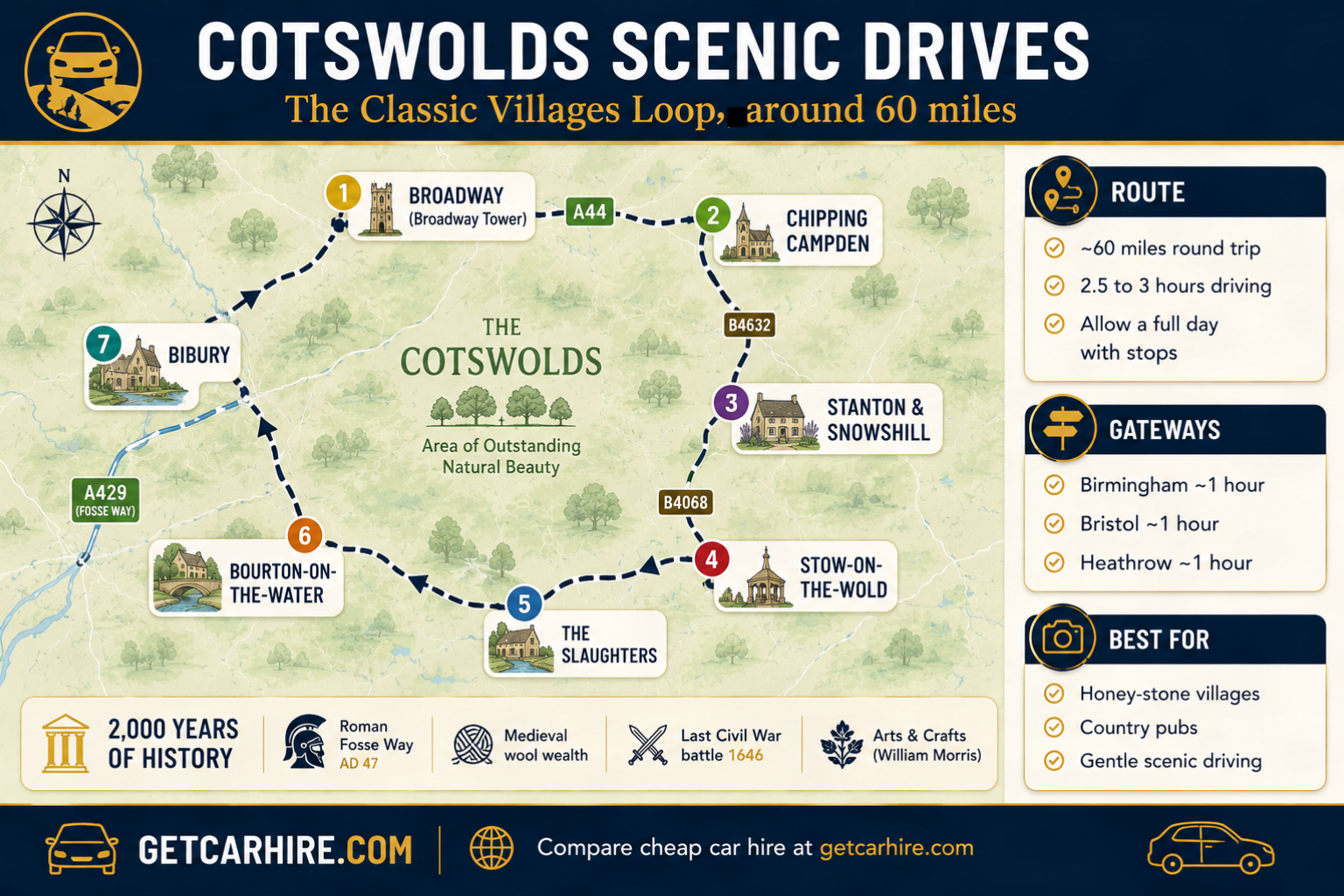
The Classic Cotswolds Scenic Drives Loop
This circular route is the finest of the Cotswolds scenic drives, around 60 miles linking the most beautiful villages of the northern Cotswolds, and it can be driven in either direction. These Cotswolds scenic drives begin in Broadway and travel clockwise, but the beauty of a loop is that you can join it wherever your gateway brings you. The driving on these Cotswolds scenic drives is gentle and the distances short, so the real pleasure is in stopping often, for a coffee, a riverside walk, or simply to admire another perfect honey-stone view.
1. Broadway and Broadway Tower
Known as the jewel of the Cotswolds, Broadway is the ideal place to begin the Cotswolds scenic drives. Its broad, gracious main street is lined with golden-stone cottages, galleries and tearooms, sloping gently up towards the green hills beyond. Above the village stands Broadway Tower, a folly built in 1798 on the second-highest point in the Cotswolds, where on a clear day you can see across 16 counties. The climb up Fish Hill on the A44 to reach it is one of the most rewarding short drives in the region.
Pit-stop: The Lygon Arms on Broadway high street is a handsome historic coaching inn, perfect for morning coffee or a proper lunch before you set off. From Broadway, follow the B4632 and minor roads North towards Chipping Campden, a drive of around 15 minutes through classic rolling countryside.
2. Chipping Campden
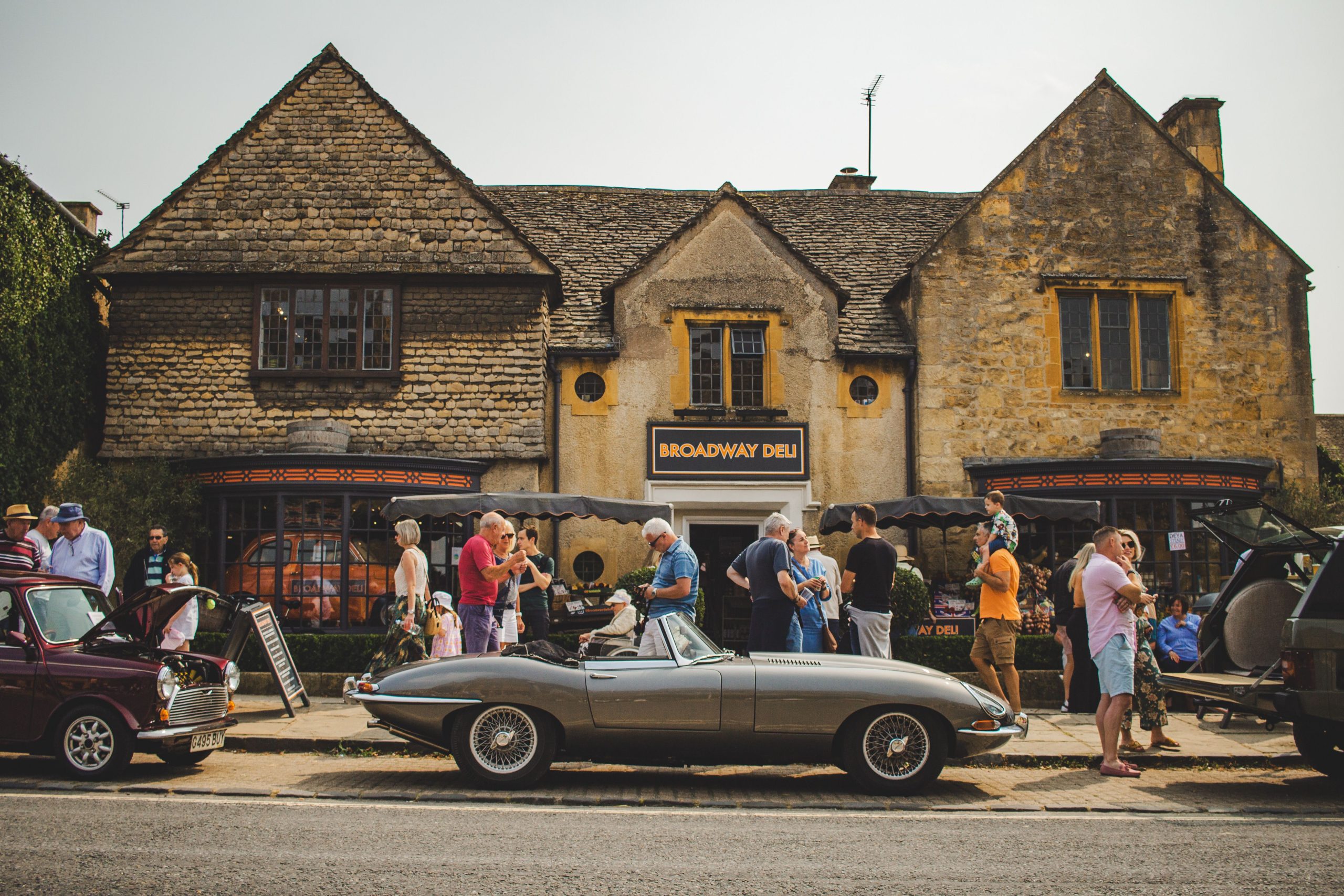
Chipping Campden is, for many, the most beautiful town in the Cotswolds, a near-perfect High Street curving gently between honey-coloured buildings that grew rich on the medieval wool trade. The 17th-century Market Hall still stands at its heart, and the town became a cradle of the Arts and Crafts movement after C.R. Ashbee brought his Guild of Handicraft here in 1902, a story told at the Court Barn Museum. Remarkably, the Hart family of silversmiths, descended from those original craftsmen, still work in the town to this day. It is a place made for wandering, with independent shops, galleries and almshouses at every turn.
Pit-stop: The Eight Bells Inn is a wonderful 14th-century pub, originally built to house the stonemasons who constructed the parish church. Settle in by the fire for doorstop sandwiches, fish and chips or one of its renowned Sunday lunches. Alternatively, the Lygon Arms here serves a classic Steak, Ale and Stilton Pie. From Chipping Campden, head South on the A429 and B roads towards Stow-on-the-Wold, around 25 minutes away, perhaps detouring through the tiny villages of Snowshill and Stanton on the way.
3. A Detour to Stanton and Snowshill
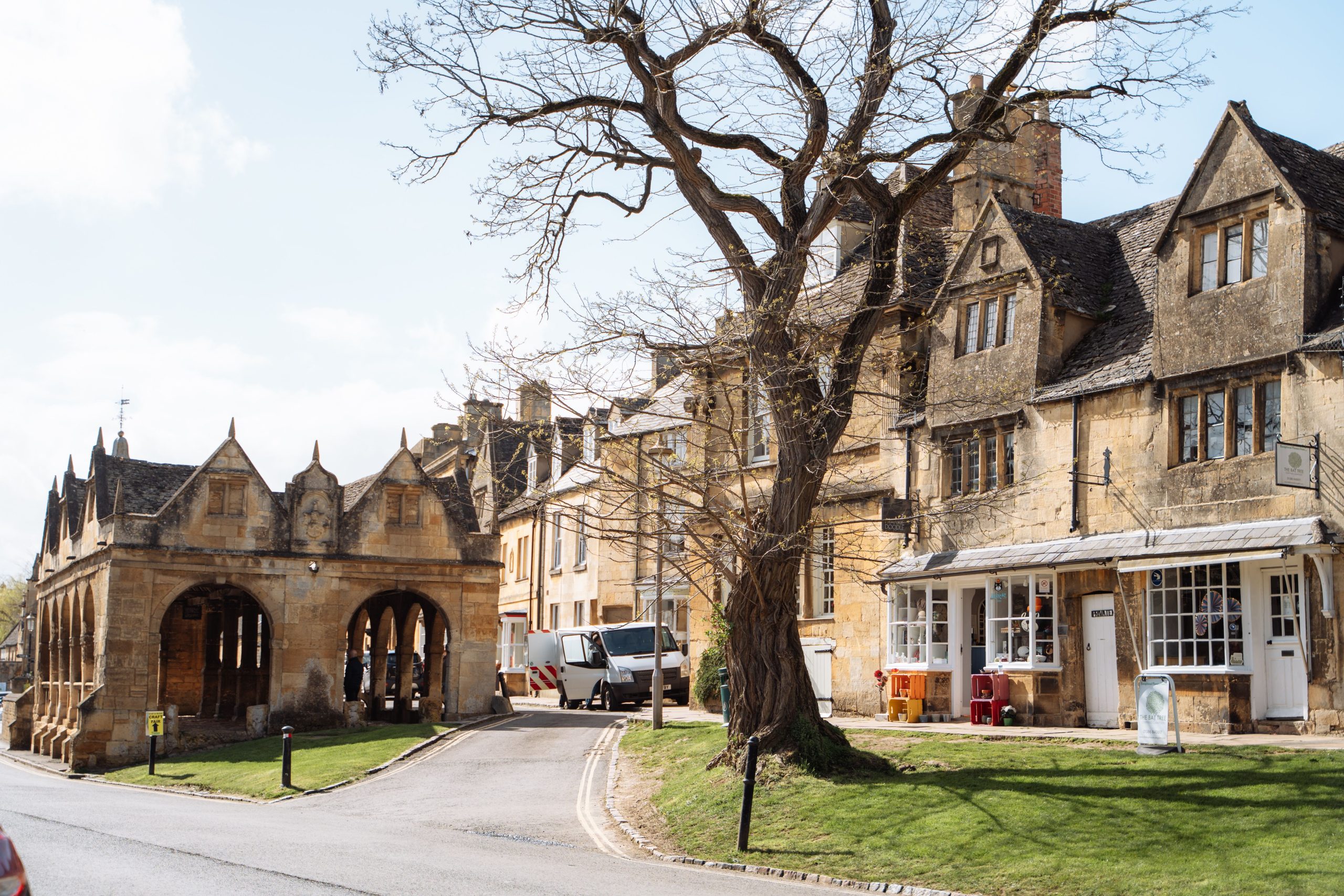
If you have time, two of the Cotswolds best-kept secrets lie just off the main route. Stanton is a single, sloping street of immaculate 17th-century cottages, almost untouched by the modern world and gloriously free of crowds. Nearby Snowshill is famous for its eccentric manor house, a National Trust property crammed with one man’s lifetime of curiosities, and for the lavender fields that turn the hillsides purple in high summer. Both are short, pretty drives along narrow lanes, so take them slowly.
4. Stow-on-the-Wold
The highest of the Cotswold market towns at some 800 feet and a highlight of any Cotswolds scenic drives itinerary, Stow-on-the-Wold gathers around a handsome market square that has hosted fairs since the Middle Ages. Today it is the antiques capital of the Cotswolds, its square and side streets full of dealers, galleries and inviting cafes.
Do not miss the north door of St Edward’s Church, framed by two ancient yew trees, an image so atmospheric it is said to have inspired the doors of Moria in Tolkien’s imagination. The same church held hundreds of Royalist prisoners after the Battle of Stow in 1646, the last battle of the First Civil War, fought just north of the town; a plaque in the market square marks the spot where the defeated commander Sir Jacob Astley was captured.
Pit-stop: The Porch House claims to be the oldest inn in England, with origins said to reach back to 947 AD. Beneath its ancient beams you can enjoy a hearty fish pie, a steak or a homemade pudding. From Stow, it is a short and lovely drive of around 10 minutes South West on the B4068 towards Bourton-on-the-Water and the Slaughters.
5. The Slaughters: Upper and Lower
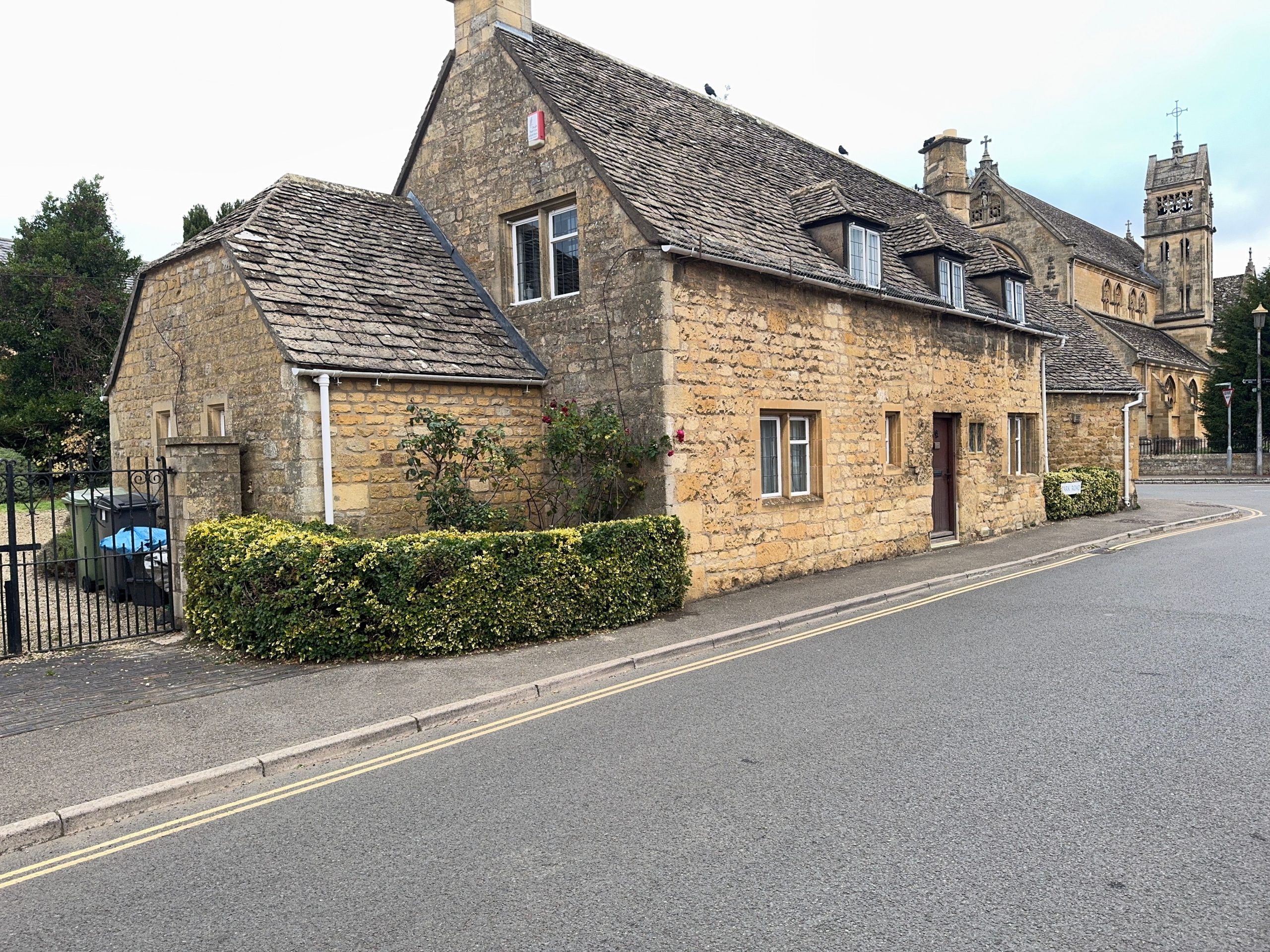
Despite the forbidding name, which comes from an old English word for a muddy place, Upper and Lower Slaughter are among the most serene villages in all England. Linked by a footpath along the gentle River Eye, they have no shops, no pubs and barely a sign of the 21st century, just honey-stone cottages, a historic water mill and clear water running beside the lane. Park considerately and walk between the two; it is one of the loveliest short strolls in the Cotswolds.
6. Bourton-on-the-Water
Nicknamed the Venice of the Cotswolds, Bourton-on-the-Water is the busiest and most famous village on the Cotswolds scenic drives, and with good reason. The shallow River Windrush runs right through its centre, crossed by a series of low, elegant stone footbridges and flanked by wide green lawns. It is a delightful place to while away an hour, with traditional attractions including the Model Village, a one-ninth scale replica of Bourton itself, and the Dragonfly Maze.
Pit-stop: The Mousetrap Inn is a cosy, welcoming spot just off the main throng, ideal for fish and chips or a hearty Sunday roast away from the crowds. Bourton can be busy, so arrive early or late in the day to see it at its best. From here, the final leg heads South on the A429, the old Roman Fosse Way, towards Bibury, around 25 minutes away.
7. Bibury
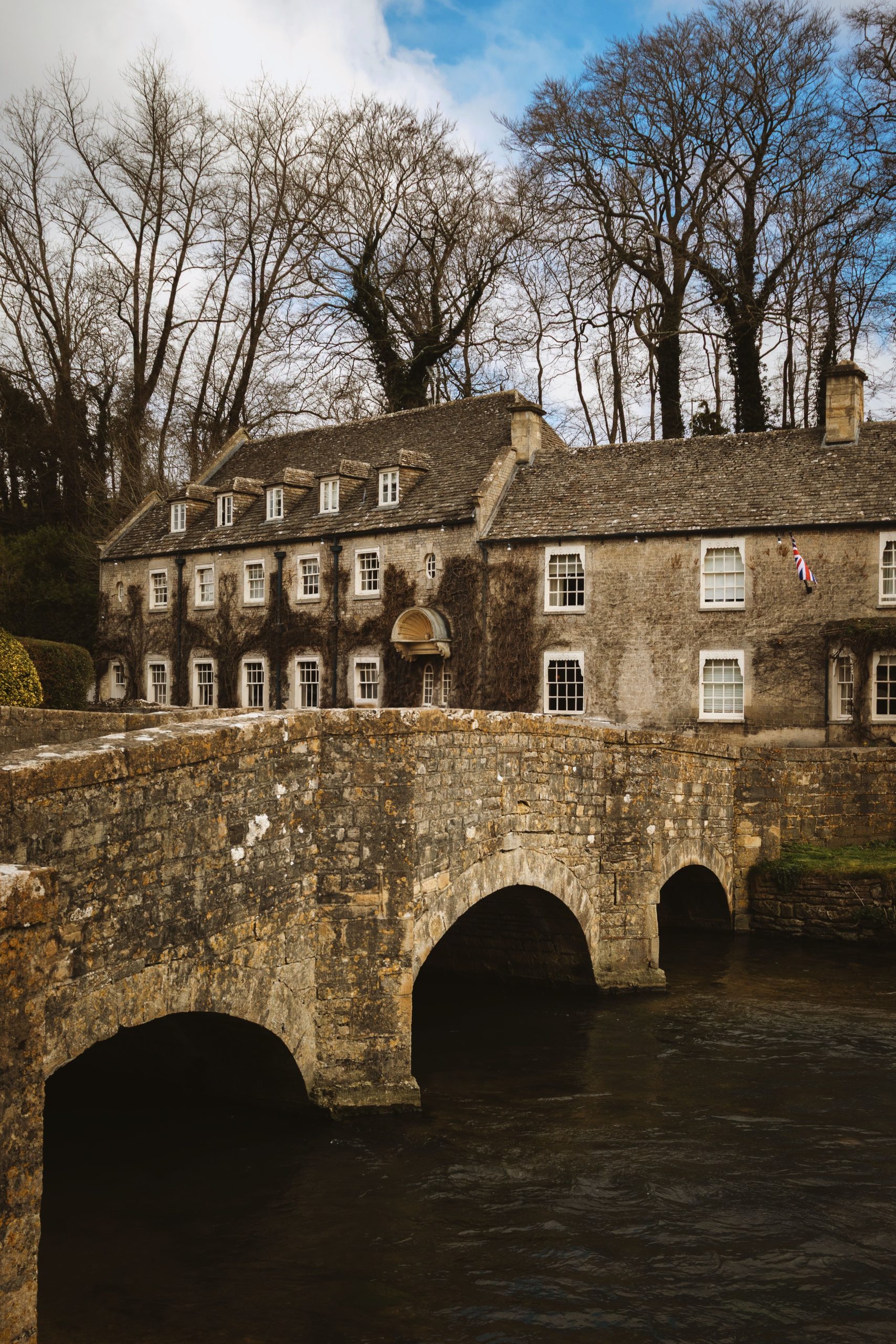
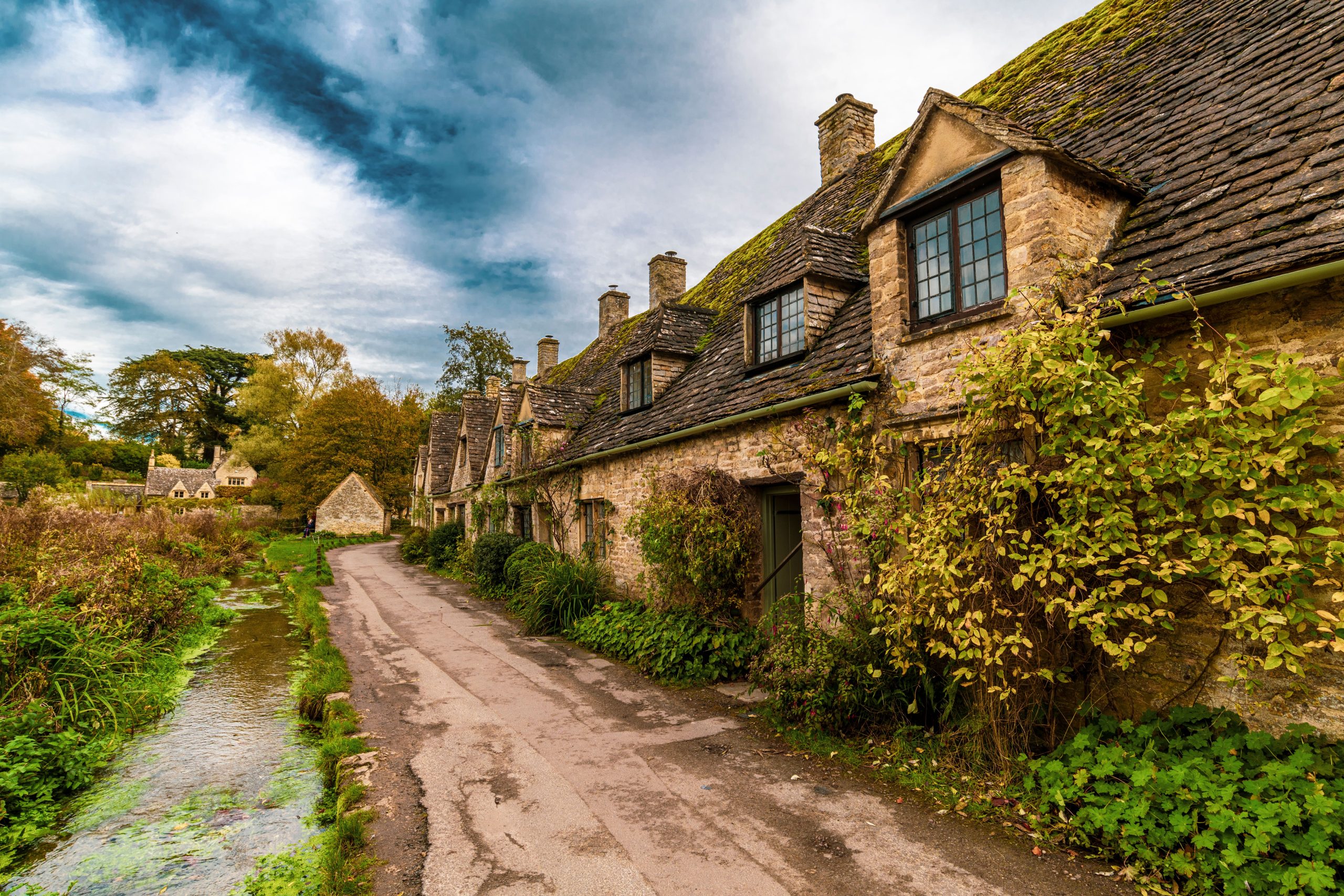
William Morris, father of the Arts and Crafts movement, called Bibury the most beautiful village in England in the 1870s, and few who see Arlington Row would argue. This honey-stone terrace of 14th-century weavers’ cottages, reflected in the River Coln, is one of the most photographed scenes in the country, so arrive before 10am to enjoy it without the crowds. Bibury is also home to a historic trout farm, and smoked Bibury trout is a genuine local delicacy worth seeking out.
Pit-stop: The Swan Hotel sits right beside the river, a grand former coaching inn serving everything from afternoon tea to full dinners, with that famous smoked trout often on the menu. From Bibury, you can loop back North towards Stow and Broadway to complete the circle, or continue South to Cirencester and the gentler southern Cotswolds.
The Best Roads for Scenic Driving
While the whole region is a pleasure to drive, a few of the Cotswolds scenic drives stand out for their scenery and deserve to be sought out. The B4632 between Broadway and Stratford-upon-Avon skirts the Cotswold escarpment with sweeping views, climbing Cleeve Hill, the highest point in the Cotswolds at over 1,000 feet. The B4068 linking Bourton-on-the-Water and Stow-on-the-Wold winds gently through the Slaughters and is one of the prettiest short drives in the area.
For a sense of history beneath your wheels, the A429 follows the line of the Fosse Way, the dead-straight Roman road that has carried travellers across the Cotswolds for nearly 2,000 years, linking Cirencester with Moreton-in-Marsh. And the A44 from Chipping Campden up over Fish Hill rewards the climb with one of the finest panoramas in the region, the perfect approach to Broadway Tower. Drive these roads slowly, with the windows down, and you will understand why the Cotswolds are considered one of England’s great touring landscapes.
Gardens, Castles and Houses Along the Way
The Cotswolds are famous for their gardens and historic houses, and several sit right on or near the Cotswolds scenic drives, making perfect additions to a driving tour. Near Chipping Campden, Hidcote is one of England’s greatest Arts and Crafts gardens, a series of outdoor rooms each with its own character, while neighbouring Kiftsgate Court Gardens is a family-created masterpiece known for its roses. Both are a short, scenic drive from the village.
To the West, near Winchcombe, Sudeley Castle has royal Tudor connections and award-winning gardens, the only private castle in England to have a queen, Katherine Parr, buried within its grounds. History lovers can detour to Chedworth Roman Villa, one of the finest in Britain, where 2nd-century mosaics and a bath house survive beneath cover. Garden lovers heading towards Moreton-in-Marsh should not miss Batsford Arboretum, 60 acres of rare trees that blaze with colour in autumn. These attractions are easy to fold into the loop, turning a half-day drive into a full and varied day out.
For families, the route is dotted with gentle attractions: the Model Village and Dragonfly Maze at Bourton-on-the-Water, the Cotswold Farm Park near Guiting Power, and the Birdland wildlife park, all reachable in minutes by car. This mix of grand gardens, ancient houses and family fun is exactly what makes the Cotswolds such a rewarding region to explore by road.
- Route difficulty ratings
- Safety tips
- Best-for recommendations
- Birmingham, Bristol and Heathrow gateway access guide
Extending Your Trip: The Southern Cotswolds
If you have a second day, extending your Cotswolds road trip into the southern Cotswolds offers a quieter, gentler counterpoint to the famous northern villages. From Bibury, the historic market town of Cirencester, capital of the Roman Cotswolds, is just 20 minutes away, with its magnificent parish church and the Corinium Museum. Beyond it lie elegant Tetbury, known for antiques, the tiny picture-perfect village of Castle Combe, and Painswick, the Queen of the Cotswolds, with its churchyard of clipped yew trees. The southern stone takes on a lighter, more silvery tone, and the valleys grow deeper and steeper.
Tips for Driving in the Cotswolds
Driving the Cotswolds scenic drives is a joy, but a few practical points will make your trip smoother. The roads between villages are mostly narrow B roads and country lanes, often single-track with passing places, bordered by dry-stone walls with little room for error. Take your time, use the passing places courteously, and be ready to reverse to let oncoming traffic through.
Parking is the single biggest challenge, especially in honeypot villages like Bibury and Bourton-on-the-Water. Many villages have small pay-and-display car parks, which fill quickly in peak season, so arriving before 10am or after 4pm makes a real difference. Never block lanes or private driveways. Many of the smaller villages, including the Slaughters, are best explored on foot once you have parked.
A small or medium car is ideal for the narrow lanes and tight village parking. The terrain is gently hilly rather than mountainous, though the escarpment around Broadway and Cleeve Hill has some steeper climbs, so an automatic can make for a more relaxed drive. Fuel stations are found in the larger towns such as Stow-on-the-Wold, Moreton-in-Marsh and Cirencester, but are scarce in between, so keep the tank topped up.
The best times to visit are late spring, when the gardens bloom and the rapeseed fields turn gold, and autumn, when the woodlands blaze and the crowds thin. Summer brings the longest days but the busiest villages, while winter has a quiet, frosty charm of its own. Whenever you come, a hire car gives you the freedom to enjoy the Cotswolds scenic drives at your own pace, chasing the light and lingering wherever the view demands it.
Cotswolds Driving Route: Frequently Asked Questions
How many days do you need to drive the Cotswolds?
You can drive the classic Cotswolds driving route in a single day, allowing time for stops, as it is only around 60 miles. To explore properly on a longer Cotswolds road trip, including the southern Cotswolds around Cirencester and Tetbury, two to three days is ideal, staying overnight in Stow-on-the-Wold, Broadway or Chipping Campden.
What is the best route through the Cotswolds?
The classic Cotswolds driving route loops through the northern villages: Broadway, Chipping Campden, Stow-on-the-Wold, Bourton-on-the-Water, the Slaughters and Bibury. This circuit of around 60 miles links the most beautiful honey-stone villages and can be driven in either direction over one full day.
Do you need a car to visit the Cotswolds?
A car is by far the best way to see the Cotswolds. Public transport between villages is sparse and slow, and the most beautiful spots, including the Slaughters and many viewpoints, are difficult to reach otherwise. A hire car lets you explore at your own pace and reach the quieter corners.
Which is the prettiest Cotswolds village?
Bibury, with its famous Arlington Row of 14th-century weavers’ cottages, is often called the prettiest village in England. Other strong contenders include Bourton-on-the-Water, Chipping Campden and the secluded Slaughters. The beauty of a driving tour is that you can judge for yourself.
When is the best time to drive the Cotswolds?
Late spring and autumn are the best times, with beautiful colours and fewer crowds than summer. For the best Cotswolds scenic drives, visiting villages early in the morning or later in the afternoon helps you avoid the busiest periods and find parking more easily, especially in Bibury and Bourton-on-the-Water.
How far are the Cotswolds from Birmingham, Bristol or Heathrow?
All three are around an hour to 90 minutes away. Birmingham Airport is about an hour from the northern villages, Bristol around an hour from the southern Cotswolds, and Heathrow roughly 90 minutes up the M40. Each is an ideal place to pick up a hire car.
Plan Your Cotswolds Scenic Drives Road Trip
The Cotswolds scenic drives reward those who take their time, and a hire car is the only way to truly explore them, from the famous villages to the hidden hamlets down the lanes between. Pick up your car at Birmingham, Bristol or Heathrow, all around an hour away, and set off into one of the most beautiful corners of England. Compare cheap car hire deals with getcarhire.com and start planning your Cotswolds scenic drives through the honey-stone villages of the region.
Exploring more of England by road? Take a look at our Peak District scenic drives guide.