
Table of Contents
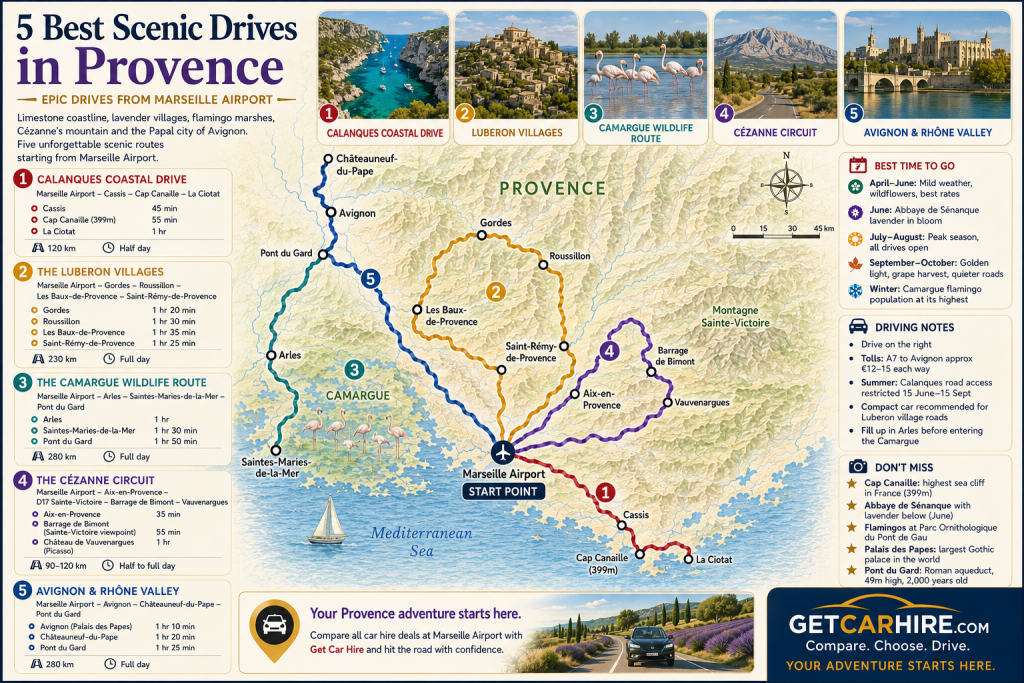
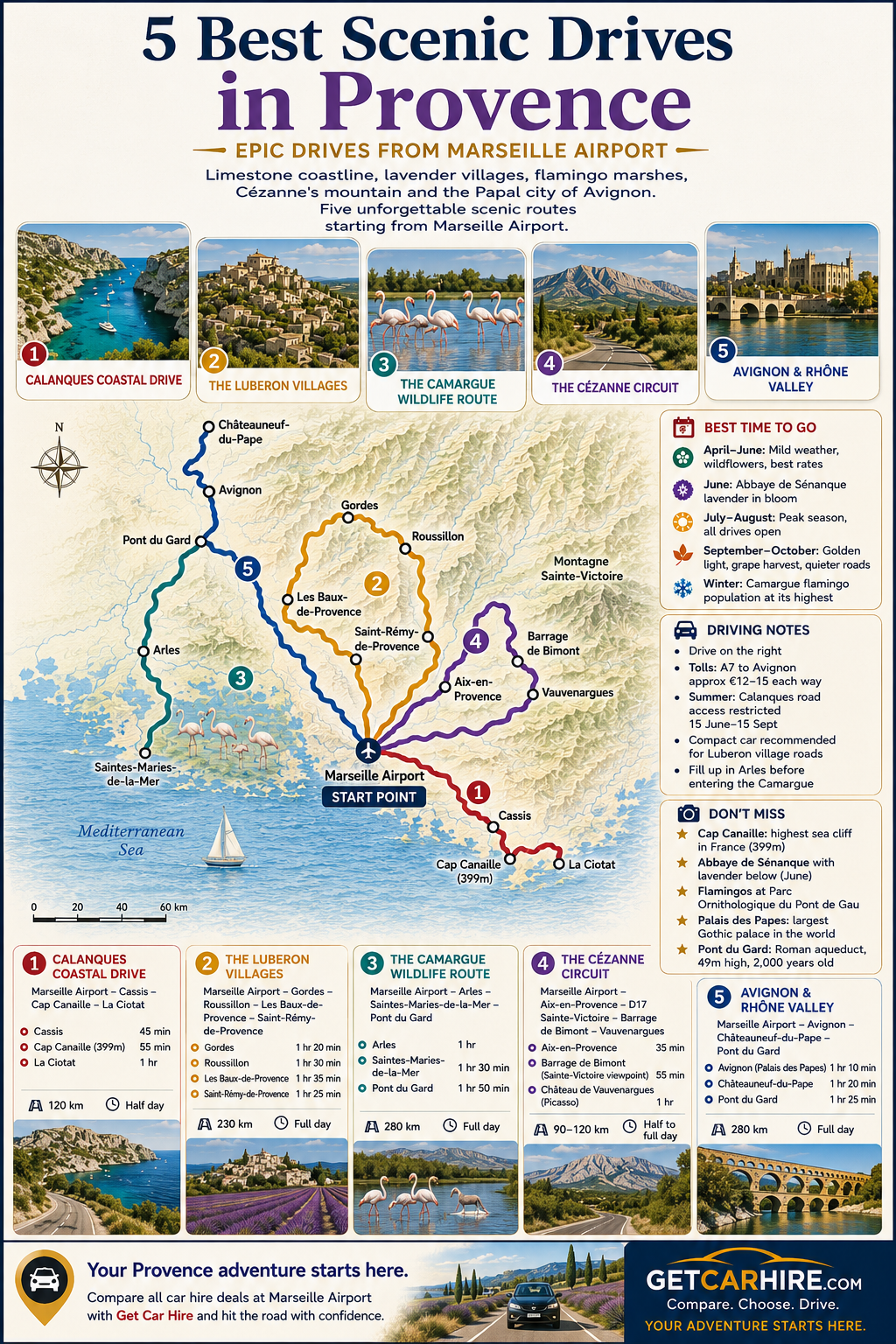
The 5 best scenic drives in Provence from Marseille Airport begin the moment you leave the terminal and head in any direction. North to Avignon and the Palais des Papes. East to the Luberon’s limestone villages, ochre quarries and lavender fields.
West to the Camargue delta where flamingos feed in the shallows and white horses run the marshes. South along the coast to the Calanques, where limestone fjords drop directly to water so turquoise it barely looks real.
And nearby, almost overlooked, Cézanne’s Provence: the pale ridge of the Montagne Sainte-Victoire rising above Aix-en-Provence exactly as it appears in 80 paintings made between 1882 and 1906.
Marseille Airport is 27 kilometres northwest of the city. It is one of the best-positioned airports in France for road trip purposes: within two hours of Avignon, the Luberon, the Camargue, the Calanques and the Pont du Gard. The landscape changes every 30 kilometres and none of these circuits requires the motorway to deliver something extraordinary.
Compare all operators and secure your hire car at Marseille Airport through Get Car Hire before you travel. Booking in advance is consistently 40% to 60% cheaper than walk-up desk pricing, particularly in July and August.
Drive 1: The Calanques Coastal Drive – Marseille to Cap Canaille and Cassis
| Departure Point | Destination | Distance | Drive Time |
|---|---|---|---|
| Marseille Airport (MRS) | Marseille city centre (Vieux-Port) | 27 km | 30 min |
| Marseille Airport (MRS) | Cassis (port and harbour) | 45 km | 45 min |
| Marseille Airport (MRS) | Cap Canaille (Route des Crêtes, 399m) | 52 km | 55 min |
| Marseille Airport (MRS) | La Ciotat (Eden Cinema, old port) | 58 km | 1 hr |
| Full circuit | Marseille Airport return via A50 | ~120 km | half day |
Summer restriction: access roads to Sormiou, Morgiou and Sugiton calanques closed to private vehicles approximately 15 June to 15 September, 8am to 8pm. Access by shuttle bus from Luminy campus or on foot. Route des Cretes and Cassis always accessible by car. Boat trips from Cassis harbour available year-round.
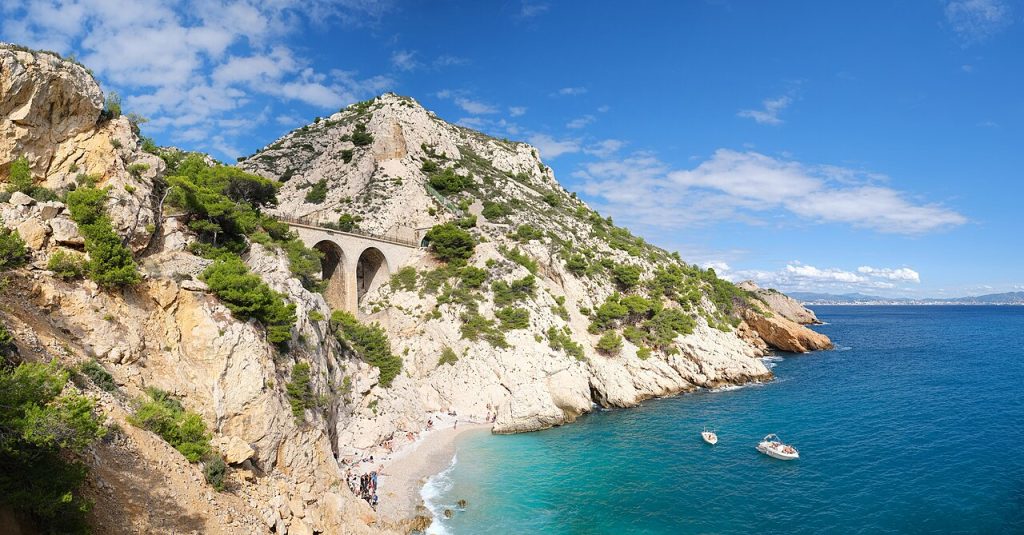
Of the 5 best scenic drives in Provence from Marseille Airport, the Calanques Coastal Drive delivers the most extraordinary coastal landscape in France.
The national park, established in 2012 and covering 520 square kilometres of land and sea between Marseille and Cassis, is the starting point.
The Calanques are narrow limestone fjords carved by freshwater erosion before the Mediterranean filled after the last ice age, dropping directly to water of an improbable turquoise.
Important: Summer access restriction: The access roads to the western Calanques (Sormiou, Morgiou, Sugiton) are closed to private vehicles between approximately 15 June and 15 September, from 8am to 8pm. Access is by shuttle bus from Marseille’s Luminy campus or on foot. The Route des Crêtes and Cassis are always accessible by car.
Cassis is a small port town of approximately 8,000 people with an outsized reputation. The harbour is flanked by pastel houses, the wine is the local AOC Cassis blanc, and the hills above the town produce the most dramatic coastal scenery in the south of France.
Boat trips from the Cassis harbour visit the three main calanques (Port-Miou, Port-Pin and En-Vau) and are the most reliable way to see the deepest fjords in summer.
The Route des Crêtes (D141a) is the centrepiece of this drive. The road climbs from Cassis along the cliff edge to Cap Canaille, at 399 metres the highest sea cliff in France.
The vertical drop from the road’s outer edge to the water below is uninterrupted. The view east along the Côte Bleue coast and west back toward Marseille is among the finest coastal viewpoints in Europe. The road continues nine kilometres to La Ciotat, where the Lumière brothers premiered their first film for a paying audience in 1895. For seasonal access information see the Calanques National Park official site.
Best time to drive: Of the 5 best scenic drives in Provence, this one is most sensitive to time of day. Arrive at Cap Canaille between 9am and 11am when the morning light is on the white cliff face.
Drive the Route des Crêtes eastbound (Cassis to La Ciotat) to keep the sea view on the passenger side and your attention on the road rather than the drop.
Insider Tip: Drive the Route des Crêtes eastbound from Cassis toward La Ciotat. This puts the cliff-edge sea view on the passenger side. The view from La Ciotat back across the bay to Cap Canaille on the return is, if anything, the finer of the two directions.
Drive 2: The Luberon Village Circuit – Gordes, Roussillon and Les Baux
| Departure Point | Destination | Distance | Drive Time |
|---|---|---|---|
| Marseille Airport (MRS) | Aix-en-Provence | 30 km | 35 min |
| Marseille Airport (MRS) | Gordes (Abbaye de Sénanque below) | 100 km | 1 hr 20 min |
| Marseille Airport (MRS) | Roussillon (Sentier des Ocres) | 110 km | 1 hr 30 min |
| Marseille Airport (MRS) | Les Baux-de-Provence | 120 km | 1 hr 35 min |
| Marseille Airport (MRS) | Saint-Rémy-de-Provence (Van Gogh) | 110 km | 1 hr 25 min |
| Full circuit | Marseille Airport return via A7 | ~230 km | full day |
Leave airport by 8am to reach Gordes before 9:30am ahead of coach tours. Compact car strongly recommended for Luberon village roads. Abbaye de Senanque lavender peaks mid-June; check access road one-way restrictions. Gordes: park in lower village car parks. Full circuit approximately 230km from Marseille Airport.
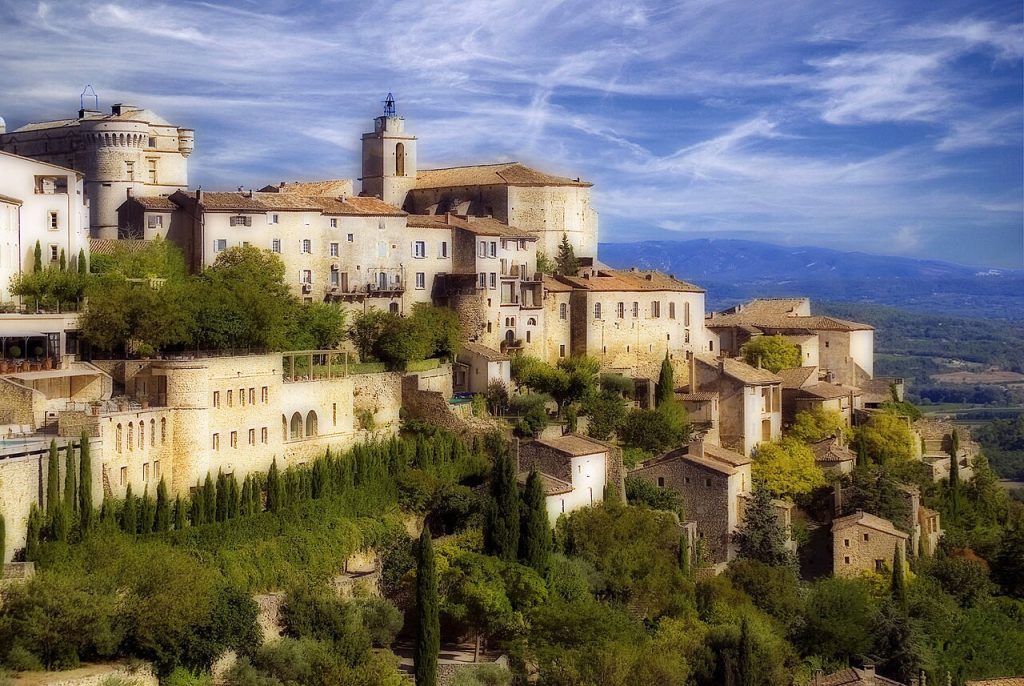
The Luberon village circuit is the most comprehensively Provençal of the 5 best scenic drives in Provence from Marseille Airport. The Luberon is a limestone mountain range named a regional natural park in 1977.
The villages on its ridges are among the most comprehensively beautiful in France: pale limestone catching Provençal light with the efficiency of a natural reflector, set in lavender fields, olive groves and cherry orchards at altitudes that keep them 10 degrees cooler than the coast in July.
Gordes is built on a limestone promontory above the Val de Sault, approximately 100 kilometres from Marseille Airport via Aix-en-Provence and the D943. The view from the D2 road below, looking up at the stacked stone houses rising to the Renaissance château at the summit, is the photograph that appears on more covers of Provence travel books than any other.
Below Gordes in the valley of the Senancole, the Abbaye Notre-Dame de Sénanque is a 12th-century Cistercian monastery of extraordinary beauty. The approach in June or July, when the lavender fields in front of the abbey are in bloom, is one of those moments that makes the planning of a road trip worthwhile.
Roussillon, 12 kilometres east of Gordes on the D2, is built entirely of ochre. The Sentier des Ocres, a 30-minute walking circuit through the disused ochre quarries on the village edge, displays the most vivid natural colour in Provence. Entry costs approximately €3.
Les Baux-de-Provence occupies a narrow limestone spur at 200 metres with the ruins of the Château des Baux (destroyed by Cardinal Richelieu in 1632) extending across the higher rock above.
The Carrères de Lumières, a digital art installation in a former bauxite quarry at the base of the village, is among the most original museum experiences in France.
Saint-Rémy-de-Provence completes the circuit. In May 1889 Vincent van Gogh committed himself to the Saint-Paul-de-Mausole asylum here and in the 12 months that followed painted 143 works. His rooms and the walled garden where he painted are open to visitors.
The Roman site of Glanum, one kilometre south, includes a triumphal arch and mausoleum from the 1st century BC in better condition than almost anything else of their age in France.
Best time to drive: Of the 5 best scenic drives in Provence, the Luberon circuit is the most rewarding in the two hours before sunset. Roussillon, when the ochre is lit from the west, is worth timing your circuit for. Les Baux and Saint-Rémy are relatively uncrowded before 10am and after 5pm in peak season.
Insider Tip: The Abbaye de Sénanque lavender is at its finest in the second and third weeks of June. The access road to the abbey has a one-way system imposed in peak season. Arrive before 9am for the unobstructed view of the abbey with the lavender below.
Drive 3: The Camargue Wildlife Route – Arles, the Delta and the Pont du Gard
| Departure Point | Destination | Distance | Drive Time |
|---|---|---|---|
| Marseille Airport (MRS) | Arles (Les Arènes, Van Gogh sites) | 75 km | 1 hr |
| Marseille Airport (MRS) | Parc Ornithologique du Pont de Gau | 110 km | 1 hr 25 min |
| Marseille Airport (MRS) | Saintes-Maries-de-la-Mer | 115 km | 1 hr 30 min |
| Marseille Airport (MRS) | Pont du Gard (via Arles) | 155 km | 1 hr 50 min |
| Full circuit | Arles – Camargue – Pont du Gard return | ~280 km | full day |
Leave airport by 7:30am. Fill up with fuel in Arles before heading into the Camargue; stations are sparse along the D570 south of Arles. Flamingos most active at dawn and dusk. Parc Ornithologique du Pont de Gau: approx. 9 euros entry. Pont du Gard: approx. 9 euros per adult; timed entry advisable in July/August.
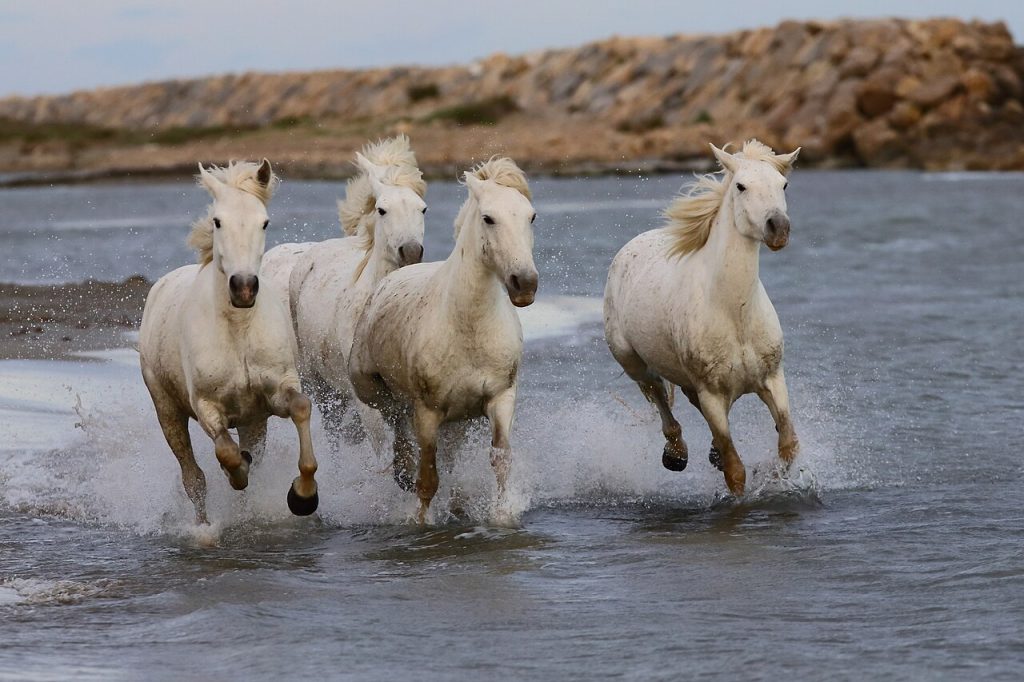
Drive 3 of the 5 best scenic drives in Provence takes you to the most unusual landscape in France. The combined delta of the Grand Rhône and the Petit Rhône covers 930 square kilometres of sea marshes, lagoons, salt pans and shallow lakes.
It is among the most important wetland habitats in Europe: home to approximately 400 species of birds including 10,000 to 13,000 greater flamingos, Europe’s only wild population of black bulls bred for the course camarguaise, and the Camargue horse that runs free across the marshes.
Among the 5 best scenic drives in Provence from Marseille Airport, this is the one that covers the greatest range of landscape types in a single day.Arles, 75 kilometres from Marseille Airport via the A55 and A54, is one of the great Roman cities of France. The Les Arènes, a Roman amphitheatre built around 90 AD, seats 20,000 and is still in use. Vincent van Gogh arrived in Arles in February 1888 and painted 300 works in 15 months.
The Fondation Vincent van Gogh Arles holds a permanent collection and exhibition programme in the old town. The sites Van Gogh painted are marked throughout the city; the walking circuit takes approximately two hours.
The Camargue delta is best accessed from Arles via the D570 south. The Parc Ornithologique du Pont de Gau, four kilometres north of Saintes-Maries-de-la-Mer, is the most accessible site for flamingo viewing: wooden walkways through the lagoons bring the birds to within 50 metres in the early morning.
The Pont du Gard, 80 kilometres northwest of Arles, is the finest surviving Roman aqueduct in the world. Built between 40 and 60 AD to carry water from a spring near Uzès to Nîmes, the bridge is 49 metres high, spans 274 metres and has not shifted measurably from its original alignment in 2,000 years.
Swimming in the Gardon below the aqueduct on a July afternoon with the bridge above is an experience the region offers freely. For entry and visit details see the Pont du Gard official site.
Best time to drive: This is the longest of the 5 best scenic drives in Provence from Marseille Airport. Leave the airport by 7:30am to reach Arles by 8:30am before the Roman sites get crowded.
Flamingos at the Parc Ornithologique are most active at dawn and in the evening. The Pont du Gard in late afternoon light, the limestone arches turning honey-coloured, is the finest time to see the structure.
Compare Marseille Airport Car Hire on Get Car Hire
Drive 4: The Aix-en-Provence and Montagne Sainte-Victoire Circuit – The Cézanne Drive
| Departure Point | Destination | Distance | Drive Time |
|---|---|---|---|
| Marseille Airport (MRS) | Aix-en-Provence (Cours Mirabeau) | 30 km | 35 min |
| Marseille Airport (MRS) | Atelier Paul Cézanne | 32 km | 40 min |
| Marseille Airport (MRS) | Barrage de Bimont (Sainte-Victoire view) | 45 km | 55 min |
| Marseille Airport (MRS) | Château de Vauvenargues (Picasso) | 50 km | 1 hr |
| Full circuit | D17 Cézanne route + Aix return | ~90–120 km | half to full day |
Atelier Cezanne open 9:30am to 6pm peak season; closed Tuesdays. Approx. 7 euros entry. Chateau de Vauvenargues exterior only; not open to the public. Pairs naturally with the Calanques drive (Drive 1) as a combined full-day itinerary. Full circuit approximately 90 to 120km from Marseille Airport.
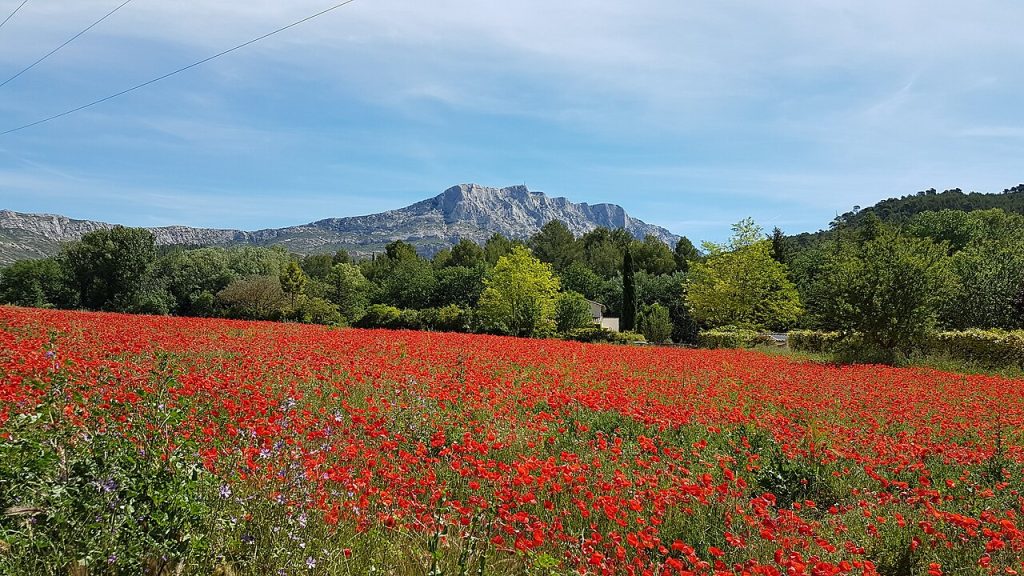
The Cézanne Circuit is the closest and quickest of the 5 best scenic drives in Provence to complete from Marseille Airport. Aix-en-Provence is just 30 kilometres from the terminal.
Founded as Aquae Sextiae by the Romans in 123 BC, the city produced Paul Cézanne in 1839. Cézanne painted the Montagne Sainte-Victoire, the limestone massif that rises to 1,011 metres east of the city, more than 80 times between 1882 and 1906.
The Cours Mirabeau, a wide tree-lined boulevard of 17th and 18th-century mansions, fountains and café terraces, is one of the most elegant streets in France. The Saturday market on the Place Richelme and the flower market on the Place de la Mairie are among the best in Provence.
The Atelier Paul Cézanne, one kilometre north of the Cours Mirabeau on the Avenue Paul Cézanne, is the studio Cézanne built in 1902 and used until his death in 1906. The studio is preserved exactly as he left it: the tall north-light windows, the objects he painted still on the shelves, the coat left on the rack. Approximately €7 entry.
The D17 road east of Aix is the Cézanne route. The road follows the southern base of Sainte-Victoire through the villages of Beaurecueil, Saint-Antonin-sur-Bayon and Le Tholonet. The Barrage de Bimont, eight kilometres east of Aix, provides the finest accessible view of the north face of the mountain. Fourteen kilometres further east, Château de Vauvenargues, bought by Picasso in 1958 and where he is buried, is worth the detour along the D10 for the scale of the mountain above it.
Best time to drive: Of the 5 best scenic drives in Provence, this circuit rewards the earliest start. The D17 leaving Aix before 8am gives the finest south-face illumination on Sainte-Victoire.
The Barrage de Bimont in the hour before sunset offers the best colour on the rock face. This circuit pairs naturally with the Calanques drive in the afternoon.
Insider Tip: This is the circuit that pairs most naturally with the Calanques drive (Drive 1). Complete the Aix and Sainte-Victoire circuit in the morning (approximately 90km, back in Aix by 1pm), then take the A51 south and A50 east toward Cassis in the afternoon. Cap Canaille in late afternoon light is at its finest from 4pm onward.
Drive 5: Avignon, Châteauneuf-du-Pape and the Pont du Gard
| Departure Point | Destination | Distance | Drive Time |
|---|---|---|---|
| Marseille Airport (MRS) | Avignon (Palais des Papes) | 95 km | 1 hr 10 min |
| Marseille Airport (MRS) | Châteauneuf-du-Pape (wine estates) | 105 km | 1 hr 20 min |
| Marseille Airport (MRS) | Pont du Gard (via Avignon) | 120 km | 1 hr 25 min |
| Marseille Airport (MRS) | Tarascon (Château on the Rhône) | 85 km | 1 hr 5 min |
| Full circuit | Avignon – Châteauneuf – Pont du Gard return | ~280 km | full day |
A7 toll approximately 12 to 15 euros Marseille to Avignon each way. Avignon Palais des Papes entry approximately 14 euros; combined with Pont Saint-Benezet approximately 18 euros. Chateauneuf-du-Pape estate tastings: free to 10 euros depending on estate. Book Avignon accommodation months ahead if visiting during the July festival. Full circuit approximately 280 km.
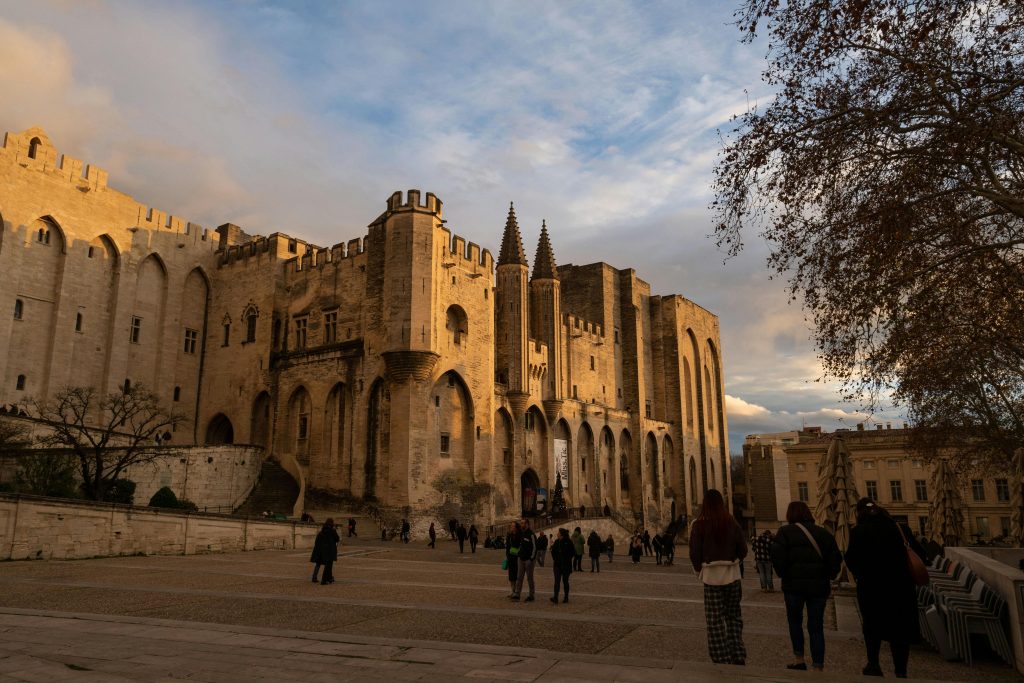
The fifth of the 5 best scenic drives in Provence from Marseille Airport heads north on the A7, the Autoroute du Soleil.
It connects, 95 kilometres from the airport, with Avignon: one of the most concentrated expressions of medieval power and wealth in Europe, and the Rhône valley that runs north of the city holds one of the most prestigious wine appellations in France.
The Palais des Papes, built to house seven popes who ruled Christendom from Avignon between 1309 and 1377, is the largest Gothic building in the world.
The Grand Tinel banqueting hall, 52 metres long and 10 metres wide, the Chambre du Cerf with its hunting-scene frescoes, and the private apartments of Pope Clement VI demonstrate a version of the medieval Church with very little connection to poverty or simplicity.
The Palais and the surrounding historic centre are a UNESCO World Heritage Site.
The Pont Saint-Bénézet, the famous bridge of the song Sur le Pont d’Avignon, was built in the 12th century and once extended the full width of the Rhône in 22 arches. Only four survive, ending mid-river, giving the bridge a more dramatic quality than it would have had complete.
Châteauneuf-du-Pape, 20 kilometres north of Avignon on the D17, is the most celebrated wine village in the Rhône Valley. Thirteen grape varieties are permitted in the blend. The ruins of the papal summer castle above the village, largely destroyed by German forces in 1944, look north across the vineyards to Mont Ventoux. The view from the castle walls is worth the climb.
The Pont du Gard, 42 kilometres east of Avignon, is described in Drive 3. On this circuit it makes a natural afternoon stop before the return south to Marseille via the A9 and A54, or via the D999 through Tarascon for those wishing to add the Alpilles on the return.
Best time to drive: Of the 5 best scenic drives in Provence, the Avignon circuit requires the earliest booking. Leave the airport by 8am to reach Avignon by 9:15am before the Palais des Papes queue builds.
Châteauneuf-du-Pape estates are best visited between 10am and 12pm for tastings before the lunch closure. The Pont du Gard in late afternoon light is the finest time to see it.
Combining the Drives: What Works in a Day
Drives 1 and 4 together (Calanques and Cézanne): When combining two of the 5 best scenic drives in Provence in a single day, the Cézanne Circuit works best in the morning.
The Aix and Sainte-Victoire circuit is a 90-kilometre half-day from the airport. Drive the D17 Cézanne route in the morning, return to Aix by 1pm, then pick up the A51 south and A50 east toward Cassis by 2pm.
Cap Canaille in late afternoon western light is at its finest from 4pm onward. Total: approximately 160 kilometres, a manageable full day.
Drives 2 and 5 together (Luberon and Avignon): Two more of the 5 best scenic drives in Provence pair naturally: the Luberon villages and Avignon occupy adjacent geography north and Northwest of Marseille.
Drive to Avignon first, spend the morning at the Palais des Papes and Châteauneuf-du-Pape, then drive south through the Alpilles via Saint-Rémy, Les Baux and Roussillon on the return to Marseille. Allow the full day: this is a 280-kilometre circuit with substantial stops.
Drive 3 alone (Camargue): The Camargue circuit is the most immersive of the 5 best scenic drives in Provence and demands its own full day. Adding a second circuit would mean rushing both.
Driving in Provence from Marseille Airport: Practical Notes
Motorway tolls: The 5 best scenic drives in Provence from Marseille Airport all share the same motorway network.
The A7 north to Avignon costs approximately €12 to €15 each way. The A50 east toward Cassis is approximately €3 to €5. Budget €10 to €20 for tolls on any full-day circuit involving the motorway network. Toll booths accept cash and card.
Parking in Aix-en-Provence: Use Parking Mignet or Parking Sextius near the old town (approximately €2 to €3 per hour). The city centre is largely pedestrianised.
Parking in Avignon: Use Parking de la Barthelasse across the Rhône on the Ile de la Barthelasse for the best view of the Palais des Papes from the river bank. Inside the walls, parking is limited and expensive in peak season.
Parking in Arles: Use Parking des Lices on Boulevard des Lices (approximately €1.50 per hour). The old town is compact enough to walk from here.
Petrol stations: For the 5 best scenic drives in Provence, the most important fuel stop is Arles before heading into the Camargue; stations are sparse along the D570 south of Arles. Before heading into the Luberon from the north, fill up at Apt or Cavaillon.
Summer road access: Planning the 5 best scenic drives in Provence in summer requires one key restriction in mind: the Calanques access roads (Sormiou, Morgiou) are closed to private vehicles from approximately 15 June to 15 September.
The Abbaye de Sénanque access road has a one-way system imposed in peak season. Arriving before 9am at both sites resolves most access difficulties.
Compact car recommendation: For the 5 best scenic drives in Provence, a compact car is the best choice. The D2 through the Luberon between Gordes and Roussillon and the Route des Crêtes along Cap Canaille are narrow in places. A compact car is more comfortable and far easier to park in hilltop villages.
Frequently Asked Questions
What are the 5 best scenic drives in Provence from Marseille Airport?
The five are: the Calanques coastal drive to Cap Canaille (the highest sea cliff in France) and Cassis; the Luberon village circuit via Gordes, Roussillon, Les Baux and Saint-Rémy-de-Provence; the Camargue wildlife route through Arles, Saintes-Maries-de-la-Mer and the Pont du Gard; the Aix-en-Provence and Montagne Sainte-Victoire circuit following Cézanne’s painting locations; and the Avignon and Châteauneuf-du-Pape circuit along the Rhône valley. Each is covered in full with route tables and timing notes in this guide.
Can I drive into the Calanques National Park from Marseille Airport?
Yes. The Calanques Coastal Drive, the first of the 5 best scenic drives in Provence in this guide, is accessible year-round with seasonal restrictions.
The Route des Crêtes along Cap Canaille and the approach to Cassis are always accessible by car. The access roads to Sormiou, Morgiou and Sugiton are closed to private vehicles from approximately 15 June to 15 September between 8am and 8pm.
During this period, access is by shuttle bus from Marseille’s Luminy campus or on foot. Boat trips to the calanques from Cassis harbour are available year-round.
Is the Luberon village circuit driveable in a day from Marseille Airport?
Yes. The Luberon circuit, second of the 5 best scenic drives in Provence, covers approximately 230 kilometres from Marseille Airport through Gordes, Roussillon, Les Baux and Saint-Rémy.
Leave the airport by 8am to reach Gordes before 9:30am, before the coach tours arrive. Allow two hours in Gordes and Sénanque, one hour in Roussillon, two hours in Les Baux and Carrières de Lumières, and one hour in Saint-Rémy. Return to the airport via the A7 south in approximately one hour 20 minutes.
How far is the Pont du Gard from Marseille Airport?
The Pont du Gard features on two of the 5 best scenic drives in Provence: the Camargue Wildlife Route and the Avignon circuit. It is approximately 120 kilometres from Marseille Airport via the A7 and D6100.
It features on two of the five circuits in this guide: the Camargue wildlife route (Drive 3) and the Avignon and Rhône valley circuit (Drive 5). Allow a minimum of two hours at the site. Entry costs approximately €9 per adult.
What is the best time of year to drive in Provence?
April, May and June are the optimal months for the 5 best scenic drives in Provence, offering the best combination of weather, manageable crowds and value. June brings the first lavender bloom at the Abbaye de Sénanque.
July and August are peak season with heavy traffic at the Calanques, Gordes and Avignon. September and October offer golden light, the grape harvest in Châteauneuf-du-Pape and significantly fewer visitors.
For winter, the Camargue flamingo population is at its highest and the roads are quiet.
Plan Your Provence Road Trip with Get Car Hire
Ready to explore the 5 best scenic drives in Provence? Compare all operators at Marseille Airport and secure your hire car through Get Car Hire before you travel.
See the full guide to car hire at Marseille Airport for collection details, seasonal pricing and everything you need to book with confidence.
The Calanques, the Luberon, the Camargue, Avignon and the Montagne Sainte-Victoire are all within reach. Booking before arrival is always cheaper than walk-up desk pricing at Marseille Airport.