
Table of Contents
5 Best Scenic Drives Near Lisbon (With Route Map and Driving Tips)
Lisbon earns its reputation as one of Europe’s finest city breaks without a hire car. The miradouros, the trams, the pasteis de nata and the seven hills are all best explored on foot.
But collect a hire car from Lisbon Airport and a completely different Portugal opens up around the city: limestone cliffs dropping to water so clear it does not look real, the fairytale palaces of Sintra visible from their hilltops across the Tagus estuary, a medieval walled city where every building is intact and the streets have not changed since the 12th century, the most famous surf beach in the world and a stretch of Atlantic coast that looks as it did 500 years ago.
This guide covers the 5 best scenic drives near Lisbon, each one a half or full day circuit from any base in the city or its surroundings. Every drive includes road numbers, where to stop, what to eat and the practical driving notes that make the difference.
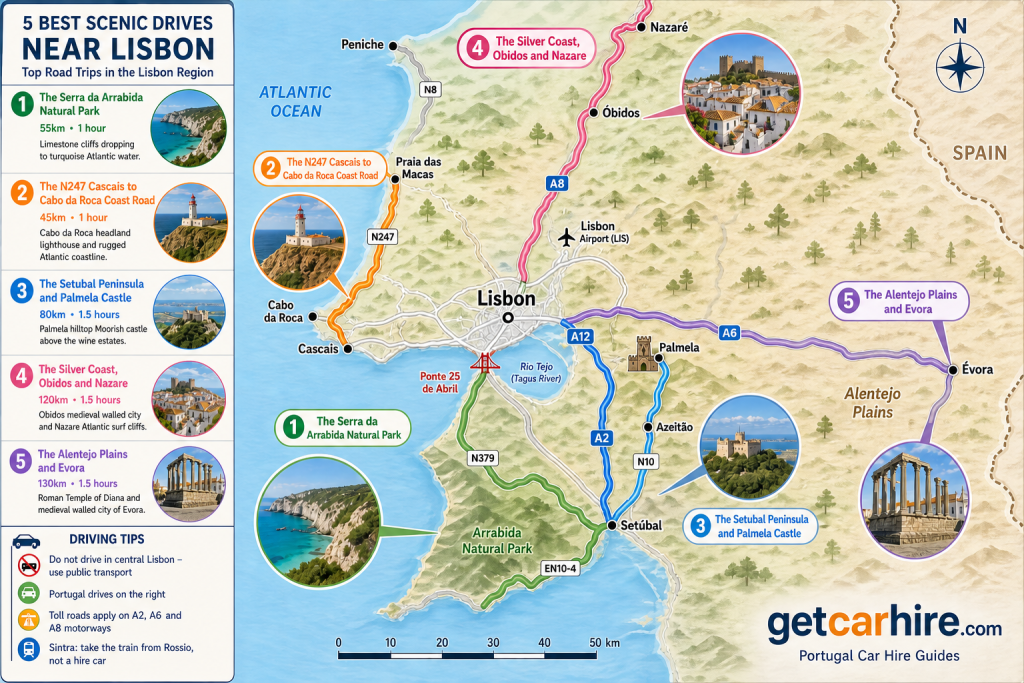
The 5 Best Scenic Drives Near Lisbon at a Glance
Drive 1: The Serra da Arrabida Natural Park. Cross the Ponte 25 de Abril bridge south on the N379 to the Serra da Arrabida limestone coast. Approximately 55 kilometres. Half to full day. The finest coastal drive within reach of Lisbon.
Drive 2: The N247 Cascais to Cabo da Roca Coast Road. West from Cascais on the N247 along the rugged Atlantic coastline to Cabo da Roca, the most westerly point of mainland Europe, then north to Praia das Macas. Approximately 45 kilometres. Half day. The most dramatic coastal road in the Lisbon region.
Drive 3: The Setubal Peninsula and Palmela Castle Circuit. South on the A2 and A12 from Lisbon to Setubal (seh-TOO-bal), then north via Palmela (pal-MEH-la) Castle and the wine estates of the peninsula back to the city. Approximately 80 kilometres. Full day. Medieval castle, local wine and the most underrated landscape near Lisbon.
Drive 4: The Silver Coast, Obidos and Nazare. North from Lisbon on the A8 or coastal N8 to the medieval walled city of Obidos (oh-BEE-doosh), then north to Nazare (na-za-REH) on the Silver Coast. Approximately 120 kilometres. Full day. UNESCO heritage, giant Atlantic waves and the most photogenic town in central Portugal.
Drive 5: The Alentejo Plains and Evora. East from Lisbon on the A6 through the cork oak plains of the Alentejo to Evora (EH-vo-ra), a UNESCO World Heritage city of Roman temples, Gothic cathedrals and medieval walls. Approximately 130 kilometres. Full day. The most culturally significant day trip from Lisbon.
What You Need to Know Before Driving Near Lisbon
IMPORTANT: Do not drive in central Lisbon itself unless you have a specific reason. The narrow streets, inconsistent signage, congested traffic and extremely limited parking make the city centre one of the most challenging urban driving environments in Europe. All five drives in this guide start from points outside the city centre — the Ponte 25 de Abril bridge, Cascais, the A2 south or the A6 east. Use public transport within Lisbon and save the hire car for the countryside.
Portugal drives on the right. Speed limits: 50 km/h in towns, 90 km/h on rural roads, 120 km/h on motorways. Portugal has an extensive electronic toll network. If your hire car has Via Verde, tolls are deducted automatically. If not, check which roads require manual payment and which are electronic-only before setting out. For full documentation requirements refer to Visit Portugal’s official driving guidance.
Sintra parking note: Sintra itself is not included as a drive in this guide for an important practical reason. The roads into Sintra are not suited to the volume of tourist traffic in summer and parking is severely limited. Visit Sintra by train from Rossio station in central Lisbon. It is faster, cheaper and significantly less stressful than driving. The N247 coast road below incorporates the best of the Sintra natural area by car without attempting to park in the town.
Drive 1: The Serra da Arrabida Natural Park
Ponte 25 de Abril to the Arrabida Coast via Setubal | N379 / EN10-4
| Start | Lisbon south bank via Ponte 25 de Abril |
| End | Arrabida beaches and Setubal |
| Distance | Approx 55 km |
| Driving time | 1 hour without stops. Allow a half to full day |
| Road | N379 south through the Serra da Arrabida to the coast, EN10-4 coastal road east to Setubal |
| Difficulty | Moderate. N379 is a good mountain road. The EN10-4 coastal road is narrow with passing places in sections. Park closed to private vehicles on summer weekends above capacity |
The Serra da Arrabida Natural Park is the single finest coastal landscape within reach of Lisbon and the one that most surprises visitors who expect the beaches to the north. The N379 south from the Ponte 25 de Abril crosses the limestone ridge of the serra and descends to a coast of turquoise water and white sand enclosed by cliffs. The limestone here filters the water to an extraordinary clarity that reads a deeper blue than any Costa del Sol beach.
The beaches of Figueirinha, Galapinhos and Creiro are the jewels of the park. Galapinhos in particular is consistently rated among the finest beaches in mainland Europe and is accessible only via the narrow EN10-4 coastal road or a short walk from the car park above.
The park also contains the Convento da Arrabida, a 16th-century Franciscan convent built into the cliff face above the sea, and the Roman ruins at Setubal (seh-TOO-bal) at the eastern end of the drive.
The road through the park is closed to private vehicles on summer weekends above a certain number of cars. Check the Arrabida park website before travelling between late June and September on a Saturday or Sunday and aim for weekday visits in peak season.
Insider Tip: Drive the Serra da Arrabida in the morning and aim to be at Galapinhos beach by 10am. The car park above the beach fills completely by midday in summer and the approach road is closed once capacity is reached. The water clarity is best in the morning before the afternoon wind picks up along the coast.

Food and Pit Stops: Drive 1
Jose Mestre, Portinho da Arrabida – at the small harbour below the convent. The freshest seafood in the park served at tables above the water. The grilled fish of the day and the choco frito (fried cuttlefish; SHO-koo FREE-too) are the dishes to order.
Restaurante Pousada de Palmela – inside the castle walls at Palmela on the return. Historic setting, excellent local wine from the Setubal peninsula and traditional Alentejan cuisine.
Cafetaria do Parque, Arrabida – simple cafe at the main car park. Coffee, local cheese and bread before or after the beach walk.
Total distance: approximately 55 kilometres from the south bank of the Ponte 25 de Abril to Setubal. Allow a half day for the coast road and beaches, or a full day adding Setubal and Palmela.
Drive 2: The N247 Cascais to Cabo da Roca Coast Road
Cascais to Praia das Macas via Cabo da Roca | N247
| Start | Cascais |
| End | Praia das Macas |
| Distance | Approx 45 km |
| Driving time | 1 hour without stops. Allow a half day |
| Road | N247 north from Cascais along the Atlantic coast past Cabo da Roca to Praia das Macas |
| Difficulty | Easy to moderate. Good road throughout with some narrow coastal sections and viewpoint car parks |
The N247 north from Cascais is one of the finest coastal drives in the Lisbon region and the one that most visitors never take. The road runs along the rugged Atlantic coastline, climbing into the hills of the Serra de Sintra before descending to small fishing villages and the dramatic headland of Cabo da Roca (KAH-boo da ROH-ka), the most westerly point of mainland Europe.
The drive begins in Cascais, the most refined coastal town in the Lisbon region, with a harbour, a palace and a pedestrianised centre that has been a Portuguese aristocratic resort since the 19th century. From Cascais the N247 runs north past the world-class surf beach of Guincho (GEEN-shoo), exposed to the full force of the Atlantic and one of the best windsurfing locations in Europe, before climbing to the Cabo da Roca visitor centre and lighthouse. The view from the headland west across the open Atlantic is genuinely affecting.
Continue north on the N247 through the village of Almoçageme and down to Praia das Macas (Beach of Apples), a traditional Portuguese beach village with good seafood restaurants above the ocean. The historic tram from Sintra to Praia das Macas runs through this village and is one of the most charming short rail journeys in Portugal.
Insider Tip: The viewpoint at Peninha (peh-NEEN-ya), a Manueline chapel perched above the cliffs north of Guincho, is one of the finest and least visited viewpoints in the Lisbon region. The turn-off from the N247 is signposted and the road to the chapel takes about 10 minutes. The view from the terrace stretches from Cabo da Roca north along the Atlantic coast and south toward the Tagus estuary. Almost no one stops here.

Food and Pit Stops: Drive 2
O Farol, Cascais waterfront – classic Cascais seafood restaurant on the harbour. The caldeirada (fish stew; kal-day-RAH-da) and the grilled fish are the standards. Good starting point before the N247 drive.
Bar do Guincho, Praia do Guincho – beach bar above the Guincho surf beach. Simple food and cold drinks with the best Atlantic view on the drive. Extremely popular on summer afternoons.
A Lagosta Perdida, Praia das Macas – at the northern end of the drive. Excellent fresh seafood and local wine at tables above the ocean. The barnacles (percebes; per-SEH-besh) are the local speciality and exceptional when in season.
Total distance: approximately 45 kilometres from Cascais to Praia das Macas. Allow a half day with Guincho, Cabo da Roca and Peninha stops.
Drive 3: The Setubal Peninsula and Palmela Castle Circuit
Lisbon to Setubal, Palmela and the Peninsula Wine Estates | A2 / A12 / N10
| Start | Lisbon south via A2 |
| End | Palmela and return to Lisbon via A12 |
| Distance | Approx 80 km circuit |
| Driving time | 1.5 hours without stops. Allow a full day |
| Road | A2 south from Lisbon to Setubal, N10 north through Azeitao wine estates to Palmela, A12 return |
| Difficulty | Easy. Motorway and national road throughout. A2 carries tolls southbound |
The Setubal Peninsula south of Lisbon is one of the most underrated landscapes within reach of the capital. The A2 and A12 from Lisbon reach Setubal in under an hour. The town itself has a handsome historic centre, an excellent covered market and the finest fish restaurants in the Lisbon region outside the capital itself.
From Setubal, the N10 north runs through the wine estates of the Setubal Peninsula Denomination of Origin, one of Portugal’s most respected wine regions producing the famous Moscatel de Setubal (mosh-ka-TEL de seh-TOO-bal) dessert wine and excellent red wines from the Castelao grape. The estates of Jose Maria da Fonseca in Azeitao (a-zay-TOW) welcome visitors and the tasting rooms are open throughout the week.
Continue north on the N10 to Palmela (pal-MEH-la), a hilltop village dominated by a Moorish castle converted into a luxury pousada. The view from the castle battlements stretches across the entire peninsula, the Tagus estuary, the Serra da Arrabida and on a clear day the outline of Lisbon on the northern horizon. There is no entrance fee to the castle exterior and it looks magnificent floodlit at night.
Insider Tip: The Jose Maria da Fonseca winery in Azeitao, established in 1834, is one of the oldest wine producers in Portugal and offers free guided tours of the historic cellars and a Moscatel tasting. The winery is on the N10 between Setubal and Palmela and takes approximately 45 minutes to visit. Book in advance in summer but walk-ins are often possible in the morning.

Food and Pit Stops: Drive 3
Mercado do Livramento, Setubal – the covered market in Setubal is one of the finest in Portugal. Open mornings Tuesday to Saturday. The fish and seafood stalls are extraordinary and the surrounding tascas serve the market’s catch simply grilled at tables inside the market building.
Jose Maria da Fonseca winery, Azeitao – tasting room serving Moscatel de Setubal and the estate’s red wines. The Moscatel served cold is one of the more memorable wine experiences in the Lisbon region.
Pousada Palmela restaurant – inside the castle walls. Traditional Portuguese cuisine with excellent local wine. The setting inside a converted 15th-century convent is unmatched on the circuit.
Total distance: approximately 80 kilometres for the full circuit from Lisbon via Setubal, Azeitao and Palmela. Allow a full day with market, winery and castle stops.
Drive 4: The Silver Coast, Obidos and Nazare
Lisbon North to the Medieval City of Obidos and the Surf Capital of Nazare | A8 / N8
| Start | Lisbon north via A8 |
| End | Nazare |
| Distance | Approx 120 km |
| Driving time | 1.5 hours without stops. Allow a full day |
| Road | A8 north from Lisbon (toll road) to Obidos junction, then north to Nazare. N8 coastal road is a toll-free but slower alternative |
| Difficulty | Easy. A8 is a toll motorway. Obidos town centre is best approached on foot from the main gate car park |
The A8 north from Lisbon carries tolls and reaches the Obidos (oh-BEE-doosh) junction in approximately 50 minutes. Obidos is the most perfectly preserved medieval walled city in Portugal: every building within the walls is intact, the cobbled streets are unchanged and the 12th-century castle at the far end of the main street has been converted into a pousada. It is genuinely extraordinary and genuinely busy in summer. Arrive before 10am for the quietest experience.
Continue north on the A8 or the slower N8 coastal road to Nazare (na-za-REH), the most famous surf destination in Europe since Garrett McNamara rode a 24-metre wave off Praia do Norte in 2011. The cliff at Sitio above the town gives the finest view of the surf breaks. The town itself below the cliff is a traditional fishing village of painted houses with an extraordinary fish market and the best caldeirada in central Portugal.
The N8 coastal alternative to the A8 is significantly slower but passes through the fishing town of Peniche (peh-NEESH), the surfing capital of central Portugal, and the protected lagoon of Obidos Lagoon. The coastal route adds approximately 45 minutes to the drive but eliminates the A8 toll.
Insider Tip: Obidos is best visited first thing in the morning before the day trip coaches arrive at around 11am. The town has free parking outside the main gate and the walk along the top of the medieval walls is included in the entry to the walls themselves. The ginjinha (zheen-ZHEEN-ya), cherry liqueur served in chocolate cups, is the local speciality and sold from tiny shops just inside the main gate. It is excellent.

Food and Pit Stops: Drive 4
Tasca do Joel, Obidos – inside the walls. Traditional Portuguese food in a genuine tasca setting. The bifanas and the local cheese are excellent lunch stops before continuing north to Nazare.
A Tasca do Celso, Nazare – in the lower town near the fish market. The caldeirada is the best in the area and the grilled sardines in summer are outstanding. Go at lunch when the fish is freshest.
Restaurante Sitio, Nazare clifftop – above the town at Sitio with a direct view of the surf breaks. Good seafood and the best vantage point for watching the Atlantic swells coming in toward Praia do Norte.
Total distance: approximately 120 kilometres from Lisbon to Nazare. Allow a full day with Obidos and Nazare stops.
Drive 5: The Alentejo Plains and Evora
Lisbon East to the UNESCO City of Evora via the Cork Oak Plains | A6
| Start | Lisbon east via A6 |
| End | Evora |
| Distance | Approx 130 km |
| Driving time | 1.5 hours without stops. Allow a full day |
| Road | A6 east from Lisbon through the Alentejo cork oak plains directly to Evora. Return via N114 through Arraiolos for a scenic alternative |
| Difficulty | Easy. A6 is a toll motorway with excellent road surface. Fuel up before leaving Lisbon — petrol stations are sparse on the Alentejo plains |
The A6 east from Lisbon crosses into the Alentejo (a-len-TEH-zhoo) within 30 minutes and the landscape changes completely. The hills and forests of the Lisbon region give way to vast rolling plains of cork oak, olive and wheat that stretch to the horizon in every direction. This is the landscape that produces most of Portugal’s cork, olive oil and wine and it has a particular quality of light in the late afternoon that has been attracting painters for centuries.
At the centre of the Alentejo plains sits Evora (EH-vo-ra), a UNESCO World Heritage City of 57,000 people that contains a Roman temple, a Moorish quarter, a Gothic cathedral, a 16th-century university and the most chilling tourist attraction in Portugal: the Casa dos Ossos (KAH-za doosh OH-soosh), or Chapel of Bones, where the walls and columns are decorated with the skulls and femurs of approximately 5,000 monks. The city is compact enough to explore on foot in three to four hours and the main sights are all within walking distance of the central Praca do Giraldo.
Evora is also the centre of the Alentejo wine region, which produces some of Portugal’s most celebrated reds from indigenous grape varieties. The Herdade do Esporao and Quinta do Carmo estates are both within 30 minutes of the city and offer tastings.
Insider Tip: Leave Lisbon early for Evora and aim to arrive by 10am to beat the tour groups at the Roman temple and the Cathedral. The A6 carries tolls: approximately €3.50 for the full Lisbon to Evora section. Fuel up before leaving the city as petrol stations are sparse on the Alentejo plains between the motorway junctions. Return via the N114 through Arraiolos (a-rye-OH-loosh), the white hilltop village famous for its hand-woven rugs, for a scenic alternative to the motorway.

Food and Pit Stops: Drive 5
Taberna Tipica Quarta-Feira, Evora – on Rua do Inverno in the old city. The most consistently recommended Alentejan restaurant in Evora. The migas (MEE-gash), bread-based Alentejan dishes, the carne de porco a Alentejana (pork with clams) and the excellent local red wines are the benchmarks. Book ahead in summer.
Cafe Arcada, Praca do Giraldo – on the main square. Historic cafe open since 1948. Coffee, pasteis de nata and the best people-watching seat in the city.
Pao de Rala bakery, Evora old town – the Convento dos Remedios nuns produce the traditional Alentejan sweets including the pao de rala (PAO de RAH-la), a marzipan-like confection that is the best food souvenir from the region.
Total distance: approximately 130 kilometres from Lisbon to Evora. Allow a full day with the Roman temple, Cathedral, Casa dos Ossos and lunch in the old city.
Find the Best Lisbon Car Hire Deals for Your Road Trip
Frequently Asked Questions
Should I hire a car for a trip to Lisbon?
If your trip is Lisbon only, a hire car is not necessary. Public transport, trams and Uber cover the city well and parking adds cost and complication. If your trip includes day trips to the Serra da Arrabida, Obidos, Nazare, Evora or the Cascais coast, a hire car collected at Lisbon Airport on the day you leave the city is essential. The five drives in this guide are all unreachable by public transport.
What is the best scenic drive near Lisbon?
The Serra da Arrabida Natural Park is the finest coastal drive and the one that most surprises visitors. The limestone cliffs and turquoise water are unlike anything else within reach of Lisbon. The N247 coast road from Cascais to Cabo da Roca is the most dramatic Atlantic cliff drive in the region. Both are half-day circuits from any Lisbon base.
Is it easy to drive near Lisbon?
Outside the city, yes. The motorways and national roads in the Lisbon region are well maintained and clearly signposted. Avoid driving in central Lisbon itself if possible. The city road network is genuinely challenging with narrow streets, congestion and limited parking. Collect the hire car on the day you leave the city and use public transport within Lisbon.
Are there toll roads near Lisbon?
Yes. The A2 south, the A8 north and the A6 east all carry tolls. The Ponte 25 de Abril bridge also carries a toll southbound (not northbound returning to Lisbon). Via Verde handles most tolls electronically if your hire car is fitted with the transponder. If not, check which roads require manual payment before setting out. The N8 coastal road north is a toll-free alternative to the A8 but adds approximately 45 minutes to the Silver Coast drive.
Can I drive from Lisbon to the Algarve on one hire car?
Yes and it is often more cost-effective than two separate rentals. The A2 south from Lisbon to the Algarve takes approximately two and a half hours and carries tolls. The A22 across the Algarve has been toll-free since January 2025. A single hire car from Lisbon Airport covering both regions gives you the full Portugal road trip experience without the complication of two separate collections and returns.
Plan Your Lisbon Road Trip
The five drives above reveal a Portugal that most Lisbon visitors never see. The limestone coastline of the Arrabida, the most westerly point of Europe, a perfectly preserved medieval city, the most famous surf beach in the world and a UNESCO Roman city on the cork oak plains: all of them within two hours of Lisbon Airport and all of them unreachable without your own transport.
For everything you need before setting off, our car hire in Lisbon guide covers pickup at Lisbon Airport, the best operators for transparent pricing and practical advice for driving in Portugal. Compare deals below and start planning your Lisbon road trip.
About the Author
Darryl Antonio is CEO of Digitalhound, a London-based digital marketing agency with over two decades of experience in SEO and content strategy. Darryl oversees digital strategy across all sectors the agency represents and manages content production and digital strategy for Getcarhire.com.
Pingback: Car Hire in Lisbon – Essential Guide to Hiring a Car at Lisbon Airport