
Table des matières
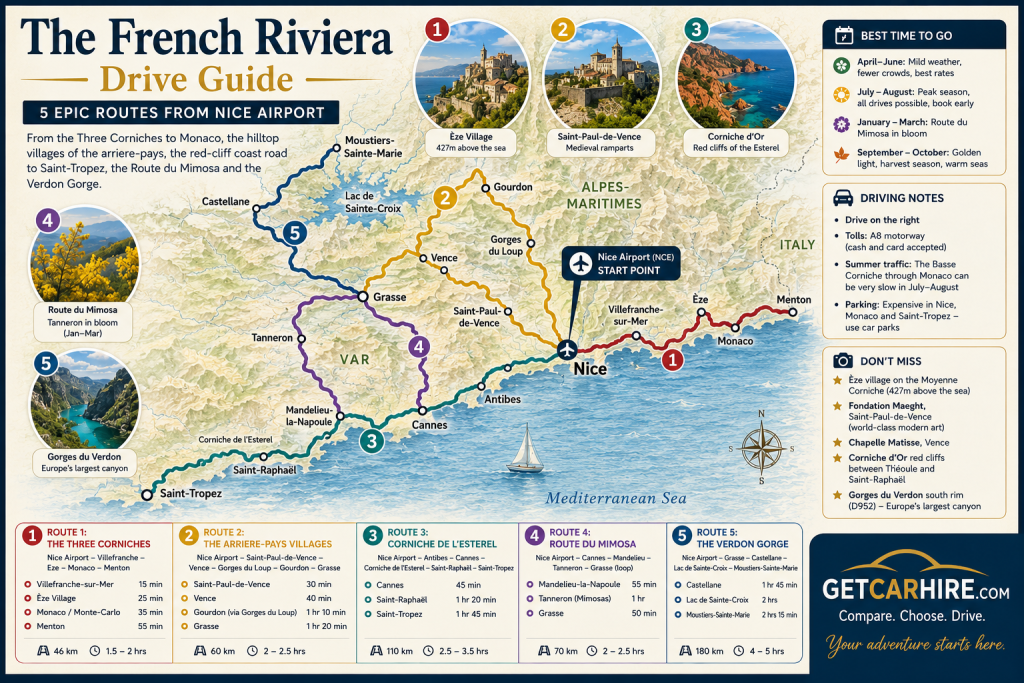
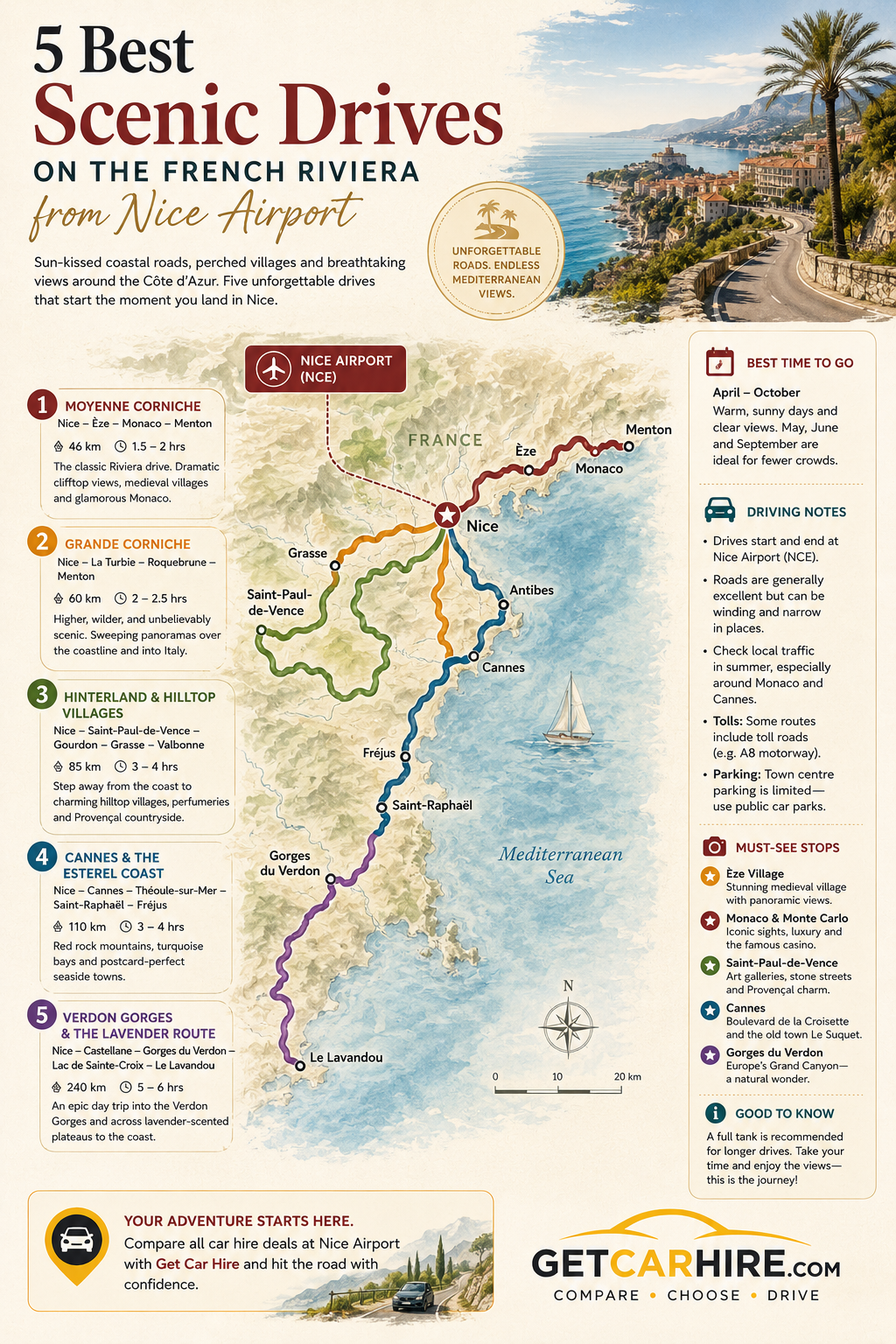
The 5 best scenic drives on the French Riviera range from one of the most celebrated coastal roads in the world to an inland gorge of a scale that requires a moment to accept. Nice Airport sits six kilometres west of the city and places every one of them within reach on a single tank of fuel.
The Three Corniches, the hilltop villages of the arrière-pays, the red-cliff coast road to Saint-Tropez, the mimosa country around Grasse and the Gorges du Verdon: five circuits, five completely different versions of what the south of France can look like.
The French Riviera is compact in the way that the very best driving regions always are. The distances are short enough that two circuits can be driven in a day without rushing either. The landscapes change quickly, from Mediterranean coast to alpine limestone to inland Provence, and the roads that connect them are, by any measure, among the finest on the continent.
Collect your hire car at Nice Airport and compare all available operators through Nice Airport car hire deals before you travel. Booking online is consistently 40 to 60 per cent cheaper than walk-up desk pricing, particularly in July and August when vehicles sell out weeks in advance.
Drive 1: The Three Corniches – Nice to Monaco and Menton
| Departure Point | Destination | Distance | Drive Time |
|---|---|---|---|
| Nice Airport (NCE) | Villefranche-sur-Mer | 8 km | 15 min |
| Nice Airport (NCE) | Èze Village (Moyenne Corniche) | 14 km | 25 min |
| Nice Airport (NCE) | Monaco (Monte-Carlo) | 24 km | 35 min |
| Nice Airport (NCE) | Menton | 40 km | 55 min |
| Nice Airport (NCE) | La Turbie (Grande Corniche) | 26 km | 40 min |
Note: Allow double the above times through Monaco in July and August. The Basse Corniche through Monaco is significantly slower in peak season than the Moyenne Corniche. The Grande Corniche is the least congested at any time of day.
Three roads carved into the limestone cliffs at 3 different altitudes between Nice and Menton form one of the most celebrated stretches of driving in the world. Each has a distinct character and rewards a different kind of attention.
The Basse Corniche (Corniche Inférieure, D6098) runs along the coast through Villefranche-sur-Mer, Beaulieu-sur-Mer, Èze-sur-Mer and Cap d’Ail into Monaco before continuing to Menton.
The Belle Époque villas, the yacht harbours and the seaside restaurants are all here. It is also the slowest road in summer, when the coast road through Monaco can add an hour to what should be a 40-minute drive.
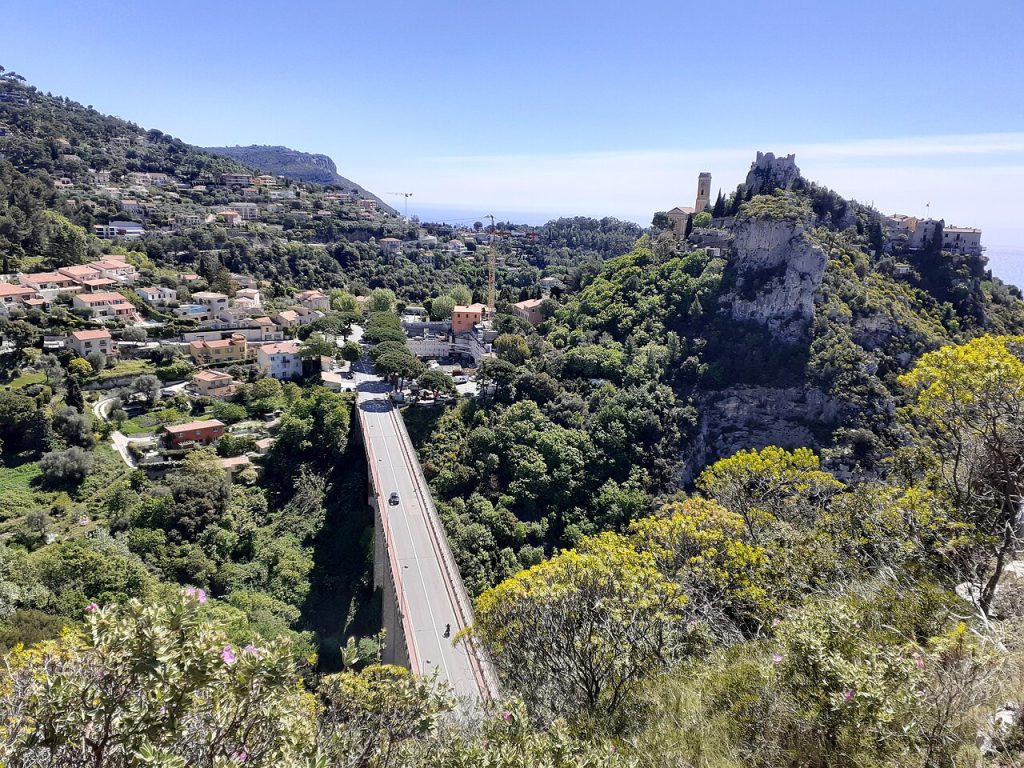
The Moyenne Corniche (D6007) is the most celebrated of the three. Built between 1910 and 1928, it climbs above the coastal villages to a vantage point where the entire Riviera coast lies below and the Maritime Alps are visible above.
The road passes through Èze village at 427 metres: a medieval perched village of narrow stone streets, a Nietzsche museum, a cactus garden and views that no filter improves. Grace Kelly was driving the Moyenne Corniche on the day she died in 1982. Alfred Hitchcock filmed To Catch a Thief (1955) here with Cary Grant.
The Grande Corniche (D2564) at 500 metres follows the ancient Roman Via Julia Augusta from Cimiez in Nice to La Turbie. At La Turbie, the Trophée des Alpes, a Roman monument built for Emperor Augustus in 6 BC, looks down over Monaco. The views from the Grande Corniche are the widest of the three roads and the traffic the lightest.
Best time to drive: Take the Moyenne Corniche eastbound in the morning (before 10am) when the light is at its best over the coast and traffic is manageable. Drive the Basse Corniche westbound on the return through Villefranche and Beaulieu. In July and August, the Basse Corniche through Monaco is best before 9am or after 6pm. The Grande Corniche is the least congested at any time of day.
Recommended circuit: Moyenne Corniche to Monaco, two to three hours in the principality (harbour, Casino square, F1 circuit streets), return via Basse Corniche through Villefranche and Beaulieu.
Drive 2: The Arrière-Pays Niçois – The Hilltop Villages
| Departure Point | Destination | Distance | Drive Time |
|---|---|---|---|
| Nice Airport (NCE) | Saint-Paul-de-Vence | 20 km | 30 min |
| Nice Airport (NCE) | Vence (Chapelle Matisse) | 25 km | 40 min |
| Nice Airport (NCE) | Gorges du Loup | 40 km | 55 min |
| Nice Airport (NCE) | Gourdon (760m viewpoint) | 55 km | 1 hr 10 min |
| Nice Airport (NCE) | Grasse (perfume capital) | 38 km | 50 min |
| Full circuit | Nice Airport return via A8 | ~130 km | 3–4 hrs driving |
Note: Best driven April to June and September to October. The road into Gourdon is narrow with tight switchbacks; allow extra time. Chapelle du Rosaire in Vence has limited opening hours; confirm before visiting. Full circuit approximately 130 km from Nice Airport.
The hinterland villages north of Nice occupy limestone ridges above the coast in a landscape of olive groves, dry-stone walls and the foothills of the Maritime Alps. The contrast with the coast 20 kilometres below is complete. These are the roads that the French themselves drive at weekends.
Saint-Paul-de-Vence, 20 kilometres from Nice Airport, is one of the most complete surviving medieval hilltop towns in France. The 16th-century ramparts, the central square with its boules pitches, the Fondation Maeght, one of the finest modern art museums in Europe, and the cemetery where Marc Chagall is buried: allow two hours minimum.
Vence, five kilometres north, is larger and less visited. The Chapelle du Rosaire (the Matisse Chapel), designed by Henri Matisse between 1947 and 1951 and considered by Matisse himself to be his masterpiece, sits on the northern edge of the town. The white interior with yellow, blue and green stained glass and the black-line ceramic murals on white tiles is extraordinary in clear morning light. Opening hours are limited; confirm before visiting.
Beyond Vence, the D2210 climbs into the Gorges du Loup, a river gorge cut through the Préalpes de Grasse where the road winds along the cliff wall through cascades and tunnels. Gourdon at 760 metres is the end point of the gorge road and the highest village in the Alpes-Maritimes. On a clear day the view extends from the Estérel massif to the Italian Alps.
From Gourdon, the circuit descends to Grasse, world capital of perfumery, where Fragonard, Galimard and Molinard all offer factory visits with free entry. Return to Nice via the A8 motorway from Cannes.
Best time to drive: Leave Nice Airport by 8:30am to reach Saint-Paul-de-Vence before 9am and have the rampart streets to yourself before the day coaches arrive. The Gorges du Loup is at its most dramatic in morning light. Grasse perfumery houses open from 9am.
Insider Tip: The road into Gourdon is narrow with tight switchbacks. A compact car is more comfortable than a large SUV and far easier to park in the hilltop villages. Parking in Gordes in peak season: use the lower village car parks rather than attempting to drive to the top.
Drive 3: The Corniche de l’Estérel – Nice to Saint-Tropez
| Departure Point | Destination | Distance | Drive Time |
|---|---|---|---|
| Nice Airport (NCE) | Antibes (old town and Cap) | 25 km | 30 min |
| Nice Airport (NCE) | Cannes | 35 km | 45 min |
| Nice Airport (NCE) | Théoule-sur-Mer (start Corniche d’Or) | 50 km | 1 hr |
| Nice Airport (NCE) | Saint-Raphaël | 80 km | 1 hr 20 min |
| Nice Airport (NCE) | Saint-Tropez | 120 km | 1 hr 45 min* |
Note: Outside peak season allow 1 hr 45 min Nice to Saint-Tropez. In July and August allow 3 hours or more. The Corniche de l’Estérel section between Théoule-sur-Mer and Saint-Raphaël makes an excellent standalone day circuit from Nice without continuing to Saint-Tropez.
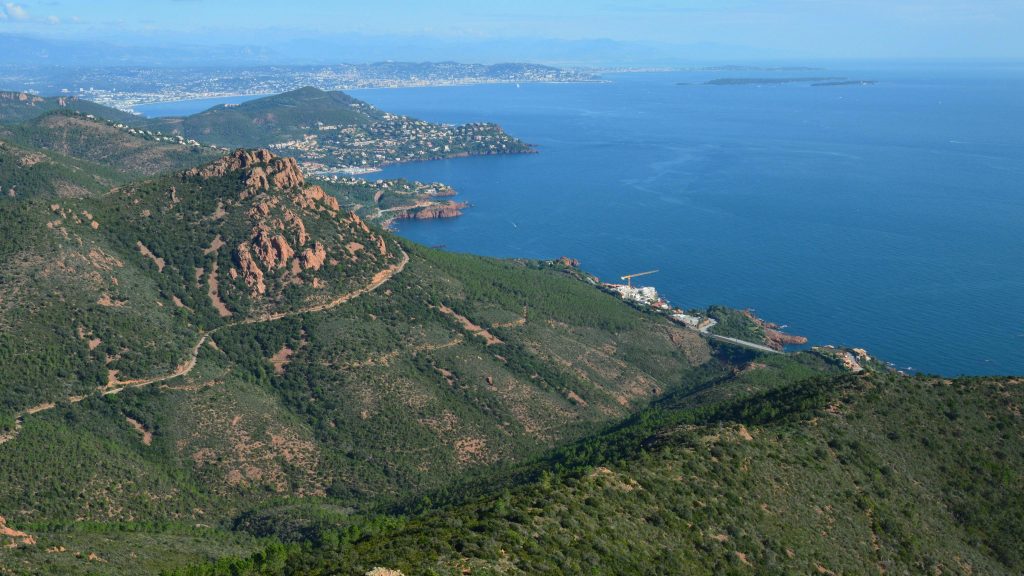
Between Cannes and Saint-Raphaël, the Massif de l’Estérel meets the Mediterranean in a collision of red porphyry rock and turquoise water. Among the 5 best scenic drives on the French Riviera, this is the one that delivers the greatest visual surprise. The contrast between the rust-red volcanic rock and the blue water below is unlike anything else on the Riviera coast.
The Corniche de l’Estérel, also known as the Corniche d’Or, follows the N98 road inaugurated in 1903 by the Touring Club de France specifically for scenic driving. The 30-kilometre section between Théoule-sur-Mer and Saint-Raphaël is the core: each headland reveals a new arrangement of red cliff, blue cove and small beach.
From Saint-Raphaël, the D559 continues through the Côte des Maures to Saint-Tropez, 120 kilometres from Nice. The old port, the Place des Lices market (Tuesday and Saturday mornings) and the Musée de l’Annonciade are the reasons to come.
The single road onto the Gassin peninsula queues for kilometres in peak season.Best time to drive: Drive westbound (Nice to Saint-Tropez direction) in the morning; the Corniche d’Or cliffs are most dramatic in late afternoon western light on the return journey eastbound. Leave Nice before 8am for Saint-Tropez in July and August to beat the peninsula queue.
Insider Tip: Leave Nice Airport before 8am for Saint-Tropez in July and August. Arriving at the Gassin peninsula approach before 9:30am avoids the worst queuing. Drive back via the Corniche d’Or in the afternoon for the finest light on the red cliffs.
Compare Nice Airport Car Hire on Get Car Hire
Drive 4: The Route du Mimosa – Mandelieu, Tanneron and Grasse
| Departure Point | Destination | Distance | Drive Time |
|---|---|---|---|
| Nice Airport (NCE) | Cannes | 35 km | 45 min |
| Nice Airport (NCE) | Mandelieu-La Napoule | 40 km | 55 min |
| Nice Airport (NCE) | Tanneron (mimosa heart) | 45 km | 1 hr |
| Nice Airport (NCE) | Grasse (perfume capital) | 38 km | 50 min |
| Nice Airport (NCE) | Cabris (hilltop viewpoint) | 45 km | 1 hr 5 min |
| Full circuit | Nice Airport return via A8 | ~110 km | 2.5–3 hrs driving |
Note: Best season late January to mid-March for the mimosa bloom. February is peak. The route is driveable year-round for Grasse and the Gorges du Loup but outside this window the defining reason for the circuit falls away. Full circuit approximately 110 km from Nice Airport.
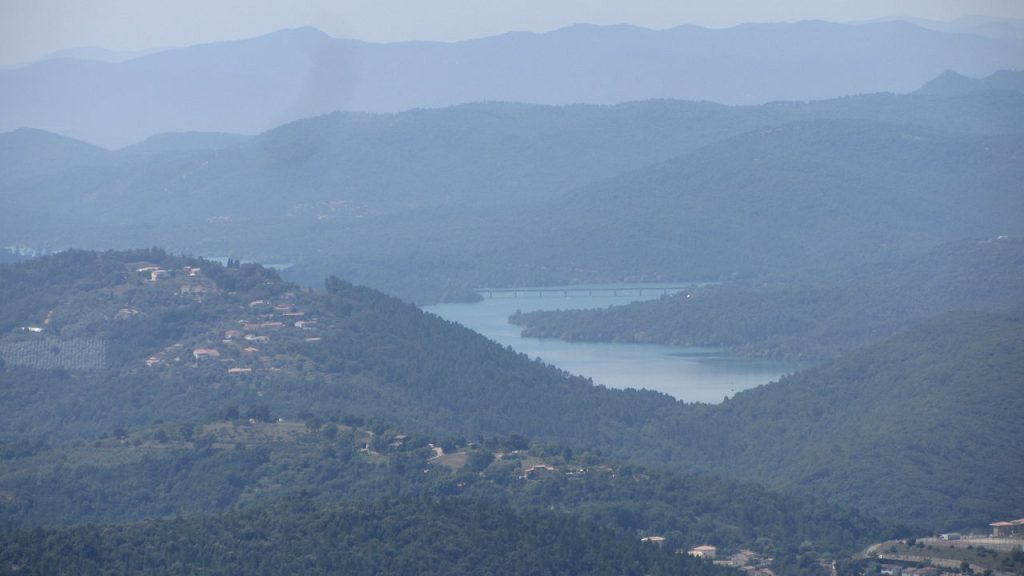
France’s most seasonal scenic drive is best for a narrow eight-week window between late January and mid-March, when the mimosa trees cover the hillsides between Mandelieu-La Napoule and Grasse in gold. The Route du Mimosa runs 130 kilometres through eight villages from Bormes-les-Mimosas in the Var to Grasse, through a landscape that turns bright yellow for two months and deep green for the other ten.
The Tanneron massif, 45 kilometres from Nice Airport via Cannes and Mandelieu, is the most concentrated section. Several thousand hectares of wild mimosa cover these hillsides and in February the road through Tanneron runs through tunnels of yellow blossom so dense that the light changes colour. The Fête du Mimosa in Mandelieu-La Napoule is held every February.
From Tanneron, the route descends through Cabris to Grasse, world capital of perfumery. The Musée International de la Parfumerie covers the history of the craft from ancient Egypt to the present. The historic houses of Fragonard, Galimard and Molinard all offer guided factory tours with free entry.
Best time to drive: Morning is best for the mimosa light on the Tanneron hillsides. The blossom is at its peak in the second and third weeks of February. The route is worth driving year-round for Grasse and the Gorges du Loup, but outside January to March the mimosa reason falls away.
Drive 5: The Gorges du Verdon – Europe’s Grand Canyon
| Departure Point | Destination | Distance | Drive Time |
|---|---|---|---|
| Nice Airport (NCE) | Grasse | 38 km | 50 min |
| Nice Airport (NCE) | Castellane (gorge eastern entry) | 90 km | 1 hr 45 min |
| Nice Airport (NCE) | Lac de Sainte-Croix | 115 km | 2 hrs |
| Nice Airport (NCE) | Moustiers-Sainte-Marie | 125 km | 2 hrs 15 min |
| Full circuit | South rim + north rim (Route des Crêtes) | ~300 km | 7–8 hrs driving |
Note: Full-day circuit. Allow a minimum of 8 hours from Nice Airport including driving time and stops. Gorge rim roads accessible April to October; some sections close in winter due to snow. Fill up with fuel in Castellane before entering the gorge.
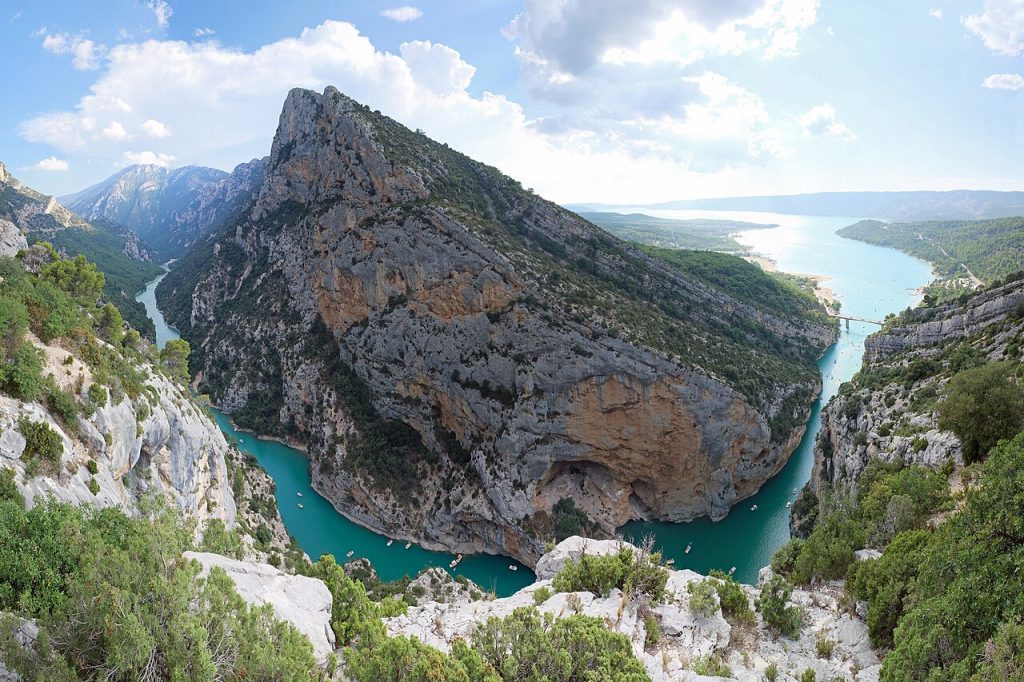
The Gorges du Verdon is the largest river canyon in Europe. The Verdon River has carved a 25-kilometre gorge through the Provençal limestone at depths of up to 700 metres.
The colour of the water, a blue-green that shifts between turquoise and emerald depending on the light, is produced by the limestone geology and the glacial origins of the river.
From Nice Airport, the route follows the A8 west to Cannes, then turns inland through Grasse to Castellane at the eastern end of the gorge: 90 kilometres, approximately 1 hour 45 minutes.
From Castellane, the D952 follows the south rim past the Lac de Sainte-Croix to Moustiers-Sainte-Marie, one of the most beautiful villages in France, its church suspended from a chain stretched across the cliffs above it.
The south rim road (D952) and the north rim road (D23, Route des Crêtes) form a 70-kilometre circuit of the gorge with viewpoints including the Balcons de la Mescla, Point Sublime and the Belvédère de la Maline. Drive the south rim to Moustiers, lunch in the village, then take the north rim back toward Castellane. Return to Nice via the A51 or retrace via Grasse.
For further detail on the gorge and current road conditions see the Parc naturel régional du Verdon.
Best time to drive: Leave Nice Airport by 7:30am for the full circuit. The gorge south rim (D952) is best driven eastbound (Moustiers to Castellane) in the afternoon when the canyon walls catch the sun. Fill up with fuel in Castellane before entering the gorge. Gorge rim roads are accessible April to October; some sections close in winter due to snow.
Combining the Drives: What Works in a Day
Two of these circuits pair naturally into full-day itineraries from Nice Airport. Three are best kept separate.
Drives 1 and 2 together: The Three Corniches to Monaco in the morning (leave by 8am, in Monaco by 9am, back by 1pm via Basse Corniche) followed by the Arrière-Pays Niçois circuit in the afternoon (Saint-Paul-de-Vence, Vence, Gorges du Loup return by 7pm). This is a long day but entirely manageable outside July and August.
Drives 3 and 4 together: The Estérel and the Route du Mimosa share geography around Mandelieu and Cannes. Drive west to the Corniche d’Or in the morning, continue to Saint-Raphaël, return via Mandelieu and Tanneron to Grasse in the afternoon. Particularly good in February when the mimosa is in bloom on the return leg.
Drive 5 alone: The Gorges du Verdon is a full-day circuit and does not pair well with any other drive from Nice. It requires the whole day to do properly.
Driving the French Riviera: Practical Notes
Tolls: The A8 motorway runs the length of the Riviera and is the fastest return route from most drives. Expect to pay approximately €5 to €8 each way between Nice and the Cannes/Mandelieu junction. Booths accept cash and card.
Parking in Nice: Use Parking Saleya or Parking Albert 1er near the old town (approximately €3 to €4 per hour). Street parking in Nice centre is pay-and-display or residents-only. Leaving the hire car at the airport or hotel and using public transport into the city is the easier option.
Parking in Monaco: Multi-storey car parks throughout the principality charge approximately €5 to €7 per hour. The Parking des Pecheurs and Parking du Chemin des Pêcheurs give access to the port area. Fuel in Monaco is marginally cheaper than in France.
Petrol stations: Fuel up before heading inland to Gourdon, the Gorges du Loup or the Verdon Gorge. Rural stations are sparse above 500 metres. The last reliable station before the Verdon Gorge is in Castellane. Supermarket stations in Cagnes-sur-Mer and Villeneuve-Loubet west of Nice offer the cheapest fuel on the coast.
Summer traffic: The Basse Corniche through Monaco, the approach road to Saint-Tropez, and the car parks at popular viewpoints along the Corniche d’Or can be severely congested in July and August between 10am and 6pm. Early starts resolve most of these issues entirely.
Foire aux questions
What are the 5 best scenic drives on the French Riviera from Nice Airport?
The five are: the Three Corniches from Nice to Monaco and Menton; the Arrière-Pays Niçois hilltop village circuit via Saint-Paul-de-Vence, Vence, the Gorges du Loup and Gourdon; the Corniche de l’Estérel coast road from Cannes to Saint-Tropez; the Route du Mimosa through Mandelieu, Tanneron and Grasse; and the Gorges du Verdon, Europe’s largest river canyon, two hours inland from Nice. Each is covered in full in this guide with route tables and practical tips.
Can I drive to Monaco from Nice Airport by hire car?
Yes. Monaco is 24 kilometres from Nice Airport, approximately 35 minutes via the A8 motorway or 45 to 55 minutes via the Moyenne Corniche. Most standard French hire car contracts include Monaco without requiring cross-border authorisation, as it is a sovereign principality rather than a separate country for rental agreement purposes. Confirm with your operator before travel. Parking in Monaco costs approximately €5 to €7 per hour.
How long does it take to drive the Three Corniches?
The Basse Corniche from Nice to Menton is 36 kilometres and takes 40 to 55 minutes in light traffic, but two hours or more through Monaco in July and August. The Moyenne Corniche takes approximately 45 minutes Nice to Menton without stops. The Grande Corniche is the least congested and takes around 40 minutes to La Turbie. Driving all three roads as a full circuit, with time in Monaco and Èze, occupies a full day.
Is the Verdon Gorge driveable as a day trip from Nice Airport?
Yes, but it requires an early start. The gorge is 90 kilometres from Nice Airport and takes approximately 1 hour 45 minutes to reach. The south rim and north rim circuit adds a further 70 kilometres. Allow eight hours from Nice Airport including driving time and stops in Moustiers-Sainte-Marie. The gorge is accessible April to October; some rim roads close in winter.
What is the best time of year to drive the French Riviera?
April, May and September offer the best combination of weather, manageable traffic and value. June is excellent before the school holiday peak. July and August are peak season with heavy traffic on the Basse Corniche and the Saint-Tropez approach. For the Route du Mimosa specifically, late January to mid-March is the only time the drive makes its full seasonal impression. The Gorges du Verdon is best April to October.
Plan Your French Riviera Road Trip with Get Car Hire
Collect your hire car at Nice Airport and compare all available operators through Get Car Hire before you travel. See the full guide to car hire at Nice Airport for everything you need on collection, costs and what to book in advance.
Booking before arrival is always cheaper than walk-up desk pricing. In July and August, walk-up rates at Nice Airport can be three to four times the online price for the same vehicle.